Domestic workers learn how to earn more

Domestic workers are expected to benefit from national competency standards intended to enrich them with occupational skills and knowledge as well as improve their livelihoods.
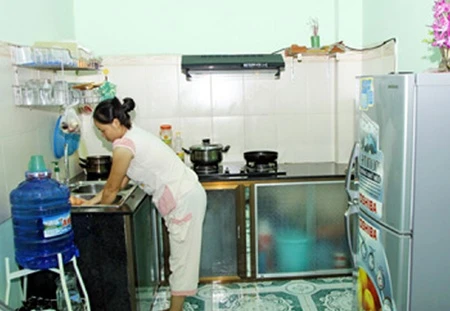
Domestic workers learn how to earn more ảnh 1Domestic workers are expected to benefit from national competency standards. (Illustrative Image - Source: baodansinh.vn)

Domestic workers are expected to benefit from national competency standards intended to enrich them with occupational skills and knowledge as well as improve their livelihoods.

The standards were published for the first time by the Research Centre for Gender-Family and Community Development (GFCD) and General Directorate of Vocational Training (GDVT) last month.

They were complied based on the directorate's vocational training programme and Regional Model Competency Standards (RMCS) for domestic work in Asia and the Pacific set by the International Labor Organisation (ILO).

The standards cover seven groups, which are basic competencies; cooking food and making drinks; cleaning houses, gardens, yards; washing and ironing; caring for infants and children; caring for elderly and ill people; caring for household pets and plants.

They also encourage domestic workers to acquire a foreign language if necessary and know how to give first-aid.

According to the research centre, the standards provide basic criteria for families to hire housemaids and pay reasonable wages while training establishments can use them as a reference source to compile training documents, aiming at providing highly qualified workers.

Ngo Thi Ngoc Anh, centre director, said that 96 percent of domestic workers in Vietnam came from the country and few had finished high school. Many flocked to the cities to become housemaids with monthly average wages between 3 million VND (133 USD) and 7 million VND (311 USD).

Households want to hire domestic workers who can professionally do housework, cook and look after children. However, up to 90 percent of Vietnamese domestic workers have yet to experience any training courses and only work based on their personal experiences, she said. A housemaid in Hanoi for three years, Nguyen Thi Thinh, 55, from Nam Dinh, has not taken any training classes.

"I followed the instruction of the house owner. At first, I found it new and strange. After two years, I am gradually used to the tasks," she said.

Being asked about the training course for housemaids, 51-year-old Pham Thi Minh, a nanny hailing from Thanh Hoa, said, "I do not have to learn how to take care of children. I have experience looking after my children in my home town."

A recent survey by the research centre in Hanoi, Nam Dinh, Khanh Hoa and Ho Chi Minh City revealed that 77 percent of domestic workers want to take training courses to earn more money.

Nearly 90 percent of employers will increase wages for trained housemaids.

The survey also found that Philippines domestic workers in Vietnam, who are good at culinary skills, knows how to use electric household appliances, deal with emergency cases, teach children English and pick up children at school every day. They earn up to 18 million VND (800 USD) to 20 million VND per month (889 USD).

Bui Sy Loi, Deputy Chairman of the National Assembly's Social Affairs Commission, said that the standards were compiled carefully with content meeting real demands of workers.

However, meeting all these standards was difficult for Vietnamese workers, he said, adding that in Vietnam, domestic work was considered an unstable job, only for people with low intellectual ability.

Loi said that as the ASEAN Community gets ready to operate, Vietnamese domestic workers needed to be trained professionally to meet regional working standards. In 2010, Vietnam had more than 200,000 domestic workers. The figure is expected to reach 350,000 in 2020.-VNA
VNA

See more

A bus picks up passengers on National Highway 22 (Le Quang Dao Street), near An Suong Bus Station. (Photo: VNA)

Free bus fares drive sharp rise in ridership in Ho Chi Minh City

As of August 12, the city’s bus network had served nearly 12 million passenger trips, up about 44% year on year. On August 12 alone, around 306,000 passengers used free buses, an increase of roughly 55%, despite students having yet to officially return to school.

Officers and soldiers bring martyrs’ remains to the sampling station at Binh Xuyen commune Martyrs’ Cemetery in Phu Tho province (Photo: VNA)

More than 1,700 war martyrs’ remains recovered

The national steering committee will continue verifying information on suspected martyrs’ graves in key areas, including Tan Son Nhat Airport in Ho Chi Minh City, Quan Y Bac Son Hill in Dong Nai, the Con Tien base area in Quang Tri and former Vi Xuyen battlefields in Tuyen Quang.

Delegates observe a minute of silence in tribute to Cuban leader Fidel Castro Ruz (Photo: VNA)

Quang Tri celebrates 100th birthday of Cuban leader Fidel Castro

Addressing the ceremony, Vice Chairman of the provincial People’s Committee Le Duc Tien said Fidel Castro was a figure of exceptional stature whose life and revolutionary career were closely associated with the victory of the Cuban Revolution and the struggle for national independence and sovereignty, as well as the aspirations of peoples around the world for independence, freedom, peace and justice.

General Secretary of the Communist Party of Vietnam Central Committee and President To Lam addresses the 2026 Vietnam–New Zealand higher and vocational education forum in Auckland on August 13, 2026. (Photo: VNA)

Top leader calls for stronger Vietnam–New Zealand ties in higher and vocational education

General Secretary and President To Lam called on the two sides to jointly develop high-quality human resources for the digital, green, circular and knowledge-based economies, prioritising areas of strong demand and high complementarity such as artificial intelligence (AI), data science, digital technology, cybersecurity, biotechnology, smart agriculture, food technology, renewable energy, environmental technology, public governance and emerging occupations of the future.

Machinery has been integrated into cargo handling lines, helping reduce labour requirements and improve import-export efficiency. (Photo: VNA)

Lang Son tackles skilled labour shortage in border-gate logistics

As the province promotes investment in logistics services and infrastructure at border gates, businesses are increasingly shifting from relying on manual labour for loading and transshipment to workers capable of operating modern equipment and handling specialised tasks.

Textbooks are sold at a bookstore operated by the Vietnam Education Publishing House. (Photo: VNA)

Hanoi to provide free textbooks from 2026–2027 school year

The municipal Department of Education and Training will work with the Department of Finance to guide wards, communes and educational institutions in implementing the student support policies adopted by central authorities and the municipal People’s Council.

The defendants at the trial. (Photo: tuoitre.vn)

AIC case in Ca Mau: Nguyen Thi Thanh Nhan sentenced to 10 years in prison

The People's Court of Ca Mau province on August 12 sentenced former Chairwoman and General Director of the Advanced International Joint Stock Company (AIC) Nguyen Thi Thanh Nhan to ten years in prison for "violating bidding regulations, causing serious consequences" in a case involving the inflation of equipment prices for environmental monitoring stations in the former Bac Lieu province (now Ca Mau province).

General Secretary of the Communist Party of Vietnam (CPV) Central Committee and President To Lam speaks with Vietnamese Embassy staff and representatives of the Vietnamese community in New Zealand and South Pacific island countries in Auckland on August 12 evening. (Photo: VNA)

Party General Secretary and President meets Vietnamese community in New Zealand

General Secretary of the Communist Party of Vietnam (CPV) Central Committee and President To Lam described overseas Vietnamese as “ambassadors” who help promote Vietnam's positive image internationally, and urged them to maintain solidarity, preserve national pride and cultural traditions, and make practical contributions to the country's development.