Earlier sex education needed to fight abuse

Public concern is once again inspiring changes to education programmes in schools, with calls for more sex education to be included in the curriculum.
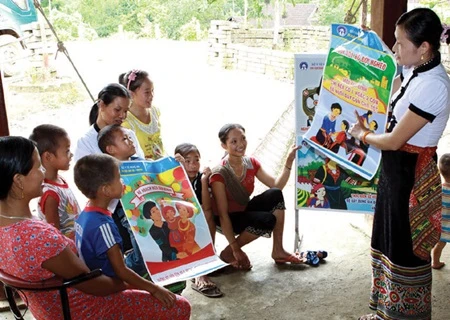
Earlier sex education needed to fight abuse ảnh 1The Hoa Mi kindergarten in Muong La district of the northern mountainous province of Son La. (Photo: VNA)

Hanoi (VNA)
- Public concern is once again inspiring changes to educationprogrammes in schools, with calls for more sex education to be included in thecurriculum so that children can better protect themselves from sexual abuse.

Recentreports of children being sexually abused in different parts of the countryhave highlighted the growing problem.

The Ministry of Labour, Invalidsand Social Affairs (MoLISA) estimates that around 2,000 Vietnamese childrenface violence and abuse annually, of whom 1,200 suffer sexual abuse. Amongthese, more than 13 percent are girls under the age of six.

But the real number of Vietnamesechildren being sexually abused may be much higher, said MoLISA deputy ministerDao Hong Lan.

Education experts have criticisedthe fact that children in Vietnam learn about sex education too late, whichmakes them more vulnerable to abuse.

Dr Vu Thu Huong from the PrimaryEducation Department under Hanoi National University of Education said thatunder the current education programmes, children begin sex education in fifthgrade.

“It’s too late nowadays, as manychildren start puberty early. They experience puberty before being taught aboutsex education, which is supposed to provide them with the understanding andskills to deal with major physical and mental changes they will experienceduring puberty,” she said.

Moreover, sex education inschools is inadequate. Current topics include the reproductive cycle and theformation of the human body, as well as advice on raising children.

Sex education must includeinformation on ejaculation, spermatorrhoea, masturbation, gender identity andespecially advice on how children can protect themselves from and respond tosexual abuse, Huong said.

Many parents and adults usuallyavoid awkward questions about sex from kids, which may lead children toconsider such topics taboo. Ultimately, children facing problems may remainsilent instead of alerting others.

“Sex education must be madeavailable for children aged three to 16, covering a range of complicatedsubjects depending on the age of the child,” she said, adding that adequateeducation could help children recognise threats of sexual abuse and be able toinform parents as soon as they feel they are in an uncomfortable situation.

Lecturer Pham Thanh Nam from theUniversity of Education under Hanoi National University, said that in school,children are taught about the reproductive system rather than a healthyattitude to sex.

From the age of three, childrenbegin to ‘explore’ their bodies, and this is the time for families and teachersto provide them with information so that children can form a healthyunderstanding about sex, which will in turn help protect them from abuse.

Le Thi Lan Anh, head of Hanoi-basedInstitute for Research on Educational Development, said that sex education wasnormally taught in biology class and teachers had not received proper training.

Teachers often felt ashamed orembarrassed when talking to children about sex. The curriculum was disjointed,resulting in children failing to understand why a boy’s voice breaks or girlsmenstruate.

Ngo Thi Thanh, principal of Nam TuLiem Primary School in Hanoi said that in her school sex education wasintegrated in classes on morality, life skills or extra-curricular activities.

The school organised outdooractivities and invited healthcare workers to talk to fourth and fifth gradersabout sex education.

Ta Ngoc Tri, vice head of thePrimary Education Department under the Ministry of Education and Training, saidthat sex education was regulated as part of extra-curricular activities atschools from primary to high schools.

In 2014, the ministry issued acircular on life skills education which also included sex education andencouraged schools to develop child abuse prevention programmes.

Professor Nguyen Minh Thuyet,chief editor of the National Education Programme said that the new programmewould pay more attention to sex education.

Sex education could be directlytaught in biology class, legal knowledge or integrated into literature classes.

“To protect children from childabuse, teaching sex education at schools is not enough,” Thuyet said, emphasingthe role of the family. In many cases, children suffered abuse from familymembers.

While waiting for the neweducation programme to be implemented next year, schools agree that teachersshould receive more training on sex education.-VNA
VNA
See more

Students offer incense in memory of the 504 innocent civilians killed in the Son My Massacre 58 years ago. (Photo: VNA)

Quang Ngai marks 58th anniversary of Son My massacre

Today, the site where the massacre occurred has been preserved as a national historical relic, keeping evidence of the war crime. It has also become a destination of particular interest for both domestic and international visitors travelling to Quang Ngai.

A voter under treatment at the Ho Chi Minh City Hospital of Dermato-Venereology drops her ballot into a mobile ballot box on March 15. (Photo: VNA)

Vietnamese in Laos value role of NA, all-level People’s Councils

Nguyen Thi Thu Huyen, Chief of the Office of the Vietnamese People Association in Vientiane, expressed her hope that deputies in the new tenure will continue to enhance their sense of responsibility, maintain close contact with voters and contribute to policymaking for fast and sustainable national development.

Poor patients under treatment at the Ninh Thuan General Hospital receive meals from the "Hieu va Thuong" charity kitchen. (Photo: VNA)

Charity kitchen lends a hand to feed needy patients

For nearly two decades, the charity kitchen “Hieu va Thuong” (Understanding and Compassion) at the Ninh Thuan General Hospital, Khanh Hoa province, has kept its fires burning daily, providing free meals for poor patients and their relatives.

A working delegation from the Fire Prevention, Fighting and Rescue Police Department under the Ministry of Public Security pays a visit to Bratislava from March 9–12. (Photo: VNA)

Vietnam, Slovakia boost cooperation in firefighting and rescue

During the visit, the delegation led by Deputy Director of the department Colonel Hoang Ngoc Huynh worked with several Slovak institutions, including the command of the Fire and Rescue Force in Bratislava, an automobile installation and repair centre under the Ministry of Interior of Slovakia, and the Lest military training centre.

A transport infrastructure project in Ho Chi Minh City (Photo: VNA)

Ho Chi Minh City steps up actions to unlock private sector growth

Ho Chi Minh City’s authorities and businesses operating in the southern metropolis have stepped up strategic orientations and concrete action programmes to translate Resolution No.68-NQ-TW of the Politburo into practice and create conditions for the private sector to make breakthroughs and become a key growth driver.

Swiss Ambassador to Vietnam Thomas Gass (Photo: VNA)

Swiss ambassador hails Vietnam's 2026 election as milestone

The March 15 election is expected to be an important milestone for Vietnam. It is not only a constitutional exercise but also a means of ensuring that policies adopted at both national and local levels are enforced with a strong focus on citizens’ interests, said Swiss Ambassador to Vietnam Thomas Gass.

President of the Vietnamese Association in Mexico Nguyen Huu Dong (Photo: VNA)

Mexico-based scholar unveils ideas to optimise Vietnamese NA’s efficiency

Talking with Vietnam News Agency correspondents in Mexico City, Dong pointed to important strides in the NA’s outgoing tenure, including improvements to the institutional framework, operating methods and stronger oversight of major national issues. In his view, the NA has increasingly asserted its role as the highest representative body of the people and a central pillar in the process of building a socialist rule-of-law state.

The Cai Mep Ha free trade zone in Ho Chi Minh City currently has four seaports and four inland waterway ports in operation (Photo: VNA)

Strategic infrastructure – key driver for Ho Chi Minh City’s economic growth

Rapid population growth and urban expansion have exposed limitations in Ho Chi Minh City’s infrastructure, particularly traffic congestion at key gateways and in central areas. In response, the city is steeping up investment in major projects to improve connectivity, expand urban space and remove development bottlenecks.

Illustrative image: Authorities strengthen control at the Dinh Ba International Border Gate to prevent illegal entry and exit. (Photo: VNA)

Authorities warn against hiring foreign workers violating immigration rules

Investigations revealed that several foreign nationals had been sponsored by two companies headquartered in Ho Chi Minh City to apply for temporary residence cards under the category of investors. However, the individuals were not genuine investors but had completed procedures through intermediaries in order to remain in Vietnam.

Illustrative image (Photo: VNA)

Hanoi promotes family values to mark International Day of Happiness

The activities will take place from March 15 to 21, with the peak on March 20. The highlight will be a launch ceremony for the 2026 International Day of Happiness, calling on authorities at all levels, organisations and the community to join hands in building safe, equal and progressive family environments, while promoting love, sharing and responsibility among family members.