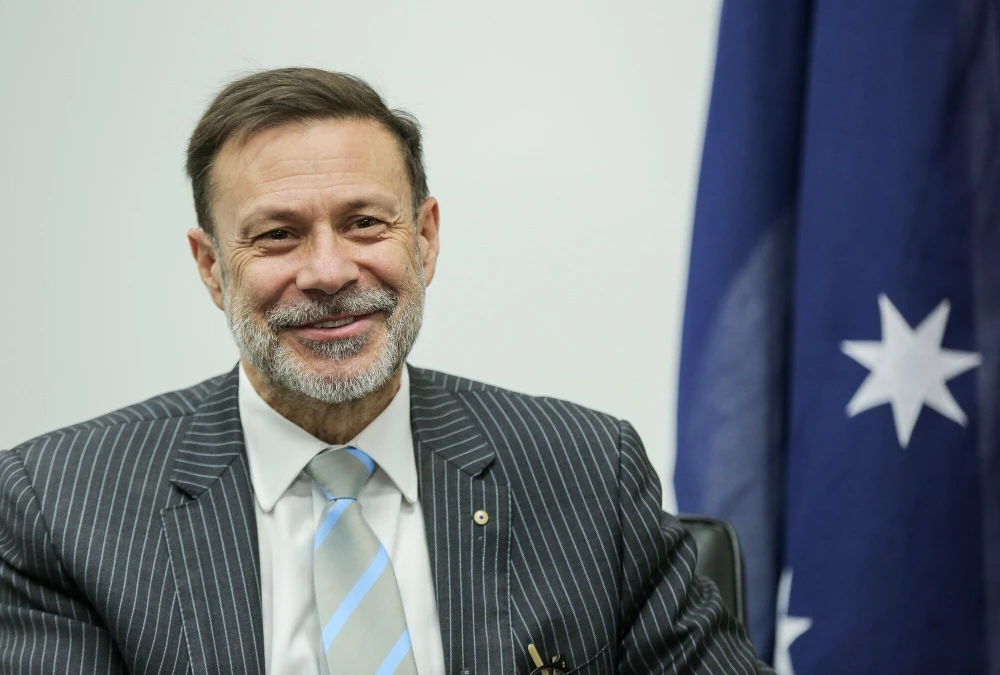
Hanoi (VNA) – Ambassador Andrew Goledzinowski has affirmed that education is a foundational pillar of the Vietnam-Australia bilateral relationship in his recent article.
His article is as follows.
Traditionally, when Vietnamese people thought of Australia, they may have thought of kangaroos, the Sydney Opera House, or our beautiful beaches. These days, for many Vietnamese people, the first thing that comes to mind is our world-class education.
From the very beginning of our bilateral relationship, Vietnamese people have studied in Australia, and there are now around 100,000 alumni. This includes around 7,000 who received an Australia Awards scholarship to do so. These Australian alumni are now achieving great successes in Vietnam, creating their own networks among themselves and their peers, and contributing a great deal to Vietnam’s economic development, and the growing ties between our two countries.
So, education is a foundational pillar of Australia and Vietnam’s bilateral relationship - and has been for more than 50 years.
That’s why in the Comprehensive Strategic Partnership (CSP) that was announced by our two Prime Ministers in March 2024, we committed to working together to strengthen support for the development of Vietnam’s human resources development. This includes a pledge to further explore opportunities to increase our cooperation in education and training through two-way exchanges, dialogues and institutional linkages.
And this pledge is already a reality. The Australian Government knows how important Australian education is to support Vietnam’s economic development objectives. Expanding our transnational education partnerships and engagement with industry is an important part of this effort. For example, in May this year, the Australian Government supported 44 Vietnamese universities to develop their internationalisation strategies and form partnerships with Australian counterparts. Next week, we will host a delegation of nine Australian training providers who are coming to Vietnam to work with education and industry partners to develop skills and training partnerships in the health sector.
Later in September, we will host another delegation to Vietnam to showcase Australian education and training capability to address Vietnam’s green economy skills requirements and its ambitious objective to reach net zero by 2050. This will boost our already strong collaboration, building on more than 300 existing joint programmes between Australian and Vietnamese academic partners.
We recognise that Australia’s education sector is a national asset, and not only for our relationship with Vietnam. Since 2001, more than 3.5 million international students have lived and studied in Australia. They are an invaluable part of Australian communities, bringing new ideas and skills which enrich our society, along with diverse perspectives and experiences to our classrooms and communities.
However, in some ways we have been too successful in attracting international students to Australia. And some people from countries around the world have been using the student visa programme to come to Australia to live and work without any desire to actually study in Australia.
Like many countries around the world, Australia is feeling the crunch after COVID-19. The cost of living is high – this includes the cost of housing, groceries, petrol, and essential services. So, we need to be measured in the way we manage our visa system.
The people who are exploiting our visa system are in the minority and come from a number of different countries. But the Australian Government has had to respond, and we are doing so by renewing our focus on the integrity of our visa system. This includes making some changes to our student visa programme designed to ensure genuine students continue to have access to Australia’s world class education institutions.
As a result of our focus on integrity, student visa processing times have increased. Those studying at low-risk providers (including Australia’s top universities) will receive the fastest processing times, but even for those students the processing times will still be longer than in the past. Additional time may be required to process visas where our visa decision makers need to apply higher scrutiny.
As always, visa processing times will also depend on the quality and completeness of the visa application lodged, and the applicant’s responsiveness to requests for additional information. We also require documents to be translated into English before being attached to the application.
So, putting in a complete application is critical to receiving an outcome more quickly. We advise all applicants to “check twice, submit once”. Global processing times can be found on the Home Affairs website. (https://immi.homeaffairs.gov.au/visas/getting-a-visa/visa-processing-times/global-visa-processing-times)
We appreciate that choosing where to study overseas is one of the biggest decisions in a young person’s life, and for the family networks supporting them. We feel extremely privileged and proud that so many Vietnamese students choose Australia.
We also appreciate all those students who choose to study at RMIT and other Australian institutions which offer tertiary education options in Vietnam. In all my meetings, I always encourage Australian education providers to increase their presence in Vietnam. This way, they can reach more students with our world class education and contribute even more to Vietnam’s higher education goals.
I know that Vietnam is a country that places an incredibly high emphasis on education, which is in turn why Vietnam’s economy has developed at such a pace in recent years. It is my firm belief that Australian education institutions will be the fuel that powers Vietnam to becoming a high-income country by 2045.
For now, processing times may be longer than usual. It is my hope that that’s a small price to pay to ensure a high-integrity system that benefits Vietnamese students for years to come.
For more information on studying in Australia, I encourage students and their parents to visit the Study Australia website. (https://www.studyaustralia.gov.au)./.