Efforts needed to conserve rare primates in Ha Giang

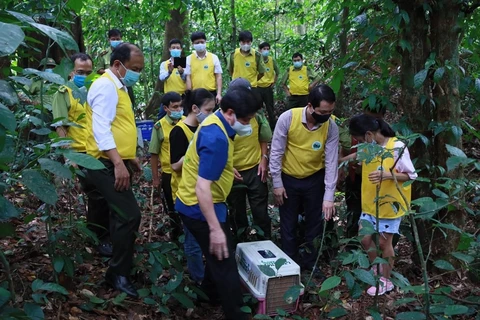
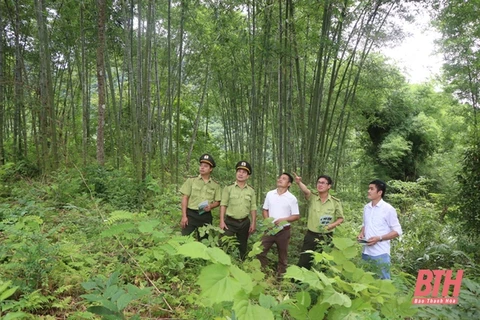
Local authorities and forest rangers in the northern province of Ha Giang have worked together with the Fauna & Flora International (FFI) to conserve the Tonkin snub-nosed monkey since they were spotted in the province.
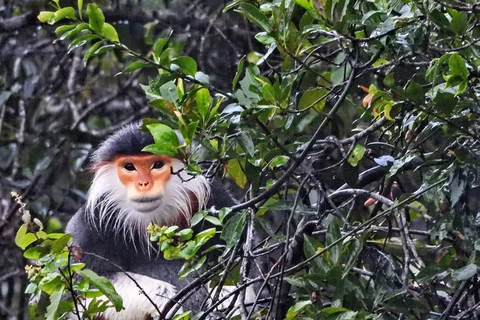
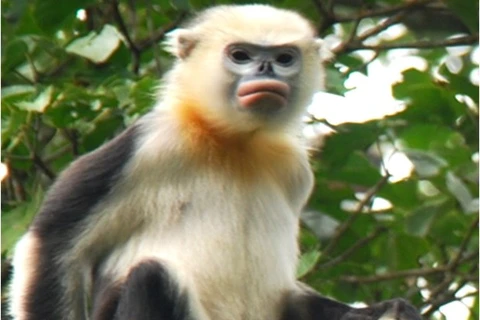
Efforts needed to conserve rare primates in Ha Giang ảnh 1Tonkin snub-nosed monkey in Ha Giang (Photo: FFI)
Hanoi (VNA) – Local authorities and forest rangers in the northernprovince of Ha Giang have worked together with the Fauna & FloraInternational (FFI) to conserve the Tonkin snub-nosed monkey since they werespotted in the province.

HaGiang is the sole province in Vietnam which is home to a population of the monkeys,one of the rarest primate species in the world. In 2002, a population of 60 individuals was spotted in the Khau Ca special-use forest in Vi Xuyen and Bac Me districts of Ha Giang province. Another population, estimated at 30-60, was found six years later in the Tung Vai area in Quan Ba district.

In 2015, the Prime Minister issued a decision on the establishment of the Du Gia National Park by merging the Du Gia nature reserve and the Khau Ca Tonkin Snub-nosed Monkey Species and Habitat Conservation Area in the Dong Van Karst Plateau Geopark. The park covers an area of 15,006 ha, with 11,224 ha under strict protection. 
As a result, the population of the monkey in the park rose from 60 to around 160 in 2019.

Meanwhile, the population of the monkeys in Quan Ba district’s three communesof Cao Ma Po, Ta Van and Tung Vai, has decreased to 10 from about 35 in 2007, the FFI reported, adding that their living environment has been negatively affected by human activities, particularlyillegal hunting.

Atpresent, only 5,000 ha of forests are suitable for snub-nosed monkeys’ life in this area.

Accordingto the FFI, there are only about 250 such monkeys in the world, with most ofthem being in Ha Giang.

The FFIsaid preservation of the primate is of special significance, and stressed the need to createdifferent populations of the primate as well as diverse gene sources./.
VNA
See more

The German Agency for International Cooperation (GIZ)'s Managing Director Thorsten Schäfer-Gümbel speaks at the working session with the Vietnamese-German University. (Photo: VNA)

Vietnam, Germany step up collaboration on energy transition, green hydrogen

Schäfer-Gümbel praised the strong commitment of Vietnamese partners to sustainable energy goals. He noted that the long-standing development cooperation between Germany and Vietnam is evolving, with energy transition emerging as a strategic area of collaboration in addressing global challenges.

Cat Ba langur is an extremely rare primate species found exclusively in the humid tropical forests of Cat Ba island (Photo: VNA)

Belgian TV spotlight: Vietnam's wild nature reborn

Through the lens of “Le Jardin Extraordinaire”, Vietnam was portrayed not simply as a travel destination but as a still-emerging realm of discovery: a nation whose nature, though heavily wounded in the past, demonstrates extraordinary powers of recovery, quietly upholding its pristine essence against the pressures of time.

The macaque, scientifically known as Macaca arctoides. (Photo: VNA)

Quang Tri receives endangered stump-tailed macaque

The Cam Lo-Dong Ha forest protection unit in the central province of Quang Tri has received a rare stump-tailed macaque, a species listed as endangered, precious and rare in the Vietnam Red Data Book.

At a ceremony to donate 100,000 trees to the Naval Region 4 (Photo: HANE)

Tree planting programme spreads green momentum in islands

The Ho Chi Minh City Association for Conservation of Nature and Environment (HANE) on January 11 announced 10 outstanding green programmes and activities carried out in 2025, including a programme to plant 1 million trees in Vietnam’s island areas.

Lam Dong releases hundreds of wild animals into the wild. (Photo: VNA)

Lam Dong releases hundreds of wild animals back into the wild

According to the Ta Dung National Park Management Board, the park has for years served as a trusted destination for authorities and residents to hand over and release wildlife. Such actions not only contribute to biodiversity conservation but also help reduce illegal hunting and captivity of wild animals.

According to the Hanoi Department of Agriculture and Environment, air quality index (AQI) readings have at times reached poor and very poor levels. (Photo: VNA)

Hanoi targets 20% reduction in PM2.5 levels

Hanoi has affirmed its commitment not to trade environmental protection for economic growth. The city is moving to establish low-emission zones (LEZs) as a core measure to control emissions and promote green, sustainable urban development.

A waste collection area. (Photo: VNA)

Ca Mau approves investment policy for waste-to-energy plant

The waste-to-energy plant is planned for construction in Dat Moi commune, covering a total area of about 20 hectares. It will have a waste treatment capacity of approximately 600 tonnes of household waste per day and a power generation capacity of 6MW.