Environmental auditing creates premise for sustainable development goals

After three years of implementing the Hanoi Declaration adopted by the Asian Organisation of Supreme Audit Institutions (ASOSAI), the document has proved effective in both stepping up the implementation of sustainable development goals (SGDs) and tackling global environmental challenges.
Environmental auditing creates premise for sustainable development goals ảnh 1Deputy Auditor General Ha Thi My Dung talks to the media on the Hanoi Declaration. (Photo: VietnamPlus)

Hanoi (VNA) - After three years of implementing the Hanoi Declaration adopted by the Asian Organisation of Supreme Audit Institutions (ASOSAI), the document has proved effective in both stepping up the implementation of sustainable development goals (SGDs) and tackling global environmental challenges.

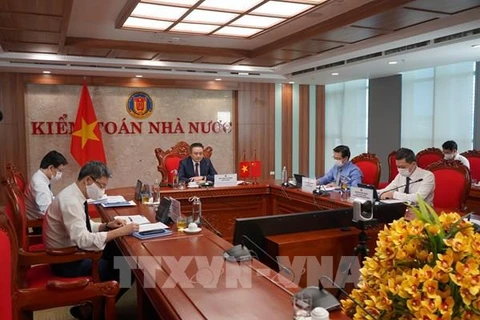
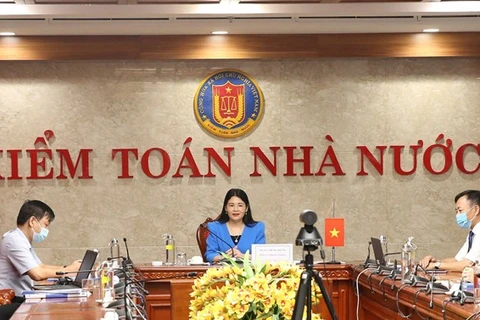
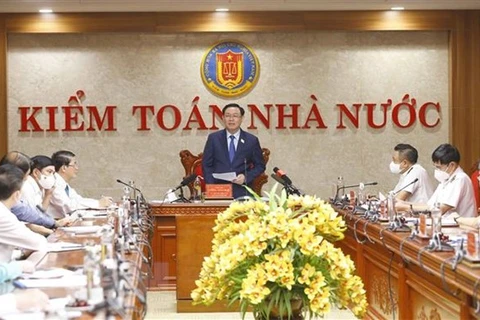
The statement was made by Deputy Auditor General of the State Audit Office of Vietnam (SAV) Ha Thi My Dung during an interview with press agencies on the threshold of the 15th ASOSAI Assembly held online from September 6-9.

The Hanoi Declaration was endorsed by the 14th ASOSAI Assembly, hosted by Vietnam in 2018, with the theme “Environmental Audit for Sustainable Growth".

The declaration has become an important part of ASOSAI's strategic vision for development, with the aim of realising the sustainable development goals of the United Nations.

Over the past time, ASOSAI has continuously played an active role in the activities of the international audit community through the ASOSAI Working Group on Environmental Auditing (WGEA) and the ASOSAI Capacity Development Committee (CDC). Specifically, the ASOSAI WGEA has actively contributed to the sharing of knowledge and experience, encouraged the implementation of auditing cooperation among SAIs, and conducted surveys on demand for environmental auditing of SAIs, through the Work Plan 2020-2022.

In addition, SAIs have proactively applied science and information technology in environmental audit activities, such as increasing the use of global positioning system (GIS) and remote sensing technology to assess the impact of mining activities, the use of remote sensing data to study land use activities; and the use of drones to calculate the scope and volume of sand mining.

An important milestone of ASOSAI during the 2018-2021 term was the establishment of a Task Force to implement sustainable development goals at the 54th ASOSAI Governing Board in July 2019 in Kuwait. The 15th ASOSAI Assembly approved this task force to prove the willingness of ASOSAI to address urgent global issues.

During 2020-2022, ASOSAI has been cooperating with the Knowledge Sharing Committee of INTOSAI (International Organisation of Supreme Audit Institutions) on a cooperative audit programme relating to public healthcare systems, with the participation of 26 Asian nations and three Pacific nations.

The results of the collaborative audit are expected to contribute to the sustainability of the national public health system through recommending INTOSAI's international audit standards on government efforts to strengthen the capacity of early warning, risk reduction and national and global health risk management.

Assessing the effects of the Hanoi Declaration, Dung said the achievements of the ASOSAI Working Group have proven that ASOSAI is a strong model for the region.

The adherence to the recommendations of the Hanoi Declaration of ASOSAI has shown just how serious the region is about common challenges, particularly in environmental auditing and sustainable development, which is a top priority of many nations.

Environmental and sustainable development auditing has proved a structured approach to help shape responses.

Firstly, it has enabled governments to enact stronger measures to protect the environment, as well as raising awareness in dealing with related issues.

Secondly, it has enabled the establishment of long-term mechanisms and allowed changes in the current legal, and future policy, framework.

Thirdly, it has assessed the suitability of government programmes and projects from a sustainable development perspective.

Fourthly, it has adjusted the approach from argumentative auditing to focusing on auditing capabilities for policymaking, to help implement policy goals.

Fifthly, these audit programmes allow greater operational efficiency through knowledge sharing, helping to cope with future challenges.

The content of the Hanoi Declaration on environmental audit and implementation of the SDGs will always be inherited and developed as a priority pillar in ASOSAI’s Strategic Plan and important documents, most recently the ASEAN Strategic Plan for 2022-2027 and the Bangkok Declaration, Dung affirmed.

The ASOSAI Strategic Plan for 2022-2027 will continue affirming the importance of implementing the SDGs and promoting SAIs’ efforts in achieving the SDGs.

In addition, the goal of implementing the SDGs was once again inherited and developed in the Bangkok Declaration drafted by SAI Thailand, ASOSAI Chair for the 2021-2024 term, which states that the Hanoi Declaration affirmed the benefits, efforts and contributions of ASOSAI to the implementation of sustainable development goals, helping to promote knowledge sharing and capacity development in the ASOSAI community in the field of environmental auditing for sustainable development./.
VNA

See more

President of the National Assembly Tran Thanh Man and his spouse Nguyen Thi Thanh Nga leave Ulaanbaatar on September 11, concluding their official visit to Mongolia. (Photo: VNA)

NA President Tran Thanh Man concludes official visit to Mongolia

Seeing off the delegation at Chinggis Khaan International Airport were Mongolian Ambassador to Vietnam Ganbaatar Hulan; Chairwoman of the Mongolia-Vietnam Friendship Parliamentarians’ Group J. Bayarmaa; Vietnamese Ambassador to Mongolia Nguyen Tuan Thanh; and embassy officials and staff.

Hon Khoai Island cluster in Ca Mau province – a key economic connection point for the Mekong Delta region (Photo: VNA)

Resolution opens up development space, creates new momentum for regional growth

Resolution No. 27 on regional development and the organisation of national development space in the new period places regional development as a means of organising national growth and a tool for reorganising development space, allocating resources and enhancing competitiveness. This takes on particular significance following the restructuring of administrative units, as the expanded scale of many localities creates better conditions for integrating urban, industrial, agricultural, maritime, border-gate and logistics spaces.

National Assembly President Tran Thanh Man and his spouse, together with Chairman of the State Great Hural (Parliament) of Mongolia Sandag Byambatsogt and his spouse, present gifts to children performing on horseback at the Chingisiin Khaanii Khuree complex on September 11. (Photo: VNA)

Vietnamese NA President experiences Mongolian traditional culture

NA President Man, his spouse and the Vietnamese delegation attended a mini Naadam Festival, which recreated Mongolia's largest and oldest traditional festival and a source of pride for the Mongolian people. The Naadam Festival was inscribed by UNESCO on the Representative List of the Intangible Cultural Heritage of Humanity.

Chairman of the Central Council for Theoretical Studies Nguyen Xuan Thang and a delegation of the council attend a meeting co-chaired by Zhao Yide, member of the Communist Party of China (CPC) Central Committee and Secretary of the CPC Shaanxi provincial Committee, and Liu Haixing, member of the CPC Central Committee and head of its International Department. (Photo: VNA)

Vietnam, China strengthen theory exchanges

Drawing on China's development experience and Vietnam's 40 years of Doi Moi (Renewal), the two Parties share profound similarities in remaining steadfast in their revolutionary ideals, consistently starting from objective realities, placing the people at the centre, and continuously pursuing innovation and creativity.

Giulio Chinappi, an Italian political analyst from the Centre for Mediterranean Eurasia Studies (CeSEM) (Photo: VNA)

Top leader’s visits to Russia, France highlight Vietnam’s breakthrough development vision: expert

Talking to Vietnam News Agency correspondents in Italy, Giulio Chinappi, an Italian political analyst from the Centre for Mediterranean Eurasia Studies (CeSEM) said the state visit to Russia came at a special time as the two countries look towards more than 75 years of diplomatic relations. This trip successfully linked the solid legacy of traditional friendship with a modern foreign policy vision directly serving Vietnam’s future development needs.

Vietnamese Deputy Prime Minister and Minister of National Defence General Phan Van Giang (right) and French Minister for the Armed Forces and Veterans Catherine Vautrin exchange an agreement on cooperation in UN peacekeeping operations between the Vietnamese Ministry of National Defence and the French Ministry for the Armed Forces and Veterans. (Photo published by VNA)

Vietnam, France seek to deepen defence cooperation

Vietnamese Deputy Prime Minister and Minister of National Defence General Phan Van Giang said Vietnam-France defence ties have continued to grow, with cooperation expanding in various areas, including high-level delegation exchanges; the deputy-minister-level strategic dialogue and defence cooperation mechanism; military medicine; education and training; search and rescue; UN peacekeeping operations; maritime cooperation; and defence industry.

The talks between General Secretary of the Communist Party of Vietnam Central Committee and President To Lam and French President Emmanuel Macron in Paris on September 10. (Photo: VNA)

Vietnam, France seek to deepen Comprehensive Strategic Partnership

General Secretary of the Communist Party of Vietnam (CPV) Central Committee and President To Lam and French President Emmanuel Macron agreed to effectively implement existing cooperation mechanisms, and explore deeper sectoral cooperation to meet development needs in the new context.

General Secretary of the Communist Party of Vietnam (CPV) Central Committee and President To Lam (left) and French President Emmanuel Macron meet with the press on September 10 in Paris. (Photo: VNA)

Top Vietnamese leader, French President meet press ahead of talks in Paris

Vietnam and France need to make full use of their respective strengths, capitalise on their complementary advantages, elevate strategic areas of cooperation to a higher level, and establish new frameworks for bilateral cooperation, General Secretary of the Communist Party of Vietnam (CPV) Central Committee and President To Lam suggested.

General Secretary of the Communist Party of Vietnam (CPV) Central Committee and President To Lam (left) and French Prime Minister Sébastien Lecornu meet in Paris on September 10. (Photo: VNA)

Top Vietnamese leader meets with French Prime Minister

The two leaders agreed to actively exchange all-level delegations, soon establish new cooperation mechanisms commensurate with the level of bilateral ties, and effectively implement the Vietnam-France Action Plan for 2026-2028. They concurred to continue strengthening cooperation in defence and security, United Nations peacekeeping operations, and in preventing and combating organised transnational crime, among other areas.

General Secretary of the Communist Party of Vietnam (CPV) Central Committee and President To Lam and delegates attend the International Space Summit in Paris, France, on September 10 (Photo: VNA)

Top Vietnamese leader proposes space network for development and resilience at International Space Summit

In his speech, General Secretary and President Lam highly valued French President Emmanuel Macron’s initiative to organise the International Space Summit, which provides an opportunity for countries to exchange views and help shape a new vision in which the development of capabilities goes hand in hand with responsibility, and national interests are aligned with the common interests of the international community.

Minister of Foreign Affairs Le Hoai Trung (left) and his French counterpart Jean-Noel Barrot on September 10 (Photo published by VNA)

Vietnam, France seek to deepen comprehensive strategic partnership

Vietnam attaches importance to its relations with France, one of its leading partners in Europe and on the international stage, and wishes to continue close coordination with France to deepen the bilateral Comprehensive Strategic Partnership in a substantive and effective manner.