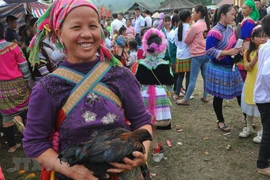
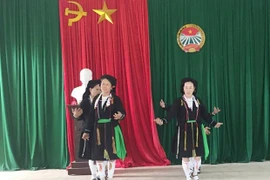
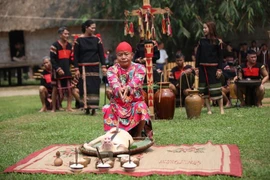
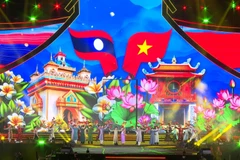
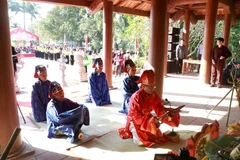
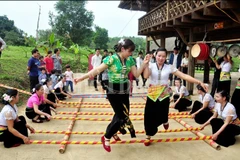
A "then" singing performance by Tay people at the Vietnam National Village for Ethnic Culture and Tourism (Photo: VNA)
 Hanoi (VNA) – Vietnam is home to 54ethnic groups, each of which has its own unique cultural identity. At the Vietnam National Village for Ethnic Culture and Tourism, ethnic minoritypeople join State agencies and experts in preserving and introducing theircommunities’ cultural values to visitors.
The village, located in the Dong Mo tourism areain Hanoi’s Son Tay town, is described as a “common home” of the 54 ethnicgroups across the nation. It has a total area of 1,544ha with seven functionalzones. Among them, the zone for ethnic minority villages is considered theheart of the culture-tourism village.
So far, people from 13 ethnic groups have come fromevery corner of the country to reside here, including Tay, Dao, Muong, Thai,Kho Mu, Ta Oi, Co Tu and Khmer.
Thanks to them, the culture of these groups hasbeen demonstrated through not only their traditional houses or places ofworship, but also the daily activities and festivals held by ethnic minoritiesin the village.
 Nguyen Thi Xuyen, a Tay woman from Thai Nguyen province, introduces the traditional house of her community to visitors (Photo: VNA)
 At a traditional house of Tay people, Nguyen ThiXuyen in traditional costume welcomed visitors with broad smiles. She briefedus about how the house was built and how their clothes made. We later enjoyedthe minority’s “then” melodies, a national intangible cultural heritage that isseeking UNESO’s recognition, performed by herself and her young Tay fellowpeople.
She told us that she comes from the northern mountainousprovince of Thai Nguyen and has lived at the village for four years. Currently,the house is home to eight Tay people from different localities, who areresponsible for preserving and popularising their cultural values.
To be eligible to be invited here, they must haveinsight and knowledge about their culture and be able to illustrate the dailylife of Tay people.
Xuyen said she felt homesick during the firstdays of living there because she was far from her family and neighbours, butnow she was used to it and can return to her hometown in Thai Nguyen every twoor three months.
"I sometimes feel like a soldier. A soldierprotects the country, while I come here to maintain my community’s culture. Werepresent all Tay people to introduce the quintessence of our culture tovisitors," Xuyen said.
She added that she was delighted to welcomevisitors, but also felt sad after saying farewell to them.
Meanwhile,the tranquil atmosphere of the Xe-dang ethnicity village was brightened up bythe sound of Klong put and T’rung, traditional musical instruments made ofbamboo.
Artisan Y Sinh and several women from Dak To district, the Central Highlands provinceof Kon Tum, left their home for the culture-tourism village to showcase their minority’scultural values.
“Although I was not trained to become an artist, I came here to save our ethnicgroup’s culture. If no one does something, the traditional music will disappearforever,” Sinh said.
 Artisan Y Sinh (L) introduces T'rung, a traditional musical instrument of Xe-dang people, to young visitors (Photo: VNA)
 With burning desire and skill, Sinh has successful revived the original T’rungand Klong put, which had almost slipped into oblivion. She has also made newmusical instruments to diversify the bamboo orchestra.
In the beginning, she was only meant to stay in the village for a few days to joinevents and programmes, then the village management board invited her to stay tointroduce her ethnic group’s culture.
“I feel grateful to the Party and State for building a cultural space forXe-dang people in this village, the common house of all 54 ethnic groups. Itwill be very joyous if people from all the groups come here as we will have achance to exchange with other groups. Aside from that joy, we can also togetherintroduce our communities’ culture to tourists,” she said.
At another area of the village, young men and women of the TaOi ethnic minority group from A Luoi district in the central province of ThuaThien – Hue were performing a traditional dance to celebrate the new ricefestival. Nearby, a woman was weaving to show visitors her ethnic group’straditional craft which has been recognised as national intangible culturalheritage.
 Ta Oi people perform a traditional dance celebrating the new rice festival at the Vietnam National Village for Ethnic Culture and Tourism (Photo: VNA)
 Ho Thi Tu, a woman from the ethnic group, saidthese are regular activities at the village, adding that implementing theParty’s guidelines on cultural preservation, people have come to the village tointroduce their cuisine, agricultural products and “Zeng” weaving.
“People want to preserve and promote the uniqueculture of the Ta Oi ethnic group,” she said.
Dong Feng, a visitor from China, called thegathering of ethnic groups in one place a “good idea” because ethnic minoritygroups often live far away from the largest ethnic group of Kinh people.
“If ethnic people want to learn about different cultures,they have to go very far. This would be very difficult. Therefore, when peopleare brought together at the village, they can easily study the life, customsand culture of other ethnic groups,” he said.
Nguyen Van Thai, a tourist from Hanoi, said thathe came here to learn about the ethnic minority cultures that he had only readabout in newspapers before.
“Visiting the village today, I find that theVietnamese ethnic cultures are diverse and beautiful. I could enjoy dishes ofTay ethnic groups and I really liked it. I will recommend my friends to thevillage.”
The Vietnam National Village for Ethnic Cultureand Tourism aims to preserve and promote ethnic cultural values as well asenhance mutual understanding and solidarity among ethnic groups.
With the policy of “letting ethnic groupsintroduce themselves”, the management board of the village has worked withlocalities to welcome thousands of people from ethnic groups to join activities at thevillage.
The activities truthfully reflect the life andfestivals of ethnic groups, which creates a special attraction to visitors.
The presence of ethnic minority people at thevillage has brought vitality and become the soul of the ethnic villages.
In 2018, more than 560 ethnic minority peoplefrom 39 localities along with 14 groups of ethnic communities from thenorthwestern, Central Highlands and southwestern regions recreated 22traditional festivals at the village. The participation of nearly 500 theatreartists contributed to creating a picture of cultural diversity at the “commoncultural house.”-VNA
VNA