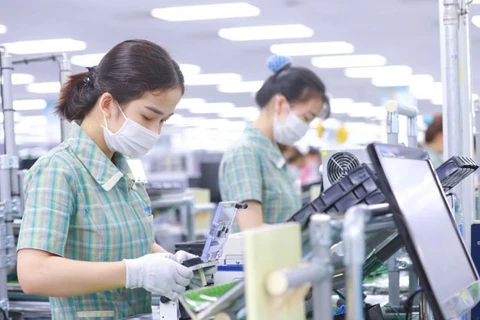
Operation of a firm at Yen Phong industrial park (Photo: VNA)
 The BCI nudged up to 45.1 in Q3, from 43.5 the previous quarter. While still below the 50-point threshold for four straight quarters, this small rise indicates emerging positive economic momentum.
Between Q2 and Q3, there was a 3 percentage point drop in pessimism regarding the current situation, while positive and neutral perspectives increased by 6 and 4 percentage points respectively.
Furthermore, the Q3 survey revealed a shift in projections for the quarter to come. Compared to responses in the Q2 survey, there was an 11 percentage point rise in businesses anticipating economic stabilisation and growth for the upcoming quarter. On the other hand, businesses projecting a negative trend reduced by 5 percentage points, said EuroCham.
Vietnam's global investment appeal remains strong, with 63% of surveyed businesses positioning Vietnam within their top 10 FDI destinations. Even more striking, 31% ranked Vietnam among their top three, while an impressive 16% hailed it as their foremost investment destination. Reflecting this confidence, over half of those surveyed plan to increase their FDI in Vietnam by the end of the year.
However, a substantial 59% cited administrative difficulties as their main challenge when operating in Vietnam.
To improve the nation's FDI attraction, 58% of respondents said streamlining bureaucracy is key, 48% advocated for enhancing the regulatory environment, one-third called for upgrading transport infrastructure, and 22% emphasised easing visa and work permit requirements for foreign experts.
 Ford factory in Hai Duong province (Photo: VNA)
 Regarding the EU-Vietnam Free Trade Agreement (EVFTA), over 60% of companies called the deal beneficial after more than two years of its implementation, citing tariff cuts as the top perk, followed by improved competitiveness in Vietnam, reduced trade barriers, expanded partnerships with local firms, and increased access to the Vietnamese market.
"It's clear: Team Europe stands firmly behind Vietnam," said EuroCham Chairman Gabor Fluit, commenting on the BCI. "Nearly one-third of our members ranking Vietnam as a top-three investment location sends a powerful message about our faith in this partnership."
However, he noted challenges remain. "While we saw promising Q3 GDP and FDI growth, issues persist - especially with exports and real estate. To progress, addressing administrative burdens, unclear regulations, and permitting hurdles is crucial. We remain committed to open dialogue to effectively tackle these issues together."
The quarterly BCI, which is conducted by Decision Lab, serves as a vital tool for understanding the perceptions of European and Europe-related companies and investors in the Vietnamese market. Conducted since 2011, the BCI collects feedback from EuroCham Vietnam's extensive network of 1,300 members across a diverse range of sectors. This survey provides valuable insights into the current business landscape in Vietnam and offers a glimpse into future expectations.
Decision-makers, media, and business professionals see the BCI as a key indicator of economic activity in the country. It is a trusted source of information on the business environment in Vietnam, and its findings are widely used to inform government policies and investment decisions./.
VNA