At the signing of the EVFTA. (Photo: VNA)
 Hanoi (VNA) – The signing of the EU-Vietnam Free Trade Agreement (EVFTA) in Hanoi on June 30 after six years of negotiation is expected to serve as a lever for the growth of Vietnam’s economy and business community.
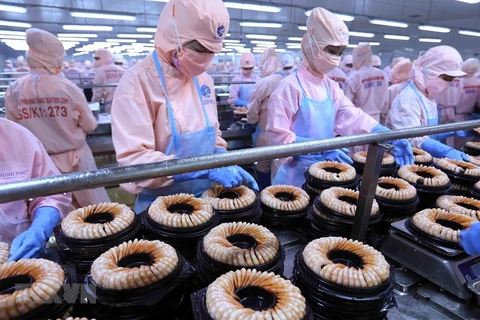
The EU is currently the third largest trade partner, and one of the two’s biggest export markets of Vietnam, with two-way trade hitting 50.4 billion USD in 2018.
With EVFTA, Vietnamese businesses have opportunities to make deeper inroad into the EU market with a population of 508 million people, and total gross domestic product (GDP) of around 18 trillion USD.
According to the Ministry of Planning and Investment’s research, EVFTA will make Vietnam’s gross domestic product (GDP) expand by an average 2.18-3.25 percent during 2019-2023, 4.57-5.3 percent during 2024-2028, and 7.07-7.72 percent during 2029-2033.
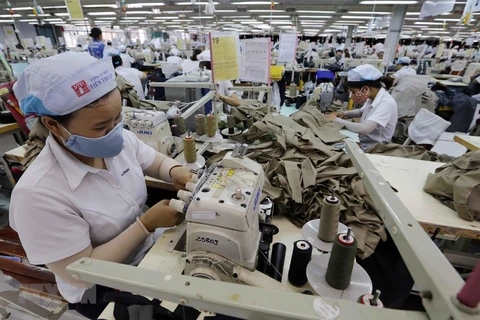
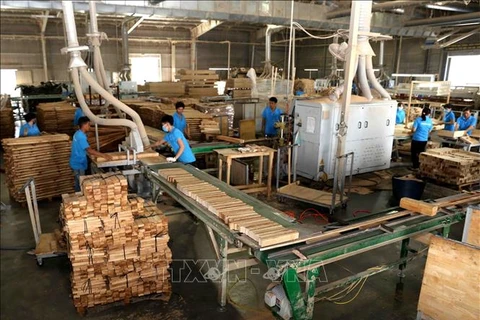
Thanks to the deal, Vietnam’s shipments to the EU are expected to pick up an additional 4-6 percent compared to without the deal, equivalent to 19 billion USD, in 2019. Revenues from exports to the EU would increase by 20 percent in 2020, 42.7 percent in 2025 and 44.37 percent in 2030 compared to without the FTA. Imports from the EU will also rise, but at a slower pace, estimated at 15.28 percent in 2020, 33.06 percent in 2025 and 36.7 percent in 2030.
The pact is considered one of the first new-generation and high-quality trade deals, as it not only covers trade-related issues but also those in investment, governance, protection of workers’ rights and benefits and the environment. The EVFTA also ensures a balance of benefits for both Vietnam and the EU and takes into consideration the development gap between the two sides. At the same time, the agreement complies with the provisions of the World Trade Organisation (WTO).
The level of commitment in the EVFTA is the highest of any FTA Vietnam has signed. It has significant meaning especially when only 42 percent of Vietnam’s exports to EU now enjoy zero tariff under the generalised system of preferences (GSP).
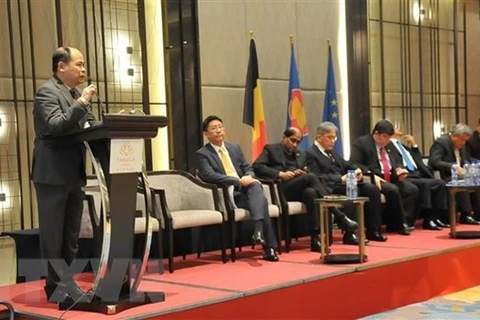
Deputy Director of the Ministry of Industry and Trade’s European-American Market Department Tran Ngoc Quan, the EVFTA will open up market-access opportunities for businesses from both sides, and create a favourable legal environment for signatory countries in doing business and access markets.
However, with the establishment of an even playground under the pact, Vietnamese enterprises will have to compete with EU firms right in the domestic market.
Furthermore, foreign direct investment firms will jump into the Vietnamese market to make use of the trade pact, posing great challenges for local businesses.
 Minister of Industry and Trade Tran Tuan Anh (Photo: VNA)
 However, Minister of Industry and Trade Tran Tuan Anh said that if Vietnam can take full advantage of the EVFTA, coupled with the country’s improvement in business climate and institutional reforms, the country will definitely enhance the quality of growth.
Vietnam and the EU have agreed on a cooperative mechanism on building capacity for Vietnam to implement the trade pact, he said, stressing that as the interaction and complementary natures of the two markets are large and wide, enterprises have more opportunities to collaborate rather than compete with each other.
On the other hands, Vietnam will have to reform its legal system and mechanisms to ensure that exports are qualified to enter the EU market, he said, pointing out that the EVFTA has strict stipulations on investment and customs procedures, trade facilitation, technical standards, quarantine measures, intellectual property rights, government purchase, and sustainable development, among others.
He also said that local businesses must be well prepared to expand their market. They can only benefit from the deal if they are able to improve product quality and packaging to satisfy the EU’s requirements in product origin, technical standards and food safety and hygiene.
In October 2010, the Prime Minister of Vietnam and the President of the European Union agreed to start negotiations on the EVFTA after technical procedures were all completed. EVFTA is a new-generation trade pact between Vietnam and 28 member states of the EU. Both sides officially launched negotiations on the pact on June 26, 2012.
On December 1, 2015, negotiations concluded, and the preliminary text of the agreement was announced on February 1, 2016. On June 26, 2018, the two sides agreed that the EVFTA was split into two agreements, one for trade and one for investment. In June 2018, both sides accomplished legal review for the EVFTA and the EU-Vietnam Investment Protection Agreement (EVIPA).
After the two agreements were inked, they would be presented to the European Parliament (EP), and the parliaments of 28 EU member states for approval. The EVFTA will be adopted at the end of 2019 or the beginning of 2020 while it will take at least two years for the pact to be passed by the EP and the parliaments of its 28 members.
According to Ambassador - Head of the Vietnamese mission to the EU Vu Anh Quang, Vietnam and EU have made concerted efforts to remove legal and technical barriers, as well as accelerate the approval of the pact by EU’s committees.
Lobbies were made at all levels, including the highest level, at all bilateral and multilateral forums. In addition, the Ministry of Foreign Affairs and the Ministry of Industry and Trade directed Vietnam’s diplomatic delegations in EU to give top priority to push the EVFTA in the past year.
As for the EU side, business associations and consulting organisations also worked hard to promote the two pacts through many workshops on the EVFTA and arranging for Vietnamese and European firms operating in Vietnam to introduce Vietnamese business climate in the EU.
To date, Vietnam has signed more than 10 bilateral free trade deals. However, EVFTA is considered very important as the EU is a large market besides the US and Japan. Furthermore, the EU is an important partner in Vietnam’s foreign policy of diversification and multilateralisation. -VNA
VNA