Exchange rate fluctuations bring huge profits to many banks

Net profits from the foreign exchange trading segment of many banks have gained positive results thanks to a strong USD/VNĐ exchange rate fluctuations this year.

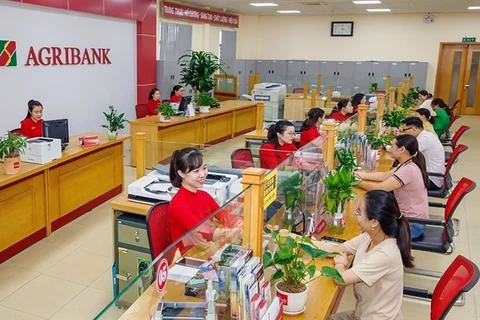
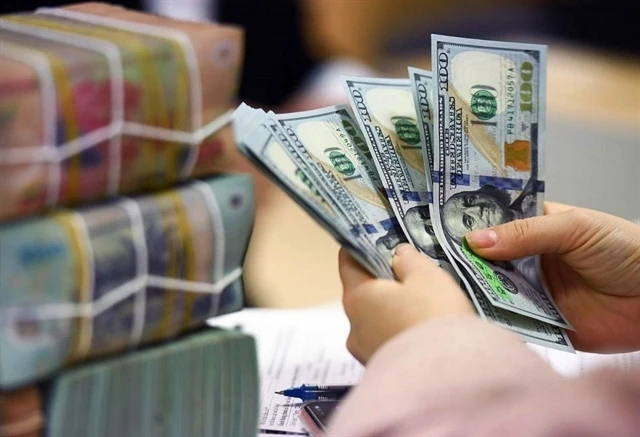
The total net profit from the foreign exchange trading segment of 29 banks in the first three quarters of 2024 reached more than 19.62 trillion VND, up 7% over the same period last year. (Photo: cafef.vn)

Hanoi (VNS/VNA) - Net profits from the foreign exchange trading segment of many banks have gained positive results thanks to a strong USD/VNĐ exchange rate fluctuations this year.

According to banks’ financial statements, the total net profit from the foreign exchange trading segment of 29 banks in the first three quarters of 2024 reached more than 19.62 trillion VND, up 7% over the same period last year.
State-owned BIDV continued to maintain its leading position in terms of value in the business segment, with a net profit of more than 3.92 trillion VND, up 25% over the same period last year.

In the group of private banks, MB topped the list with a net profit of nearly 1.52 trillion VND, representing an impressive growth of 65%.

Techcombank also made its mark with a net profit of nearly 1.02 trillion VND in the first three quarters of this year, while the bank reported a loss of 117 billion VND in the same period last year.

Similar to Techcombank, VPBank also recorded a sharp increase in net profit from the foreign exchange trading segment, with more than 594 billion VND. This figure was not so large compared to the whole banking industry, but it was a significant growth rate compared to VPBank’s loss of more than 600 billion VND in the same period last year.

Other banks also made large profits from this business segment, such as MSB with 846 billion VND, Sacombank with 831 billion VND, ACB with 827 billion VND, HDBank with 609 billion VND and SeABank with 563 billion VND.

According to the banks’ financial reports, foreign exchange trading mainly relies on two main sources of revenue - spot foreign exchange trading and currency derivatives. This business segment depends heavily on fluctuations in the US dollar and other foreign currency exchange rates in the domestic market.

October 2024 witnessed a sharp increase in the USD/VNĐ exchange rate, with a 4.2% depreciation of the Vietnamese dong against the dollar compared to the beginning of this year. Notably, the dong in October 2024 alone devalued by up to 1.2% compared to September 2024. According to Mirae Asset, most of this depreciation originated from strong fluctuations in the dollar index (DXY), which increased rapidly due to better-than-expected US economic data.

This pressure has significantly affected the dong and created a burden on the Vietnamese economy, especially when Vietnam’s foreign exchange reserves have decreased after the State Bank of Vietnam (SBV) had to sell a significant amount of the US dollar to stabilise the forex market. Vietnam’s foreign exchange reserves are currently only at 2.4 months of imports - lower than the 3-month of import level recommended by the International Monetary Fund.

Analysts from Mirae Asset Securities Company forecast that the USD/VNĐ exchange rate may continue to remain high or increase further if global factors, especially from the US, do not cool down. The US Federal Reserve (Fed)'s policy of maintaining high interest rates to control inflation may continue to boost the dollar, putting great pressure on other currencies including the dong. Therefore, the central bank's lowering of interest rates will face many challenges, as this may increase pressure on the exchange rate.

To minimise the foreign exchange pressure, Mirae Asset suggests that the SBV seek additional measures to stabilise the liquidity of the market, without reducing the country’s foreign exchange reserves. The solutions include strengthening cooperation with major trading partners to diversify foreign currency sources, considering adjusting interest rate policies to reduce the impact of exchange rates on inflation and considering policies to support local exporters to increase foreign currency-denomivated revenue collected or reduce unnecessary costs of imports to ease pressure on domestic enterprises./.

VNA

See more

Inside Bach Dang shipbuilding factory (Photo: VNA)

Vietnam's industry spearheads transition to circular economy

The circular economy is no longer just a policy choice. It has become an inevitable trend for delivering sustainable and green growth, sharpening competitiveness at home and abroad, and meeting Vietnam’s net-zero emissions target by 2050. It is now a prerequisite to sustain long-term economic expansion, particularly in industrial production and supporting industries.

Algerian officials, representatives of foreign embassies, and numerous global oil and gas companies attend the Bid Round. (Photo: VNA)

Vietnam joins int'l bidding for oil and gas exploration in Algeria

Currently, PVEP is involved in oil exploitation at Blocks 433a and 416b of the Bir Seba field in the Hassi Messaoud area, Ouargla province, located more than 600 km south of Algiers. The project stands as one of Petrovietnam’s most successful overseas ventures, demonstrating the operational capacity and technical expertise of Vietnamese engineers on the global stage.

A customer is making payment via QR code at a coffee shop. The Ministry of Finance has proposed new regulations on taxable revenue thresholds for household businesses. (Photo: VNA)

Finance ministry eyes flexible tax thresholds

In a draft law amending several articles of the laws on personal income tax, corporate income tax and value-added tax, Vietnam's finance ministry proposed scrapping the fixed revenue threshold of 500 million VND. Instead, it suggested the threshold be set by the Government based on prevailing economic conditions.

Part of the Vung Ang II Thermal Power Plant. (Photo: VNA)

Vung Ang II thermal power plant inaugurated in Ha Tinh

With a total investment of 2.2 billion USD, the Vung Ang II Thermal Power Plant is developed under a build-operate-transfer (BOT) model and has a designed capacity of 1,200 MW, comprising two turbines. The plant is expected to play a key role in ensuring stable electricity supply for the central region and neighbouring areas, thereby facilitating the development of industries, agriculture and services.

Aircraft at the Noi Bai International Airport in Hanoi. (Photo: VNA)

Vietnam seeks stable jet fuel supplies from China amid Middle East disruptions

On the basis of the long-standing friendship and cooperation between Vietnam and China, as well as close ties between their aviation authorities, the Civil Aviation Authority of Vietnam has asked the Civil Aviation Administration of China to direct relevant fuel suppliers to ensure sufficient and stable supplies for Vietnam.

Illustrative photo (Photo: Xinua/VNA)

Remittances to Ho Chi Minh City decline in Q1 amid global headwinds

Data from the State Bank of Vietnam (SBV)'s Region 2 branch showed that remittances transferred through credit institutions and economic organisations in Ho Chi Minh City exceeded 2 billion USD in the January–March period, down 15.6% from the previous quarter and 16.9% year-on-year.

The shipments are unloaded at the airport. (Photo: VNA broadcasts)

Nearly 100 tonnes of Vietnamese fruits, vegetables airlifted to UAE

Vietnamese fresh produce and processed foods are increasingly recognised for their quality, with items such as cashew nuts, coffee and spices gaining popularity among Middle East consumers. In 2025, Vietnam’s farm produce exports to the UAE exceeded 445 million USD, up nearly 24% year-on-year.

The World Coffee Heritage Forum officially opens at the World Coffee Museum in Dak Lak province, with eyes on UNESCO recognition for Vietnamese coffee culture. (Photo: VNA)

World Coffee Heritage Forum opens in Dak Lak

Dak Lak is known as the 'capital' of Vietnamese coffee, with rich, fertile basalt red soil ideal for agriculture. The coffee provides livelihoods for thousands of locals and has developed a unique cultural space, closely tied to the socioeconomic life, customs and identity of local communities.