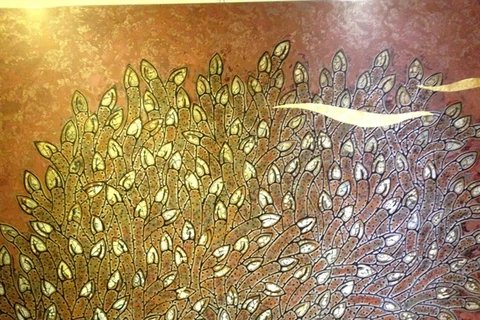
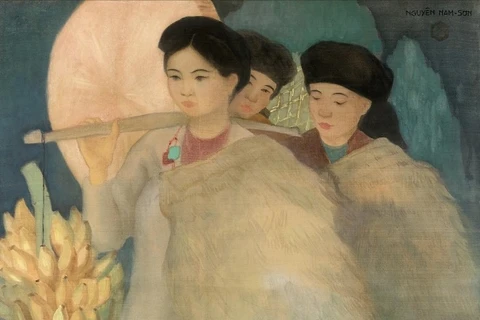
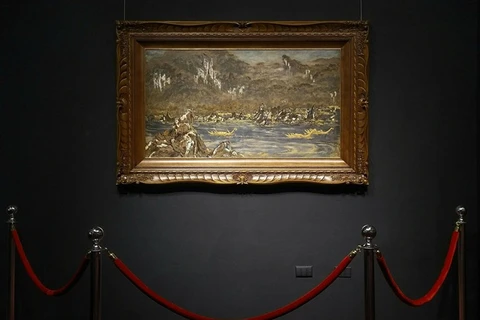
A lacquer painting entitled Thieu nu trong vuon (Girls in The Garden) by master painter Nguyen Gia Tri (Photo courtesy of the Vietnam Museum of Fine Arts)
 Hanoi (VNS/VNA) - Lacquer paintings belong to the Vietnamese, said Bui Thi Thanh Mai, Deputy Director of the Vietnam Museum of Fine Arts, while addressing a seminar on lacquer art held in Hanoi on June 13.
"Some countries like Britain, France and Germany also showcase lacquer paintings, but the term son mai [lacquer] was created by Vietnamese," Mai said. "Son mai comprises two words son (lacquer) and mai (grind) which relate to the material and process used to make a son mai painting.
Over the past 80 years, Vietnamese lacquer masters reached milestones in developing traditional crafts towards artistic creativity.
"Let young artists be free to explore and create art like our masters. The history of lacquer or son mai art is built from contributions from each country in the world, and Vietnam played an important role in the development of lacquer art."
Mai made the conclusion after listening to ten presentations and opinions from the seminar participants.
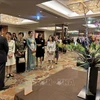
The seminar, entitled Tranh Son mai - Chat Lieu va Nghe Thuat (Lacquer Painting - Materials and the Art) was co-held by the museum and the Hanoi Goethe Institute, with the participation of lacquer painters, art critics, experts and lecturers from Vietnam, Germany, the Netherlands and France.
Participants were introduced to the concept of lacquer painting; the history of lacquer art; as well as specific requirements for lacquer materials and the preservation and restoration of lacquer paintings at the Vietnam Museum of Fine Arts.
From the German Museum of Lacquer Art Munster, director Monika Kopplin introduced the style and techniques developed by European lacquer artists, whilst Dave van Gompel from the Netherlands, an expert in the restoration of Japanese lacquer painting analysed Japan’s modern lacquer works in the context of preservation and development.
Expert Gompel also said that artists must respect the old, but not fear the new. They should avoid the widening gap between artists and craftsmen; cherish the material, farmers and tool makers; invest in education and communication; explore markets outside Vietnam and invest in conservation and preservation.
The first Vietnamese lacquer paintings were made by students at École Superieure des Beaux Arts de I’Indochine (Indochina Fine Art Colleges) in the 1930s.
The Vietnamese people had been using resin from the lacquer tree to make crafts and valuable objects for hundreds of years, including objects of religious value.
"After visiting Van Mieu (The Temple of Literature) with Vietnamese students, French teacher Joseph Inguimberty realised the potential of lacquer resin, which was used in the temple’s decorations.
He noticed the beautiful gilded and lacquered objects and architectural elements. He suggested his students experiment with lacquer resin as a painting material, as an alternative to the traditional western technique of oil painting," said artist Doan Van Nguyen, who is a veteran lacquer painter and lecturer at the Vietnam Fine Arts University.
Nguyen stressed that Vietnamese lacquer was quite different from its Chinese counterpart.
“Vietnamese lacquer paintings are covered and ground many times with lacquer resin before the artist inlays crushed egg shells, gold, silver and other materials". Nguyen also reveals that he has successfully restored his lacquer paintings which were partly damaged by oxygen. He is ready to co-operate with the museum to restore damaged lacquer masterpieces. His own lacquer painting is also in the museum’s collection.
Art critic Nguyen Hai Yen also participated in the seminar. She spoke about lacquer master Nguyen Gia Tri. He was one of the first artists who took up lacquer resin as a new painting medium and is now considered the greatest exponent of Vietnamese lacquer painting.
"Artist Tri stopped his studies at the Indochina Fine Arts College for many years to focus on drawing. During this time, he noticed differences when using lacquer resin to make traditional craft objects and make paintings," said Yen.
Yen said that during the early part of Tri’s career, his lacquer paintings accorded with the romantic colonial style and ideals, but he soon began experimenting successfully with more abstract concepts.
Yen also expressed her desire to make lacquer paintings a Vietnamese trademark in the world.
Lacquer painting was a milestone for Vietnamese fine art, but how it will be preserved in the museum is an issue that many participants at the seminar were concerned with. The museum’s former deputy-directors Nguyen Anh Nguyet and Nguyen Xuan Tiep gave presentations about lacquer painting preservation in the museum.
Nguyet highlighted achievements in restoring some master works, including Nguyen Gia Tri’s master work Thieu Nu Trong Vuon (Girls in The Garden). The painting was damaged by bullets in the American war. The big holes were treated but the lines and colours were not. Meanwhile Tiep is worried about backwards infrastructure and urges the use of technology to preserve the lacquer painting collection in the museum.
"The lacquer painting collection is very big, due to many reasons the number of restored paintings is very few," said Tiep. "It requires the best materials to restore the damaged works."
Deputy Director Mai thanked the participants for attending the seminar and highly appreciated the opinions which will help the museum to preserve, restore and popularise Vietnam’s lacquer paintings.-VNS/VNA
VNA