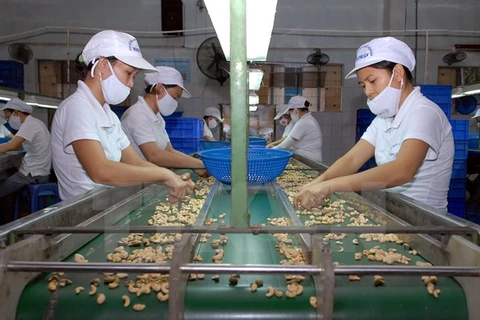
RoK products showcased at the 2016 Food Ingredients Vietnam exhibition in HCM City (Photo: VNA)
 Hanoi (VNA) - A seminar and business meeting themed "Korean food market access", supporting Vietnamese businesses to boost farm product exports to the Republic of Korea (RoK) market, was held in Hanoi on May 24.
Attending the seminar were 12 RoK food importers, along with Vietnamese businesses and associations.
Ta Hoang Linh, Deputy Director of the Vietnam Trade Promotion Agency (Vietrade) under the Ministry of Industry and Trade, said that RoK was the third largest trade partner and the fourth biggest export market for Vietnam.
The free trade agreement between Vietnam and RoK (VKFTA) took effect at the end of last year, committing to cut more than 90 percent of tariffs in order to boost opportunities for Vietnamese exports to the country, he said.
The free trade agreement would create new export opportunities for more than 500 Vietnamese products, especially agro-forestry and aquatic products like shrimp, crab and fish. Tropical fruits, garments and textiles, wood and mechanic products would also benefit from the relaxation of tariffs.
Speaking at the seminar, a representative of the RoK in Vietnam said that the Korean market had a population of nearly 50 million people and a high food consumption. Food trade between Vietnam and RoK reached 12 million USD in 2015. The two countries are also planning to increase trade value in the sector to 20 million USD by 2020.
Kim Nam Hyong, a representative from Amoje Corporation, said at the seminar that the current trend in the RoK food market is that of packed food products, which were quick and convenient for consumers to use.
The target market for these products was not only housewives but also restaurants as they could facilitate many dishes quickly with low numbers of staff, which saves on labour cost, he added. Kim also advised Vietnamese businesses to research the changing tastes of Korean thoroughly to avoid guarantee successful market penetration.
The representative also emphasised food safety as a top priority, to match the country's high standard of imports, equivalent to that of the US and Japan.
Packaging would also need to be attractive, conveying enough information about the product to customers.
Talking about the consumption trends in RoK, Woo Deok Kwan from CJ Foods said that Korean customers cared about healthy products, therefore choosing packed food, which could be cooked at home.
Simplification in cooking was a current trend in RoK, and Vietnamese businesses should understand this when thinking about exporting their own products, Woo advised.
RoK has a variety of pre-packaged products, however there are limited numbers of products containing fruit and vegetables, he said, therefore the country expects to import frozen fruit from Vietnam. These were products which are available in abundance in Vietnam, making it an attractive prospect for RoK businesses.
Ra Joohee, from Pulmuone Co, Ltd advised Vietnamese businesses to focus on tropical fruits when exporting to RoK.
"We expect to import more pineapple and mango from Vietnam as these products have higher competitive advantages compared to these of other countries", she said.
We also wanted to import frozen rambutan, passion fruit and selected dried fruit from Vietnam, she said.
Vietnam needed to diversify its products, as well as paying more attention to a product's appearance and packaging, she suggested.
A representative from a Vietnamese food exporter shared with media that the RoK standard was rather strict towards farm products as it was a country producing for its citizen. "This is a compulsory barrier that Vietnamese exporters have to overcome if they want to access the RoK food market".-VNA