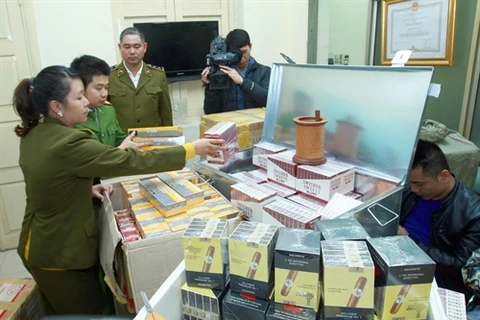
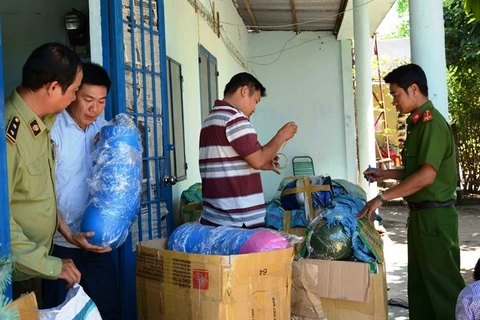
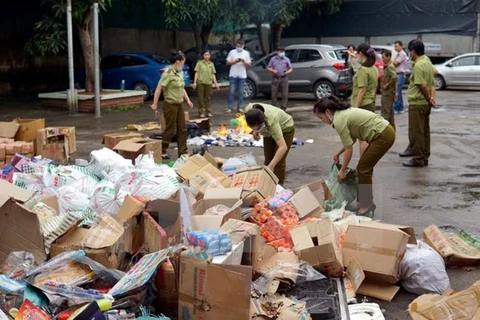
Market surveillance personnel inspect bottles of smuggled alcohol before destroying them in a busted case taking place in the southern province of Binh Duong. (Photo: VNA)
 Hanoi (VNA) - The crackdown on counterfeit and smuggled wines and cigars has tightened as the Tet holiday approaches. However, it seems that the fight has not been effective, with many consumers still wary when shopping for goods at markets in Hanoi.
Minh Truong, a resident in Hanoi’s Hoan Kiem district, said that he struggled to buy foreign wines.
Truong once bought a fake bottle of wine sold at a liquor shop even though he checked the wine carefully.
“It is quite difficult to distinguish between fake and authentic products as the bottle, label and even the colour of fake wine look identical to the real one,” he said.
Quynh Huong, another consumer in Hoan Kiem district, said that she no longer trusted the liquor stores in town. She usually bought wine from friends who travelled abroad.
“I can’t tell if a bottle of wine is real or fake, so I’d rather not buy it here,” she said.
Under current regulations, alcohol that is not correctly labelled with import stamps will be classified as counterfeit. However, it’s likely that even certification stamps can not guarantee genuine products.
Pham Ngoc Hung, vice chairman of the Vietnam Anti-Counterfeiting Fund, told the Lao dong (Labour) newspaper that there were many tricks used to make counterfeit wines look like those from famous brands. Violators could substitute poor-quality alcohol into a used bottle of wine to trick consumers, or fake the bottle, cork, labelling and even certification stamps to sell the product.
Hung said it was challenging for consumers to tell the difference between fake and real products at a glance and they could easily be cheated.
Recently, many cases of fake imported alcohol have been discovered.
Last October, more than 300 bottles of wine lacking clear origins were seized when they were transported to the central province of Thanh Hoa for consumption.
On the same month, city police, in co-operation with police in Hai Phong City and Thanh Hoa and Nghe An provinces seized nearly 5,000 bottles of fake alcohol, which was a mixture of imported and domestic wine and labelled with false certification stamps. The bottles were made to look like well-known brands from Germany, Australia, Scotland and the US.
Last year, stories about the production of fake imported wine in Long Biên district’s Nguyen Son street were published in local press. In shining a light on the manufacture and trade of fake alcohol, consumers began to question the quality of imported wines sold at the city’s markets.
Meanwhile, the crackdown on such fake products seems to have had little effect.
Figures from the city’s Market Watch showed that inspectors made raids in 60 cases of trading and importing wines. Of that, 48 cases faced fines of over 157 million VND (6,908 USD) and 210 bottles, or 2,203 litres of alcohol, was seized.
Dr Nguyen Trung Nguyen of Hanoi’s Bach Mai Hospital said that cases of alcohol poisoning increased remarkably before and after Tet. The reason was the increased consumption of fake alcohol.
Imported cigars are among luxury goods purchased for the Tet holiday. Although selling this kind of product requires strict business conditions, they have been found at many stores in the city.
Quang Anh, a cigar smoker, said that he was surprised to find many rare and expensive types of cigars being sold at numerous stores in the city.
Cohiba Behike cigars are one example. The limited and luxurious cigars are normally sold at about 1,500 USD per box, but they have been advertised at just 5 million - 6 million VND (220-264 USD) per box in Hanoi.
Duy Sang, another cigar smoker, said that cigars were advertised as imported from Cuba or Europe, but sellers failed to show any papers to prove their origin.
Last year, the Ministry of Finance tightened regulations on importing cigars to Vietnam, in which a person could only carry 20 cigars when entering Vietnam, instead of 100 cigars as previously.
Last November, the city’s inspectors seized 389 cigars sold at a shop on Trung Kinh street as the shop owner failed to show the required papers.
Currently, Vietnam National Tobacco Corporation is the only unit allowed to import and distribute cigars in Vietnam.
A representative from the city’s Market Watch’s Unit 1 said that they would continue to investigate shops selling cigars in the city and deter violations.-VNA
VNA