Farmers earn higher incomes from protecting mangrove forests

Local households assigned to plant mangrove trees and breed aquatic species in forested areas are earning higher incomes in two coastal districts of Kien Giang province.
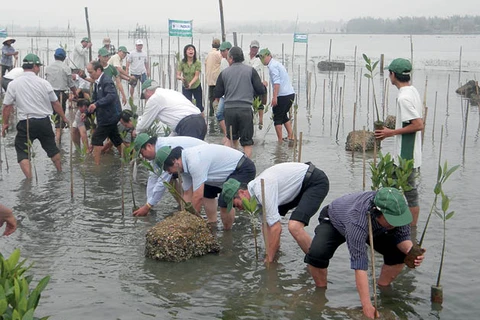
Farmers earn higher incomes from protecting mangrove forests ảnh 1A farmer plants mangrove trees in Nam Thai commune, An Bien district, the southern province of Kien Giang. (Photo: VNA)

Kien Giang (VNS/VNA) - Localhouseholds assigned to plant mangrove trees and breed aquatic species inforested areas are earning higher incomes in two coastal districts of KienGiang province.

The families were allocated a certain area offorest to protect under a provincial programme.

The submerged forests in the coastal areas of AnBien and An Minh districts have a length of 60km and cover more than 4,000ha.Of the figure, nearly 3,000ha have been allocated to 867 households. The restare protected by the An Bien – An Minh Forest Management Board.

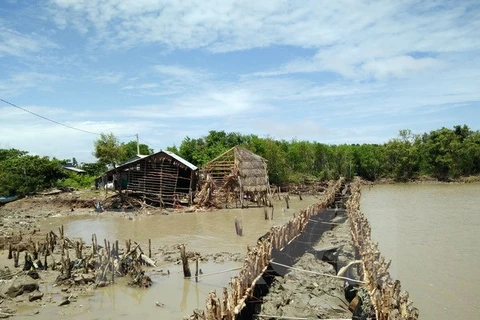
The submerged forests, which run from An Bien’s TayYen commune to An Minh’s Van Khanh Tay commune, are divided into one mainforest belt and a secondary forest belt.

The secondary forest belt in which most “duoc” (rhizophoraapiculata) trees are planted have been allocated to local households forprotection.

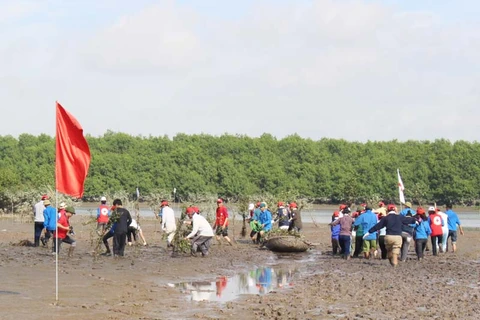
Since 2011, the board has assigned localhouseholds to protect submerged forests, plant new forests and breed aquaticspecies.

Under the policy, forest-allocated households areallowed to use 70 percent of forest land to plant trees and 30 per cent tobreed aquatic species such as fish, shrimp, crab and blood cockles.

The breeding of aquatic species in the forests hashelped many poor households escape poverty, according to the management board.

Van Kin, who has protected 15ha of submergedforests in An Minh’s Thuan Hoa commune, said besides planting mangrove trees,he breeds blood cockles, shrimp and crab in his forested area. He earnsan income of 150-200 million VND (6,600–8,800 USD) a year, mostly fromharvesting blood cockles, he said.

In the next few years, his family will haveadditional income when mangrove trees are harvested, he said. 

Tran Phi Hai, director of the management board,said that submerged forests have recovered after being allocated to households.

Nguyen Van Khoe, who protects 12ha of submergedforests in An Minh’s Nam Thai A commune, said his seven-year-old mangroveforests are well-protected. “My forests look like primitive forests and arebeautiful,” he said.

In his forests, he breeds blood cockles as thisbivalve mollusc offers higher profits than shrimp or crab, he said.

Every year, he earns a profit of 400-500 millionVND (17,600–22,000 USD) from breeding blood cockles, he said.

“Most households here have become much better-offfrom breeding blood cockles and planting submerged forests,” he said.

Blood cockles from these areas are well-known fortheir good flavour.-VNS/VNA
VNA

See more

Representatives of relevant parties witness the arrival of the shipment. (Photo: VNA)

First Czech pork shipment officially enters Vietnamese market

A Czech diplomat described the arrival of the first container as the successful outcome of a long and complex market-opening process involving years of negotiations, regulatory approvals and close cooperation between Czech and Vietnamese authorities.

A view of financial buildings in downtown Ho Chi Minh City along the Saigon River. (Photo: VNA)

HSBC: Vietnam’s growth, macroeconomic stability to face tougher test in H2

In a recently released report, Vu Binh Minh, CFA, Associate Director, FX Trading, Markets and Securities Services at HSBC Vietnam, said Vietnam’s economy has built a relatively favourable position in the first six months of the year with GDP expanding 8.18% – the highest first-half growth rate in recent years – as key growth drivers have operated in tandem.

Ha Tay Shoes has secured numerous export orders from the US and European markets. (Photo: VNA)

CPTPP strengthens free trade, expands global economic connectivity

Since taking effect, the CPTPP has significantly expanded Vietnam's access to major markets across North America, the EU, and the Asia-Pacific, contributing to strong export growth in key sectors such as textiles and garments, footwear, and agricultural, forestry and fishery products. The agreement has also encouraged greater investment into Vietnam by promoting regional production networks and clearer rules of origin.

Tan Mingming, Deputy Director of the Foreign Affairs Office of the Dezhou Municipal People’s Government. (Photo: VNA)

Chinese firms put Vietnam on expansion radar

Tan Mingming, Deputy Director of the Foreign Affairs Office of the Dezhou Municipal People’s Government, told Vietnam News Agency reporters that the city has spent years deliberately tightening its links with the Association of Southeast Asian Nations (ASEAN), with Vietnam seen as a key partner.

A perspective of the Viettel Military Industry and Telecoms Group's high-tech semiconductor chip manufacturing plant at Hoa Lac Hi-Tech Park. (Photo: Viettel)

Hanoi builds momentum as Vietnam's semiconductor hub

As Hanoi continues to strengthen its semiconductor ecosystem, the city is creating a new growth driver for both the capital and the country, enhancing Vietnam's technological capabilities and paving the way for deeper integration into the global semiconductor value chain.

Clams are processed for export at the factory of Thanh Hoa Seafood Import-Export JSC in Thanh Hoa province. (Photo: VNA)

Vietnam steps up export to achieve 550-billion-USD target

Against a backdrop of persistent uncertainty in global commerce, the Government is implementing a broad range of measures to strengthen export growth during the remainder of the year. These include expanding overseas markets through economic diplomacy, maximising the benefits of free trade agreements (FTAs), streamlining administrative procedures, reducing logistics costs, improving access to credit and helping businesses overcome trade barriers. Authorities are also encouraging deeper processing, official cross-border exports and greater market diversification to improve the competitiveness of Vietnamese products.

A hydroponic vegetable garden in Nguyet Hoa ward operated by Green Farm Co., Ltd. (Photo: VNA)

Incentive policies for high-tech agricultural zones

Under Decree No. 263/2026/ND-CP, qualified projects are given priority to participate in State support programmes as well as funds and policies on research and development, technological innovation, technology transfer, human resource training, investment promotion and trade promotion.

Wind turbines stand fully installed at a wind power project in Gia Lai province. (Photo: VNA)

Gia Lai approves 56-million-USD wind power project

The 42MW wind farm is expected to generate about 123,780.8 MWh of electricity each year. Power generated will be transmitted to the national grid via the 220kV Pleiku 2–Krong Buk transmission line.

Garments for export to the Japanese market are produced at Hung Viet Garment Company in Hung Yen province. (Photo: VNA)

Vietnam’s garment sector pivots towards value-added growth

Future growth can no longer rely on expanding production capacity alone. Meeting this year's 48 billion USD export target will require greater productivity, higher value addition, stronger domestic sourcing, broader market diversification, and faster digital and green transformation.

Trucks carrying goods wait for customs clearance at the Thanh Thuy International Border Gate in Tuyen Quang province. (Photo: VNA)

Border economy strengthens Tuyen Quang’s growth momentum

While the stronger performance provides momentum for the province's 2026 growth target of 10.17%, officials say the focus must now shift from increasing cargo volumes to expanding services, reducing costs and retaining more value locally.

Construction of several key components of Long Thanh International Airport is entering its final stages. (Photo: VNA)

Major works at Long Thanh International Airport gather pace towards completion

The ACV said on July 20 that contractors are deploying additional workers and equipment to speed up construction under Component Project 3, which covers the airport's essential aviation infrastructure. Major facilities, including the first and second runways, taxiways, aircraft aprons, the passenger terminal apron and the aircraft fuel supply system, are approaching completion.