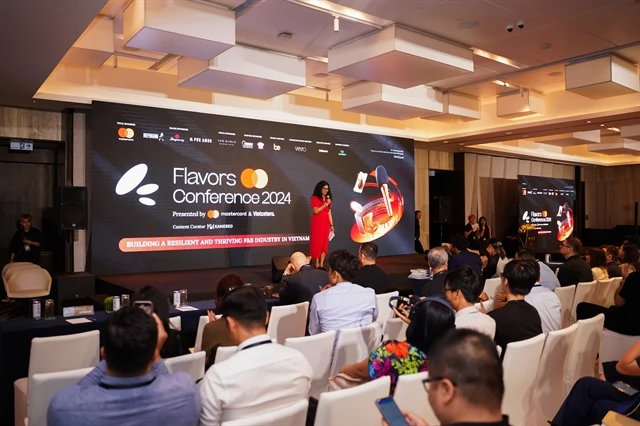
HCM City (VNS/VNA) - The food and beverage (F&B) sector of Vietnam has long been an attractive and potentially lucrative market for both foreign and domestic investors, despite facing numerous challenges, insiders affirmed at the Flavours Vietnam 2024 conference in Ho Chi Minh City on September 19.
Co-organised by Vietcetera and Mastercard, the annual Flavours Vietnam event focused on the theme "Building a Resilient and Thriving F&B Industry in Vietnam."
The event brought together over 300 industry leaders, investors, and key stakeholders to discuss and explore the latest trends, strategies, and innovations shaping the future of Vietnam’s food and beverage sector.
Given the industry's fluctuating revenue and the broader economic challenges of 2024, the event served as a crucial platform for discussing how the F&B sector can not only endure these pressures but also find avenues for growth and prosperity.
Discussions emphasised the significance of resilience, highlighting how businesses have adapted to market shifts, navigated economic fluctuations, and continued to meet evolving consumer demands.
Taku Tanaka, founder and CEO of Kamereo, noted during a discussion at the event that, “while short-term struggles may exist in specific locations, I still see significant long-term potential, particularly as consumer income continues to rise.”
Tanaka, who manages a comprehensive B2B supply chain for vegetables, observed discrepancies between HCM City and Hanoi.
“While the Government’s macro data appears strong, many customers report that their businesses are struggling. In HCM City, spending was weaker, while in Hanoi, it's more stable,” he said.
Despite these challenges, Tanaka underscored his belief in the long-term potential of Vietnam’s F&B sector, pointing out the interest of many international brands, especially Japanese F&B companies, in expanding within Vietnam.
Tanaka mentioned that many Japanese firms are considering establishing numerous locations, reflecting their lasting confidence in the market's potential.
Echoing Tanaka's sentiments, Summer Lee, founder and executive chef of Nén Danang and Nén Light Restaurant, shared her optimistic outlook on the market's future.
She highlighted Vietnamese cuisine's strong reputation overseas, particularly in Japan, which has spurred interest from Japanese companies looking to expand into Vietnam.
“I have found that Vietnamese cuisine is highly regarded overseas, particularly in Japan. Many Japanese companies are keen to expand into Vietnam and vice versa, showing reciprocal interest,” she said.
At the conference, insiders shared experiences and lessons learnt on how to be successful in the market as well as to attract more customers.
A representative of Mastercard Vietnam said that the economy has posed many challenges for industries, especially the F&B sector.
Vietnamese F&B businesses need to carefully balance value offers and profitability while facing several key challenges, largely driven by evolving consumer behaviour and the growing digitalisation of the F&B sector, he said.
According to Mastercard, the F&B landscape in Vietnam is dynamic and fast-changing, characterised by evolving consumer demand for digital technology and personalised experiences.
To remain resilient and thrive on market opportunities, Vietnamese F&B businesses need to implement strategies that enhance customer engagement and leverage technology for customised experiences that align with consumer preferences.
There are strategies that F&B businesses may implement to maintain and reinforce their competitiveness in the coming times, the company suggested.
First, F&B businesses must do a better job of meeting consumer demands.
Second is building on trust, and rewarding loyalty. Loyalty programmes are a means to better understand their customers and reinforce the factor of personalisation.
Third is providing personalisation, including customising menu items and experiences based on location, time of day, weather, real-time product availability and more for unidentified customers; tailoring products to the unique affinity and past purchase history of repeat customers.
“Personalisation allows F&B businesses to increase order value by recommending additional items based on customer preference, enhancing engagement and relevant components of the customer experience,” the company said.
Flavours Vietnam 2024 officially commenced in June with the theme "Crafting Shared Culinary Experiences," featuring various events such as the Flavours Bar Week, Flavours Conference, Restaurant Month, and the Flavours Awards Ceremony culminating in the Flavours Festival.
The conference also introduced additional events like a themed networking session to connect participants interested in emerging trends like cashless payments and food delivery services./.