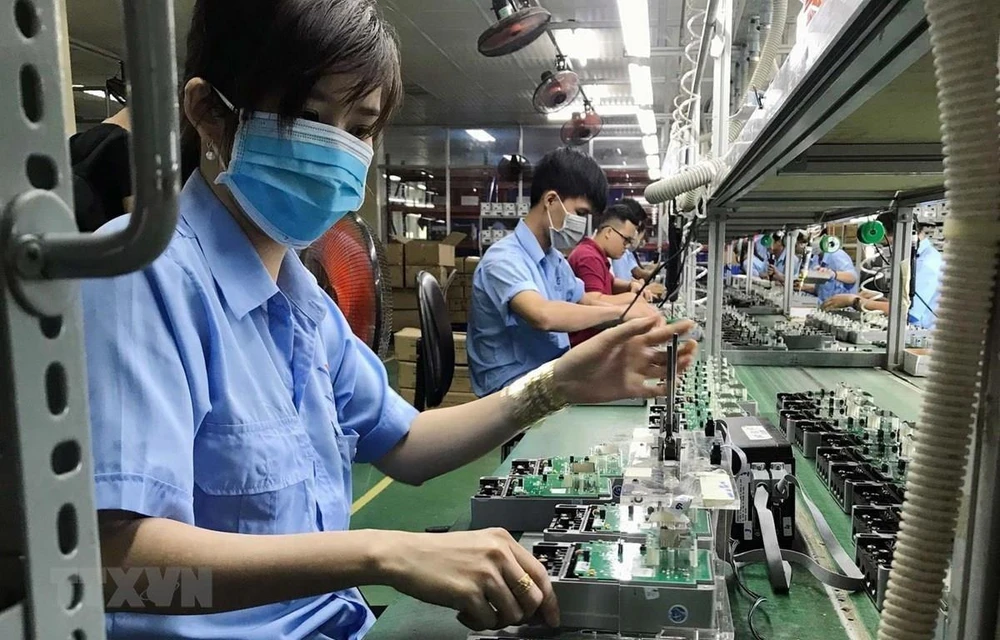
Hanoi (VNA) – A recently issued resolution of the Politburo stated that the foreign direct investment (FDI) sector is equal to and has to comply with Vietnamese law like other economic sectors.
On August 20, the Politburo issued Resolution 50-NQ/TW, specifying the objectives of foreign investment cooperation until 2030.
Accordingly, the country shall actively and selectively attract and cooperate in foreign investment and take quality, effectiveness, technology and environmental protection as the main investment assessment criteria. It shall prioritise projects that apply advanced, new, high and clean technologies, have modern governance, and connect with others in global production and supply chains.
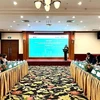
To have an insight into this issue, a seminar was held by the Government’s portal on September 6 to look into the quality of the FDI inflow into Vietnam.
FDI like “an oasis”
At the event, Chairman of the Vietnam Chamber of Commerce and Industry (VCCI) Vu Tien Loc voiced his complete support for Resolution 50, saying that to attract FDI capital effectively, the quality of both domestic and foreign investment needs to be improved.
He pointed out the fact that the ratio of FDI capital to population in Vietnam ranks second in the region, only following Singapore, but its quality remains modest as the effectiveness of FDI has yet to be on par with the volume of such capital flowing into the economy, or meet expectations in technology transfer or connectivity with domestic businesses.
Without selective FDI attraction, it will be impossible to achieve the connection target and even make domestic private firms be dwarfed by this sector, he noted.
[Much needs to be done to attract new-generation FDI capital]
Loc added the FDI sector accounts for more than 50 percent of the processing – manufacturing companies and over 70 percent of the total exports. However, joint ventures make up only one-fifth of all FDI firms. He quoted foreign businesses as saying that they purchase 28 percent of goods necessary for their activities from the domestic market, but they do not have many local partners, the main suppliers for them are FDI companies.
The FDI sector is currently like “an oasis” and hasn’t “taken root deeply” in the economy. Therefore, when there are vagaries, this capital flow may be diverted from Vietnam, Loc warned.
Disguised investment on the rise
Apart from certain achievements, the Politburo also pointed out loopholes in FDI attraction. It said in its resolution that the number of small-scale, low-technology and labour-intensive projects is still large while transfer pricing and disguised investment are increasingly complicated and on the rise. Besides, some businesses and projects have used natural resources wastefully, or violated policies and laws on labour, salary, tax, social insurance and environment.
Deputy Minister of Planning and Investment Vu Dai Thang said of the 350 billion USD of registered FDI capital, 180 billion USD has been channeled into the economy, and the remainder hasn’t been implemented.
He attributed this fact partly to fake projects, especially in real estate, noting that many projects registered a big amount of capital but have very low disbursement.
“Pull-and-push” solutions
Resolution 50 targets that in the 2021 – 2025 period, newly registered capital will reach 30 billion – 40 billion USD and implemented capital will stand at 20 billion – 30 billion USD each year on average. The respective figures for the 2026 – 2030 period are aimed at 40 billion – 50 billion USD and 30 billion – 40 billion USD.
Additionally, the rate of FDI firms applying advanced technology, modern governance and environmental protection technology is hoped to grow 50 percent in 2025 and 100 percent in 2030 compared to 2018. The rate of locally-made components in products is also set to be raised from 20 – 25 percent at present to 30 percent in 2025 and 40 percent in 2030.
To that end, the resolution specified a number of solutions that Deputy Minister Thang described as “pull-and-push” solutions that can address the abovementioned shortcomings.
Thang said a more comprehensive view is needed, instead of only looking at statistics and assuming that the FDI sector is dwarfing domestic businesses. It is necessary to have policies promoting local companies’ growth.
Therefore, aside from policies to facilitate foreign investors’ connectivity with domestic enterprises, Resolution 50 also includes several important stipulations binding FDI attraction and disbursement.
The official added Resolution 50 gives the FDI sector a status equal to other economic sectors’. The newly-registered and implemented capital targets for the following periods are closely linked with the economy. Under these targets, the FDI will fuel the development of other economic sectors./.