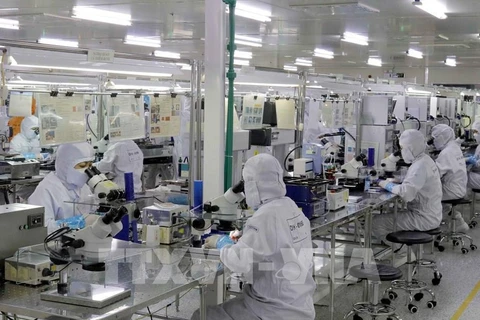
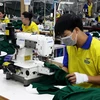
Workers at a factory of Samsung. The presence of Korean investors such as Samsung, LG, Hyosung, Hanwha, Huyndai, CJ, Lotte and Posco largely promoted the development of the part-supply industry in Vietnam. (Photo: VNA)
 The RoK has been by far the most important source of FDI to Vietnam and contributed greatly to accelerating the socio-economic development of the Southeast Asian country.
The latest figures of the Ministry of Planning and Investment (MPI) showed that the cumulative registered FDI from the RoK in the period from 1988 – when the first Law on Foreign Investment of Vietnam was put in force - to September 2022 amounted to more than 80.5 billion USD with more than 9,400 valid projects, making the RoK the biggest investor in Vietnam so far.
Starting to invest in Vietnam in 1990s, the RoK quickly became a major investor in the Southeast Asia country, especially after the two countries established the strategic cooperative partnership in 2009.
Since the Vietnam – Korea Free Trade Agreement (VKFTA) officially came into effect in 2015, the RoK’s registered FDI into Vietnam almost doubled.
The milestone was marked in 2014 when the RoK became the largest investor in Vietnam with a total registered capital of 7.32 billion USD. Statistics of the Ministry of Planning and Investment showed that the registered FDI from the RoK hit a record of 8.49 billion USD in 2017 but slowed down to 7.2 billion USD in 2018 and 7.57 billion USD in 2019.
Due to the impacts of the COVID-19 pandemic, the FDI from the RoK dropped to 3.95 billion USD in 2020 but bounced back to 4.95 billion USD in 2021.
From January to September this year, the RoK registered to pour 3.8 billion USD worth of FDI in Vietnam, a slight drop of 2.38% against the same period last year.
Although ranking second in terms of registered FDI value in the January-September period after Singapore, the RoK was the partner with the highest number of investors who showed interest and made new investment decisions in Vietnam in the period, the ministry’s report revealed.
The RoK was increasingly becoming an important investor in Vietnam, not only because of its huge capital value but also because of the compatibility of the investment to Vietnam’s FDI attraction policies. The presence of Korean enterprises in most economic sectors in Vietnam was contributing significantly to the country’s economic restructuring, export growth and job creation.
According to the MPI's Foreign Investment Agency, the RoK’s investment was mainly poured into the processing and manufacturing industry (74% as of November 20, 2021) thanks to the heavy investment of high-profile investors such as Samsung, LG, Hyundai, and Posco, followed by the real estate business (13.1%) and construction (3.8%).
Research by Bui Thi Hong Ngoc and Doan Thi Thu Huong from the Vietnam Institute of Economics pointed out that the strong FDI inflow from the RoK helped Vietnam upgrade its participation in the global value chain as well as change the export structure. Vietnam’s export structure was shifting from large percentage of low added value products like agro-foresty-fishery and raw materials to products with high technology content and high added value such as electronics.
The presence of Korean investors such as Samsung, LG, Hyosung, Hanwha, Hyundai, CJ, Lotte and Posco promoted the development of the part-supply industry in Vietnam.
Notably, the network of local vendors to Samsung increased to 254 as of the end of 2021, 51 of which were tier-1 vendors, from just four in 2014.
Samsung, now the most high-profile Korean investor in Vietnam with an estimated investment of more than 20 billion USD, said that the group would continue to provide support to enable domestic enterprises to participate more in the global value chain.
It was estimated that there were more than 8,000 Korean enterprises operating in Vietnam which provided 1 million jobs domestically and contributed around 25-30% of Vietnam’s export revenue every year.
How to remain a FDI sweet spot to RoK
Vietnam has been arising as an attractive destination for FDI in the global production shift, thanks to its stable macro-economy and the Government’s drastic efforts to improve the investment climate.
The Vietnamese economy scale reached 370 billion USD in 2021, making it the fourth largest economy in Southeast Asia with income per capita of more than 3,700 USD. Vietnam signed 15 FTAs with more than 60 countries and territories, including the largest markets in the world, which helped diversify the markets, products and supply chains.
The General Statistics Office expected the Vietnamese economy to beat the target to reach a growth rate of around 7.5-8% this year, after strong post-pandemic growth of 8.83% recorded in the first nine months of this year.
The International Monetary Fund (IMF) on October 11 forecast the Vietnamese economy to expand at 7% this year, compared to 2.6% in 2021, as the country was benefiting from its growing importance in global supply chains.
The Vietnamese economy was a highlight in the region when the IMF’s growth forecasts for Asia and the Pacific were lowered to 4% this year, well below the 5.5% average over the last two decades, as inflation exceeded central bank targets in most countries.
The ASEAN 3 Macroeconomic Research Office (AMRO) in its 2022 Annual Consultation Report on Vietnam published on October 12 also predicted 7% growth for Vietnam in 2022 on the back of strong external demand, a recovery in domestic demand and strong FDI inflows.
AMRO’s previous studies suggested that strong FDI inflows were one of the key factors behind Vietnam’s economic transition to manufacturing, leading to stronger participation in global value chains over the years.
However, the annual export growth of Vietnam was driven by FDI companies and their import-export activities, which unfortunately implied that local companies did not participate in the global value chains as much. One of the reasons was that many local companies did not yet possess the skills and capabilities to produce the quality inputs required by multinational companies.
AMRO urged Vietnam to make further efforts to develop domestic supporting industries in the manufacturing value chains.
Pham Thanh Tung from the Ministry of Industry and Trade’s Agency of Industry said that it was important to enable more and more local companies to participate in the global value chains to maximise the benefits of the FDI inflows.
He pointed out that there were currently about 5,000 enterprises operating in the part-supply industry, 88% of which were of small and medium scale with limitations in production and technology capabilities.
A recent MPI's report to the Government revealed that the loose linkage between the FDI and local companies remained the biggest limitation in FDI attraction and use. The average local procurement remained low, at around 20-25%.
It’s a tough road for Vietnamese enterprises to participate and move up the global value chain ladder, Tran Thi Lan Anh, General Secretary of the Vietnam Chamber of Commerce and Industry said, stressing the important roles of the FDI inflows and the support in improving capacity for domestic partners from FDI companies.
Just support from FDI companies could not push the supporting industry, said Do Thi Thuy Huong from the Vietnam Electronic Industry Association, adding that the Government should raise policies to promote the development of the supporting industry. Local companies must also make efforts to improve their competitiveness, she said.
Yoon Chang Woo, President of Posco – Vietnam, said that Vietnam needed to develop an ecosystem for the part-supply industry in which local companies could produce high-quality and reasonably-priced spare parts and could upgrade their participation in the supply chains of FDI companies. Only through this, could Vietnam attract more FDI into industries with high added value.
In addition, it was important for Vietnam to enhance the quality of the labour force with a focus on well-trained technical talents in order to attract quality FDI, including from the RoK, he stressed.
With a young population, Vietnam held great potential to become a powerhouse of skilled workers which would help attract more sophisticated FDI.
He said that a number of Korean firms were looking to promote investment into Vietnam, urging more efforts from the Vietnamese Government to continue to push on with its economic reforms and improve the investment climate.
The global trends such as zero emission and digitalisation which were promoted strongly in Vietnam would also help attract quality FDI into the country, Yoon stressed.
At the dialogue with the RoK’s Ambassador Park Noh-wan and representatives of Korean associations and enterprises in Hanoi in late July, Prime Minister Pham Minh Chinh pledged to create more favourable conditions for foreign investors in general and the Korean business community in particular, to invest efficiently, successfully and sustainably in Vietnam, with a focus on administrative reforms.
Vietnam expected to receive more investment from the RoK in the fields of high technology, innovation, research and development, digital technology, renewable energy, electronics and infrastructure development, PM Chinh said.
The PM expressed his hope that the FDI inflow from the RoK would help integrate local firms into the global supply chain network while promoting the development of a digital economy, green economy, circular economy and sustainable development of Vietnam./.
VNA