Firms reject clean production initiative

Many businesses have refused to join a clean production and energy efficiency project because they don’t find attractive enough incentives, experts said at a conference on June 15.
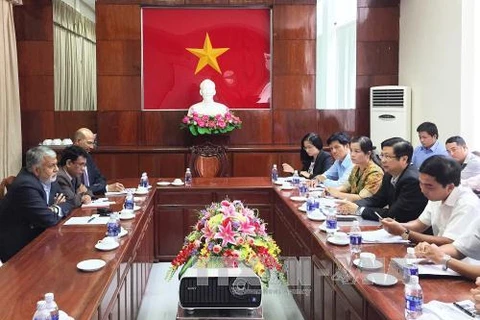
Firms reject clean production initiative ảnh 1The conference to review the CPEE on June 15 (Photo: VNA)

Hanoi (VNA) - Manybusinesses have refused to join a clean production and energy efficiencyproject because they don’t find attractive enough incentives, experts said at aconference on June 15.

The conference was held to review implementation of the five-year Vietnam CleanProduction and Energy Efficiency Project (CPEE) that closed this month.

“To encourage firms and to reach a more ambitious goal, more attractiveincentives are needed,” Nguyen Dinh Hiep, vice chairman of the Vietnam EnergyConservation and Energy Efficiency Association, said at the conference.

The World Bank-funded CPEE project aimed to strengthen capacity for effectivedelivery of the national energy efficiency programme in key industrial sectors.This would improve energy efficiency and reduce associated greenhouse gasemissions.

The project had set goal of improving energy efficiency to more than 360,000TOEs (tonnes oil equivalent) and reducing greenhouse gas emissions by 1.25million TCO2 (tonnes carbon dioxide equivalent) by 2017.

“However, only 70 percent of the goals have been met,” said a representativefrom the Department of Science, Technology and Energy Efficiency under theMinistry of Industry and Trade.

The department estimated that the project would help save 249,000 TOEs ofenergy and reduce emissions by 933,000 TCO2 this year.

To date, about 89 percent of the project’s investment has been disbursed, anddisbursement of the remaining funds would continue, officials said, withoutelaborating.

The World Bank estimates that Vietnam can effect energy savings of 11 percentwith proper investment in energy consumption.

Experts also said that Vietnam needs more policies that encourage firms to saveenergy and promote energy efficiency in the long term.-VNA
VNA

See more

A passenger poses for a photo besides a Vietjet aircraft (Photo: VNA)

Vietjet leads Southeast Asia in emissions efficiency

Under comparable operating conditions, Vietjet’s leading position highlights its ability to optimise performance across its entire operational chain, including aircraft configuration, route network design and load management.

Containers loaded at Cai Mep International Terminal (Photo: VNA)

Vietnam ranks 18th among world’s top exporters in 2025

Vietnam’s exports reached about 470 billion USD for the first time last year, up more than 16% year on year, with a trade surplus of over 20 billion USD, contributing significantly to maintaining macroeconomic stability.

Experts speak at the workshop (Photo: VNA)

Vietnam’s pet care market emerges as lucrative investment opportunity

​ Across the Asia-Pacific, 60% of respondents own pets, while Vietnam’s pet ownership rate stands at 79%, among the highest in the region. Notably, 55% of Vietnamese pet owners have two or more pets, signalling that pet ownership has evolved from a hobby into a modern lifestyle choice.

A view of the workshop on the application of AI and real-world data in food product research and development held in Ho Chi Minh City on April 22. (Photo: VNA)

AI emerges as key driver for Vietnam’s F&B sector breakthrough

Businesses start with projects that deliver quick results within six to 12 months, like quality control systems, demand forecasting, or customer service chatbots. In the long run, F&B companies are advised to move toward with AI-driven operating models to keep up with fast-changing market demands.

Trucks carrying imports enter Vietnam through Lao Cai International Border Gate. (Photo: VNA)

Smart border gates power growth in northern border provinces

With a borderline of about 182 km, Lao Cai aims to turn its border gate economic zone into a key growth engine by adopting a smart border gate model, viewing this as a breakthrough measure for improving management efficiency, reducing logistics expenses, and enhancing customs clearance capacity.

Ken Chau (right), Chairman of the Vietnam Canada Business Association, presents flowers to the organising committee of the Vietnamese Entrepreneurs Awards in Canada 2026 at the event. (Photo: Award organising board)

Vietnamese awards in Canada spotlight community strength

The gala brought together nearly 200 participants, including community leaders, entrepreneurs and guests from across the country, highlighting both the achievements of Vietnamese businesses and the community’s growing role in the socio-economic fabric of Vancouver and other Canadian cities.

Passenger numbers are expected to peak at the start of each break, particularly from the afternoon of April 24 to April 25, with a return wave on April 27 following the Hung Kings Commemoration Day. (Photo: VNA)

Transport sector ramps up capacity for holiday travel surge

Transport experts said the back-to-back holidays will create travel patterns different from previous years. While some people are expected to combine the two breaks into a longer holiday, others will travel during either period depending on personal plans. Passenger flows are therefore likely to be more evenly distributed, helping ease pressure on transport systems.

A worker at the factory of the TNG Investment and Trading Joint Stock Company in the Song Cong I Industrial Park, Thai Nguyen province. (Photo: VNA)

Imports accelerate, powering exports, public revenues

Previous years show that Vietnam typically runs a trade deficit in the first quarter before shifting to a surplus in the latter half of the year. The current deficit, therefore, is considered both normal and indicative of an economy “recharging” for growth.

Vietnamese Minister of Construction Tran Hong Minh and Korean Minister of Land, Infrastructure and Transport Kim Yun-duk hold talks on April 21 in Hanoi. (Photo: The Courtesy of the Ministry of Construction)

Vietnam, RoK step up cooperation in transport infrastructure

Minh noted that in transport, the RoK is currently Vietnam’s second-largest bilateral donor. Since 1996, the Korean Government has provided significant capital for Vietnam’s transport infrastructure, with nine projects completed to date, totalling over 1 billion USD, and six others underway worth nearly 600 million USD.