Renewables – key to green development in Mekong Delta

Renewable energy is seen as a sustainable choice for the Mekong Delta region to respond to environmental challenges, given that the country’s rice and fisheries granary has lost up to 300 million USD to prolonged drought and extreme salt intrusion.

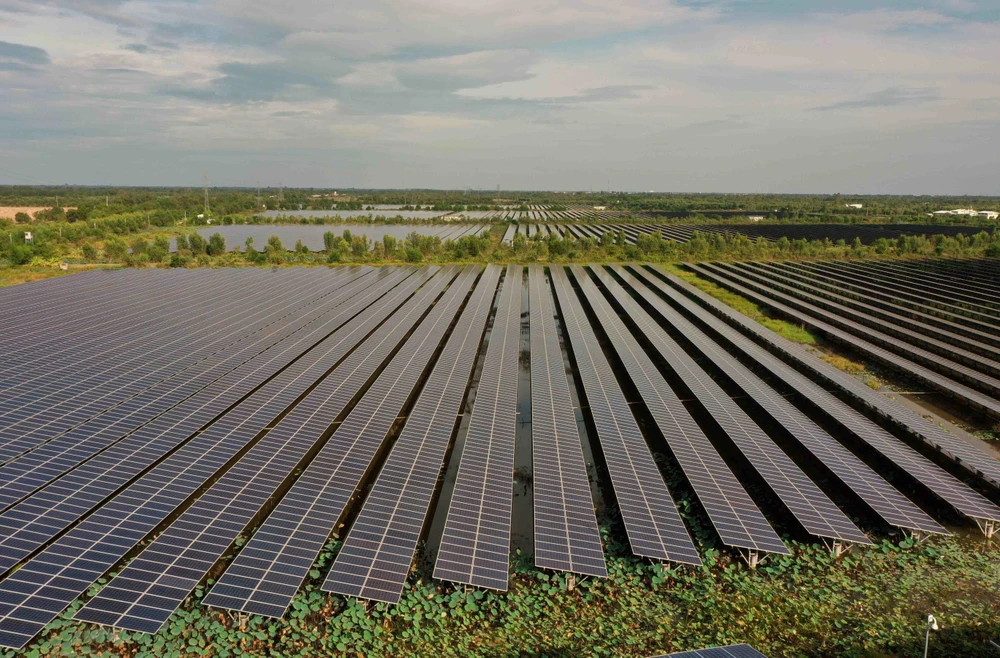
At the Europlast solar power plant in Long An province (Photo: VNA)

Can Tho (VNA) – Renewable energy is seen as a sustainable choice for the Mekong Delta region to respond to environmental challenges, given that the country’s rice and fisheries granary has lost up to 300 million USD to prolonged drought and extreme salt intrusion.

According to the annual Mekong Delta Economic Report 2022 conducted by the Vietnam Chamber of Commerce and Industry (VCCI)’s branch in Can Tho, the region boasts huge potential for development of renewable energy, especially wind, solar and biomass power.

Meanwhile, the national renewable energy development planning until 2035 estimated that more than 68,600 MW of wind power and 31,500MW of solar power could be generated in the region.

VCCI experts suggested the Mekong Delta capitalise on its potential and the nation’s priority for renewable energy development to shift to new renewables, helping bolster the local economy, reduce carbon footprints, and lessen dependence on imported materials.

With an ambitious target of turning the region into an energy hub, many localities have proposed various projects to the National Power Development Plan VIII.

Having no renewable energy projects yet, Kien Giang is studying 15 solar energy projects with total capacity of 2,427MWp, 12 of which, with a combined capacity of 1,715 MWp, have been proposed to the Ministry of Industry and Trade.

vna_potal_78_nam_cach_mang_thang_tam_va_quoc_khanh_2-9_1945_-_2023_moc_son_choi_loi_trong_lich_su_dan_toc_viet_nam_6883800.jpg
A wind farm in the Mekong Delta region (Photo: VNA)

Deputy Director of the provincial Agriculture Extension Centre Le Van Dung said that solar energy has advantages over fossil fuels as it helps reduce environmental pollution, and establishes a better breeding environment that ensures stable production for farmers.

Meanwhile, Director of the Department of Industry and Trade of Hau Giang Province Nguyen Quoc Toan said the locality has 129-MW solar power, 4,670-MW wind power and 96-MW biomass power.

He recommended development of renewable energy projects to competent authorities, and gave opinions to complete the plan to carry out the National Power Development Plan VIII during 2021-2030 with a vision to 2050.

Since power demand is expected to increase sharply until 2050, VCCI experts said Mekong Delta localities need to update, build forecasts, evaluate potential of the electricity projects, and pen long-term plans to create favourable conditions for development of the supply chain and support industry to increase production value.

Besides, they should work to attract international partners, enterprises and skilled workers so as to take full advantage of the use of renewables, they said.

According to Dr. Nguyen Anh Tuan, former Director of the renewable energy centre under the Ministry of Industry and Trade’s Institute of Energy, Vietnam has installed a total power capacity of 80,704 MW, ranking second in ASEAN and 23rd worldwide, of which 20.5% is from solar energy.

Solar power, given its cheap price, should be prioritised for development. However, such challenges as high investment costs, a lack of suitable infrastructure, and instability of the energy source due to weather conditions should be handled when developing solar power.

He suggested the Government provide concessional loans for investors to encourage the development of the energy./.
VNA

See more

Illustrative image (Photo: VNA)

Australia announces import conditions for Vietnamese pomelos

Australia’s formal publication provides an important legal basis, marking the completion of the review, assessment and agreement on technical requirements for fresh Vietnamese pomelos. This represents a significant step forward in market access, creating favourable conditions for relevant agencies, localities and businesses to prepare for export activities in the coming time.

Containers of fresh Vietnamese durian for export are subject to a full-chain traceability system. (Photo: VNA)

First “green lane” durian shipment exported to China

​Under the “green lane” process, quality control begins at the cultivation stage, including soil sampling and monitoring, and continues through harvesting and processing, with traceability labels attached to trees and applied to fruit at the time of picking. It also allows plant quarantine procedures and the issuance of certificates of origin (C/O) directly in the localities where the orchards are located.

Delegates at the Vietnam Expo 2026 (Photo: VNA)

Vietnam pushes for deeper auto supply chain ties with RoK

The RoK stood as Vietnam’s largest foreign investor with more than 95.2 billion USD in registered capital as of February 2026, or about 18% of all foreign cash flowing in, with thousands of active projects. In January-February alone, the RoK led the pack with nearly 2 billion USD in pledges, grabbing a whopping 32.7% of total registered capital and showing no signs of slowing down.

More than 600 tourism firms, 15 countries and territories, and 34 provinces and cities are promoting destinations and introducing tourism products at the fair (Photo: VNA)

Digital transformation key to elevating Vietnam’s tourism: official

Speaking at the opening of the Vietnam International Travel Mart (VITM) 2026 in Hanoi on April 10, Deputy Minister of Culture, Sports and Tourism Ho An Phong noted that despite challenges in 2025, Vietnam largely fulfilled its socio-economic development goals. Tourism remained a bright spot, recording 21.5 million foreign arrivals and 135.5 million domestic visitors, with total revenue exceeding 1 quadrillion VND (37.9 billion USD).

A drone sprays fertiliser over rice fields. (Photo: VNA)

Low-altitude economy emerges as new growth driver for Vietnam

The UAV technology is particularly effective in addressing challenges faced by ground infrastructure, especially in densely populated urban areas and remote regions. Smart aerial devices also enable real-time data collection, improving governance, decision-making and digital transformation across industries.

Passengers at Cat Bi Airport in Hai Phong city (Photo: VNA)

Aviation sector ensures fuel supply for April 30–May 1 peak

Aviation fuel suppliers are actively negotiating and diversifying supply sources both domestically and internationally, while strengthening coordination, storage and distribution capacity to meet immediate demand. These efforts aim to support airlines in optimising operations and maintaining stable flight schedules.

A session at the Vietnam–Australia Green Transition Forum 2026. (Photo: VNA)

Green transition offers opportunities for stronger Vietnam–Australia cooperation

Under the theme "Accelerating decarbonisation in agriculture and manufacturing – Unlocking trade and investment opportunities", the forum gathered nearly 200 researchers, experts and businesses involved in policy development, investment, research and innovation. Participants exchanged insights and explored ways to translate the cooperation potential between Vietnam and Australia into practical business opportunities.