Flowers and ornamental plants are Hanoi’s key agriculture products

Flowers and ornamental plants not only protect the ecological environment but also help increase people's incomes, speed up the development of new style rural areas and urban development in Hanoi.
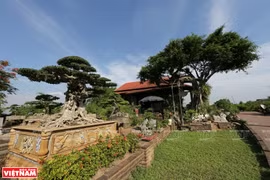
Flowers and ornamental plants are Hanoi’s key agriculture products ảnh 1Growing flowers and ornamental plants helps Hong Van commune in Thuong Tin district become more liveable. (Photo courtesy of Hanoi’s Department of Agriculture and Rural Development)
Hanoi (VNS/VNA) - Flowers and ornamental plants not only protect theecological environment but also help increase people's incomes, speed up thedevelopment of new style rural areas and urban development in Hanoi.

For the last ten years, under the new style rural area building programme, Hanoi’srural look has changed remarkably with improved infrastructure for bothproduction and people’s daily life.

The incomes of people living in rural areas have also increased.

Particularly, in many rural areas across the city, the environmental landscapehas been significantly improved with flower beds, tree-lined streets andmurals, which help make the countryside more attractive and create tourismdestinations for people to visit and enjoy.

In order to develop the rural economy, besides developing crops and livestockto serve the daily needs of people, Hanoi also gave priority to flowers andornamental plants as key agriculture products.

The city also paid more attention to boosting the linkage between productionand consumption, offering support policies.

 As a result, flowers and ornamentalplant growing areas in Hanoi increased sharply from 5,484ha in 2015 to 7,960hain 2020.

It has recognised 11 traditional craft villages of flowers and ornamentalplants including the Co Giao village; Xam Xuyen village and Noi Thon village inThuong Tin district; Ha Loi, Lieu Tri, Dai Bai villages in Me Linh district; PhuDong village in Gia Lam district, Tay Tuu flower village in Bac Tu Liem district,kumquat growing village in Tam Xa commune of Dong Anh District, Nhat Tan flowervillage and Tu Lien kumquat village in Tay Ho district.

Until now, 70 per cent of flower and ornamental plant growing areas in Hanoiare in districts of Bac Tu Liem, Me Linh, Tay Ho, Dan Phuong and Thuong Tin.

With improved quality of seeds, farming technique and advanced technologies forwater, light and temperature, growers could earn on average 0.5-1.5 billion VNDper hectare per year. Many farming models could generate 1.3-2.2 billion VND perhectare per year.

Nguyen Van Chi, head of Hanoi Rural Development Division, said that under thecity’s programme to increase the effectiveness of the new style rural areabuilding programme and agricultural restructuring in the 2021-2025 period, thetotal areas for flowers and ornamental plants are expected to increase by8,500-9,000ha.

The city also planned to plant more trees along streets and roads to ensure8-10sq.m of green space for each person.

Chi said that flower and ornamental plant growing villages would also offerfarming tourism experiences.

Chi added that in the future, the city would work with the Ministry ofAgriculture and Rural Development and other localities to review and introduce supportpolicies for flowers and ornamental plants.

The city asked relevant agencies and districts to make plans and arrangeresources to boost its flower and ornamental plants industry.

“Flowers and ornamental plants would be key products to boost local economicdevelopment, improve the environment and speed up the implementation of the newstyle rural area building programme,” Chi said.

Flower and ornamental plants growers’ associations are called on to coordinatewith State management agencies to evaluate the price of ornamental flowers,develop planting area codes, origin traceability, and establish a digital mapof ornamental flowers which would help increase information transparency,Government management and supervision.

Associations, branches and artisans recommend local State management units inthe development strategy of the flower and ornamental plant industry; materialsfor vocational training and encourage good artisans and managers to offertraining as well as share experiences./.
VNA


See more

An official of the Bank for Social Policies in Lao Cai province guides local women in using the mobile application. (Photo: VNA)

Efforts made to create value from digital environment

As digital services become more accessible and public feedback is increasingly heard, Vietnamese citizens are expected to move from simply benefiting from digital transformation to actively contributing to the development of a prosperous digital nation, where people's happiness and satisfaction remain the ultimate measures of success.

The Viet Youth Readiness Hub of the Canada Vietnam Council for Culture & Education (CVCEC) during a Vietnamese language lesson for Vietnamese-Canadian children in Toronto, Canada. (Photo: VNA)

Vietnamese culture connects generations in Canada

Beyond language skills, children learn about Vietnamese history, stories of filial devotion and national heroes, and the importance of respecting parents and teachers. Weekend classes begin with the national anthem, while festivals and traditional holidays offer opportunities to make greeting cards, prepare traditional cakes and learn to wrap 'banh chung' (square sticky rice cakes).

Delegates and local residents explore the themed exhibition “Coastal and Island Archaeology in Ho Chi Minh City: New Discoveries in 2020–2025”. (Photo: VNA)

Archaeological exhibition showcases 300 artefacts in Ho Chi Minh City

The exhibition presents 150 artefacts and 150 documentary photographs collected through archaeological surveys, field investigations and excavations over the past five years. The items were unearthed at notable sites including Cu Bi, Quang Thanh, Go Nan, Kim Long, Go Dat Nai, Giong Lon, Con Dao and Vong Thanh Da Trang. The findings have helped researchers shed light on traces of ancient settlements, craft workshops, distinctive burial practices, as well as ancient citadels and trading ports.

A TTU–VWAI representative hands the National Steering Committee 515 delegation several sets of dossiers on martyrs’ burial sites and artefacts that TTU–VWAI experts collected and studied during joint work to search for, recover and identify Vietnamese martyrs’ remains. (Photo: VNA)

Vietnam, US step up cooperation in search for fallen soldiers’ remains

Ambassador Nguyen Quoc Dung pressed partners to adopt four strategic tracks: a two-way verification process, standardised and professionalised outputs, breakthrough use of digital technology and AI, and maximum diplomatic patronage and resources, all aimed at converting documentary research into field investigation capacity.

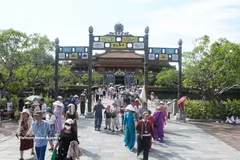
Visitors tour the Hue Imperial Citadel. (Photo: VNA)

Hue cuts heritage site entrance fees to attract more tourists

Under the first scheme, visitors using new tourist transport services to Hue will receive a 50% discount on entrance fees. Eligible services include the Hue – Phong Nha heritage railway, the Hue – Da Nang heritage steam train, and new domestic and international air routes, including charter and scheduled flights. The incentive does not cover existing air routes with increased flight frequencies.

Screenshot of the article. (PhotoVNA)

Chilean media spotlight Vietnam’s growing global role

Chilean newspaper El Clarín recently published an interview with Vietnamese Ambassador to Chile Nguyen Viet Cuong, highlighting Vietnam’s foreign policy of independence and self-reliance and international integration, its contributions to regional cooperation, and prospects for bilateral ties as the two countries mark the 55th anniversary of diplomatic relations.

The exchange of a Memorandum of Understanding (MoU) on academic cooperation between the Vietnamese Consulate General in Khon Kaen and College of Asian Scholars. (Photo: VNA published)

Vietnam Studies Centre opens in northeastern Thailand

The centre would serve as a valuable academic hub for teaching and promoting Vietnamese language, culture and history, while fostering people-to-people exchanges and connecting younger generations of the two countries.

Fishing boats enter and leave Quy Nhon port (Photo: VNA)

Gia Lai tightens controls over vessels to combat IUU fishing

Inspections by an inter-sectoral working group identified weaknesses in managing ineligible fishing vessels, controlling vessels entering and leaving ports, seafood traceability, handling violations and implementing support policies for decommissioned vessels, according to the committee.

Construction site for the Ben Thanh - Tham Luong metro project on Cach Mang Thang Tam street (Photo: VNA)

Ho Chi Minh City plans five TOD areas along Metro Line No. 2

According to the Ho Chi Minh City Department of Planning and Architecture, the boundaries of the five TOD areas along Metro Line No. 2 (Ben Thanh – Tham Luong) have been approved, covering a total area of approximately 939 ha. The city is now drawing up plans for these areas.

Russian and CIS tourist groups visit the central city of Da Nang in 2026. (Photo: VNA)

Vietnam gains popularity among Russian tourists

Vietnam recorded the fastest growth in Russian tourist arrivals among mass-tourism destinations in the first nine months of 2026, according to data from the Association of Tour Operators of Russia (ATOR) and Russia’s Federal Security Service (FSB).

The 24th Asian Maritime and Fisheries Universities Forum takes place in Hai Phong city. (Photo: VNA)

Leading Asian maritime universities gather for Hai Phong forum

Vietnam needs engineers, seafarers, experts and managers who can adopt and develop advanced technologies for the maritime industry and future marine economy. That is why Vietnam attaches special importance to international cooperation in education, training and research.