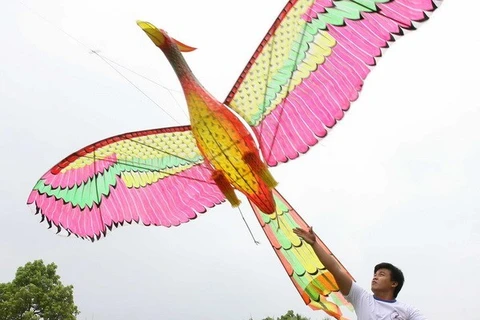
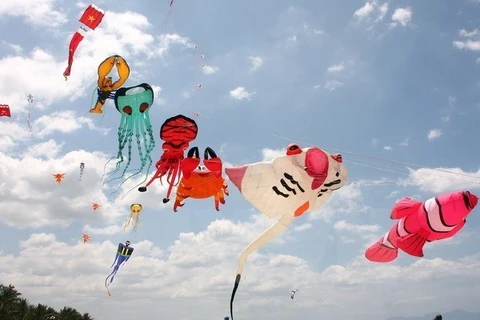
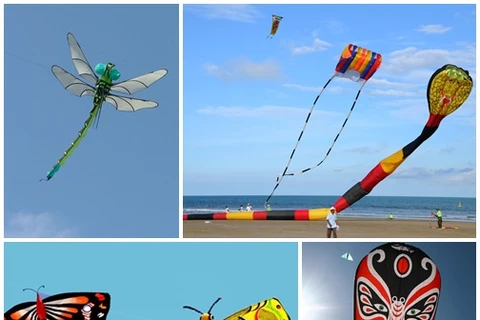
Illustrative image (Source: VNA)
Hanoi (VNA/VNS) - Over decades, the image of kites flying over immense rice fields have provided inspiration for many Vietnamese artists and musicians.
Visiting Song An Commune, Vu Thu District in the rural northern province of Thai Binh in summer time, no one can resist the picturesque landscape of boundless green rice fields, scenic grass dykes alongside the flowing river, and flute kites – looking like giant rice seeds – flying above it all, sounding bass melodies.
Although flute kites can be seen in some other regions in the North such as Hai Phong and Nam Dinh, those of Thai Binh seem the most famous as they originate from the 15th century.
In the old days, creating a kite required many complicated steps. Local people had to crush green persimmons for the resin to make the kites water-proof. To make durable kite strings, they had to split bamboo into strips before boiling and soaking them in baked-limestone water to resist white ants.
The kite should measure at least 1.8m to be able to carry a flute made of bamboo and jackfruit wood, which is lighter than other kinds of wood.
“While a single flute kite produces only bass tones, a multiple flute kite can create various tones like an orchestra,” said Nguyen Duy Dong, deputy head of the newly-founded Song An Commune’s Sao Den Flute Kite Club.
Nowadays, instead of paper, bamboo and wood, kite flyers are using more durable materials such as cloth, plastic (for kite wings), carbon fibre (for frames), and bronze and aluminium (for flutes).
The commune is also home to the Sao (Flute) Temple – a national historic and cultural site, which hosts the Sao Temple Kite Festival annually.
According to Vu Van Chinh, keeper of the Sao Temple, it was built in 1471 to worship Queen Mother Ngo Thi Ngoc Giao of King Le Thanh Tong (1442-1497) and the three meritorious brothers and officials Dinh Le, Dinh Bo and Dinh Liet, who made great contributions to the establishment of the Earlier Le Dynasty.
Every year, on the death anniversaries of those figures, descendants of Dinh Le, who was also a great general of the Le Dynasty, commemorate his merit by flying kites. Legend has it that Gen Dinh Le used to encourage his soldiers to fly kites to combat the fatigue and tiredness of battle.
Despite fierce wars or economic depressions following the end of wars, the festival has still been organised every year because the local residents want it to remain a lasting tradition of their ancestors. For them, like the imperative need of rice and water, flying flute kites are an essential part of their life.
Visitors to the Sao Temple can see a 400-year-old flute kite hanging right up above the solemn main altar – evidence that the locals regard the kite as a significant spiritual source.
The 10-day festival, which is held from the 18th to the 28th day of the third lunar month, draws dozens of flute kite fliers and thousands of visitors from neighbouring areas.
Alongside a parade of the Queen Mother’s palanquin, the festival also features several contests or folk games such as cock fighting, swimming to catch ducks, and walking on a slender bamboo trunk supported by ropes over a pond, challenging competitors to keep their balance.
The flute kite competition is the most anticipated event of the festival with tens of kite flyers from the region participating.
Every year, the competition challenges all contestants to fly their kites through a narrow space between two 10m pillars topped by two sharp hooks. This is one of the most difficult challenges for any kite flyer.
If the competitors can’t master their skills enough to let their kite string get through the pillars without touching the obstacles, they are failed.
According to kite flyer Dong, who is also a member of the organisation board, some years the competition has no winner.
Preserving a tradition
The festival is not only to honour a tradition of the region, but also to help preserve centuries-old games.
“To encourage young people to learn more about the games, the festival also includes a kite making contest for children aged between 10 and 15,” Đong said.
Furthermore, a club gathering tens of flute kite flyers of all ages in Song An Commune was founded on July 24. Although the club members have different professions, including a photographer, farmers and an electrician, all share the common hobby of kite flying.
Called by other club members as the “prize conqueror”, herbalist Hoang Gia Khanh has brought his DIY flute kites to compete often and has won several competitions nationwide. Certificates of merit and trophies can be seen on all the walls of his living room.
Khanh fell in love with flying flute kites at the age of 16, and has since shared his time between his two life goals: his herbal medicine career and his kite hobby.
For him, the most important factor of a good kite is the quality of the bamboo frame.
“The frame should be made from old bamboo plants. We never use bamboo grown by a river, lake or pond, because the water can soften the bamboo’s texture. It’s ideal to chop the bamboo during the dry season in the eight or ninth lunar month because the texture is more durable during that time,” revealed the 36-year-old herbalist.
With so many requirements, Khanh sometimes has to travel tens of kilometres to find quality bamboo.
To prevent termites, he places the bamboo on a smoking-shelf over the stove for about six months until the bamboo is completely dried. That is when the bamboo can be used to make the kite frame.
Dinh Minh Anh, a 49-year-old farmer, is head of the Sao Temple Flute Kite Club. He owns a collection of 30 large kites and 30 sets of flutes.
Like herbalist Khanh, Anh also travels to another province to buy suitable materials.
“I often load my small van with enough bamboo and jackfruit wood to use for the whole year,” he said.
Anh now is producing a seven-metre kite, which can carry an ancient one-metre bamboo flute.
For him, flying flute kites is not only his passion but somehow also his responsibility to preserve the tradition of his homeland.
His passion for flute kites has been transmitted to his teenager daughter, who is a grade 10 student.
At the age of 88, villager Nguyen Thanh Tu can no longer fly his kites due to his health, especially his poor vision, however, his special interest seems to have been passed onto his son Nguyen Van Toan.
Despite moving to HCM City almost 20 years ago, Toan comes back to his home village regularly to team up with his childhood friends and fly flute kites once again.-VNA