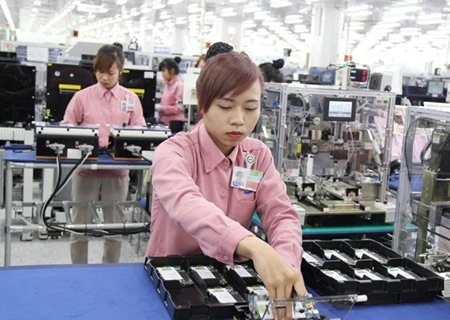
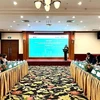
Traders and producers gather at a part supply technology fair in Hanoi. (Photo: VNA)
 Hanoi (VNA) – Industries thriving due to free trade agreements (FTAs) should seek foreign investment to develop domestic suppliers of parts or materials for manufacturing, experts said.
Ho Thi Kim Thoa, Deputy Minister of Industry and Trade, said those industries include garment, textile, and leather and footwear. The FTAs will create many opportunities and conditions in developing markets, as well as challenges due to origin rules for textiles and garments.
To deal with these challenges, industries should seek foreign investment to take advantage of the FTAs, she urged.
Meanwhile, Phan Chi Dung, Deputy Head of the Light Industry Department, said the textile, garment, leather, footwear, milk and paper industries have seen large billings for their exports, but materials for their production have been mainly imported.
For instance, Vietnam's manufacturers need 8 million sq.m of cloth, but local producers can only provide 1.8 million sq.m, while the remaining cloth must be imported, according to the Ministry of Industry and Trade. The local market supplies only 1 percent of the domestic demand for cotton, while 99 percent of cotton used in homes must be imported.
Vietnamese enterprises lack investment and technology to develop the textile industry, so they need foreign investment.
The leather and footwear industry gained a year-on-year increase of 15 percent in its export value in 2015, to 14.9 billion USD, but the industry still struggles with low supplies of leather for the local market. They currently import 70 percent of the needed leather.
Some foreign enterprises have developed leather suppliers in Vietnam. But these suppliers have had just enough material for their parent companies, the ministry said.
The leather tanning industry is often responsible for high levels of environmental pollution. So the provinces remain hesitant to grant investment licences for leather tanning projects.
The dairy industry also imports 85-90 percent of materials needed for dairy production, the ministry said. Therefore, those industries need to call on foreign investment for developing suppliers for their industries.
However, there are still many difficulties for foreign investors in working in Vietnam's market, according to Vietnam's trade counselors.
Le Phu Cuong, a Vietnamese trade counselor in Turkey, said Vietnam and Turkey had great potential for cooperation in the textile, garment, leather and footwear industries.
Large industrial companies in Turkey have promoted investment in the garment and textile industry in foreign countries. Further, Turkish enterprises have planned to move their production from China to Vietnam due to high production costs in China and available materials in Vietnam, according to Cuong.
But they have not had many projects in Vietnam, due to difficulties in getting Vietnam visas and the lack of information about local markets, the investment environment, incentives and commercial mechanisms for Turkish enterprises.
They have also been worried about competition with Korean, Japanese and Taiwanese enterprises in Vietnam. Therefore, Vietnam's trade office and industries should promote information about projects, the investment environment and industrial zones for Turkish enterprises through exhibitions and seminars.
Nguyen Duy Phu, Vietnam's trade counselor in Taiwan, said Taiwanese enterprises would promote investment in the textile and garment industries in Vietnam to take advantage of FTAs, and especially the Trans Pacific Partnership (TPP). But there were difficulties in obtaining locations for new projects because provinces are worried about environmental pollution.
"Vietnam needs special regions for investment to develop parts suppliers for the textile and garment industry, so the nation can control environmental pollution from such projects", he said.
Meanwhile, Deputy Minister of Industry and Trade Ho Thi Kim Thoa said the ministry had built the Pho Noi Industrial Zone in Hung Yen province and Rang Dong Textile and Garment Industrial Zone in Nam Dinh province to attract foreign investors.
The ministry plans to establish two other industrial zones in Dong Nai and Binh Duong provinces. Those industrial zones will offer incentives for foreign parts suppliers in the textile, garment, leather and footwear industries.-VNA