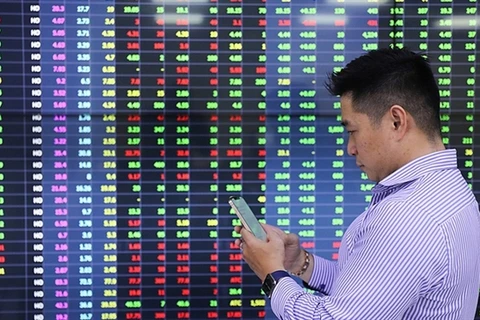
Hanoi (VNS/VNA) - Foreign investors have been strongly net selling on the domestic stock market, focusing on many blue-chip stocks, putting pressure on the market's sentiment. However, this net selling and capital withdrawal by foreign investors is not yet a worrying trend.
Last month, the Ho Chi Minh Stock Exchange (HOSE) recorded a net selling value of nearly 17 trillion VND (668.7 million USD) by foreign investors. In the first half of 2024, the net selling value reached approximately 52 trillion VND, double the value for 2022.
Out of 20 sessions in June, foreigners were net sellers in 19, with the strongest session on June 11 recording over 1.8 trillion VND in net sales. The only net buying was on June 5, at nearly 39 billion VND.
On average in the first half of 2024, foreign investors net sold 300-400 billion VND per session, not worrying compared to overall market trading.
According to Bui Hoang Hai, Vice Chairman of the State Securities Commission (SSC), foreign ownership is around 16% of total market cap, among the highest in Southeast Asia. The withdrawal has occurred in other markets too, including China, Indonesia and Thailand, due to high US rates and currency depreciations.
The Vietnamese stock market saw an increase of around 10% in the first six months of 2024, but has relatively high valuations compared to the regional markets. As a result, some foreign investors have been taking short-term profits by selling.
The data shows that the net selling value of foreign investors does not match the total value of stocks that have risen in price. This is because investment funds focused on emerging markets need to maintain their targeted allocation to the Vietnamese market. When the market value increases, these funds will sell shares in order to rebalance their portfolio weightings.
Additionally, some foreign funds may be approaching the end of their investment periods and are liquidating their positions.
Hai said this pattern of net selling and capital withdrawal by foreign investors was not a concerning phenomenon.
Looking at the broader regional context, the Japanese stock market also experienced net foreign outflows of around 37 trillion VND in June. Similarly, most Southeast Asian markets have seen continued investment capital withdrawals.
In contrast, foreign capital has been flowing into markets like Taiwan (China), India and the Republic of Korea. A large amount of money, nearly 54.4 billion USD, was invested into US-based ETF funds in just the week from June 16-21, with equity funds attracting over 46 billion USD - the largest net inflow since the start of the second quarter.
According to Nguyen Duc Chi, Deputy Minister of Finance, the most important foundations supporting the stock market are the macroeconomic conditions and the overall stability of the economy.
Despite the global difficulties and volatility, Vietnam’s economy has remained stable in recent years and the business activities of listed companies have been well-maintained. The market also has the prospect of being upgraded to a higher status soon.
Chi explained that the adjustments and portfolio restructuring by some foreign investment funds were normal occurrences, driven by their own management approaches.
He noted that the investors who chose to withdraw might end up regretting it and end up returning with even more capital. He emphasised the importance of analysing the underlying causes of this phenomenon comprehensively, in order to avoid any undue impacts on the market.
In June, foreign investors were net buyers on the Hanoi Stock Exchange (HNX), marking the fourth consecutive month of net inflows there.
Though the net buying value on the HNX, around 75 billion VND, was relatively small compared to the trading volume on the HoSE, Chi did not see this as a concerning trend.
In 2021, foreign investors saw significant net selling, totalling over 56 trillion VND. However, as domestic investors' resources were activated and flowed strongly into the securities market, the market was able to absorb all of the foreign selling pressure and continued to rise.
The Vietnamese stock market had a very active trading year in 2021, setting new records in terms of both liquidity and index levels.
PYN Elite, one of the foreign funds that has found success in the Vietnamese market, shared a positive outlook based on the profit growth of listed companies and other factors that could further bolster investor sentiment.
According to Petri Deryng, head of PYN Elite Fund, the upcoming interest rate cuts in the US are expected to relieve some of the pressure on the Vietnamese dong, a factor that has previously had a negative impact on the stock market.
Moreover, the regulation requiring foreign institutional investors to deposit 100% of funds before making stock purchases may be lifted in the third quarter of this year. With interest rates anticipated to remain low, these developments could help drive continued economic growth.
PYN Elite's portfolio currently has a high allocation, around 48%, to bank stocks. The fund's net asset value has seen strong increases, partly due to an early increase in the proportion of technology stocks in the portfolio./.