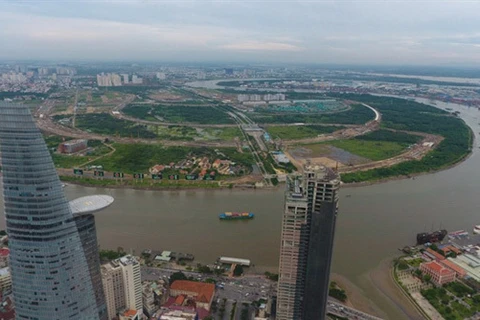
A corner of the central city of Da Nang. (Photo: VNA)
Hanoi (VNA) – Foreigners’ acquisition of land use rights in the names of Vietnamese nationals is a legal violation and is not protected by law, according to the Ministry of Natural Resources and Environment’s (MoNRE) General Department of Land Administration.
The General Department of Land Administration has discussed with the Ministry of National Defence’s relevant agencies on media reports on foreign acquisition of prime lands in the central city of Da Nang that affects national security and defence.
According to the agency, the government has adopted various policies over the last few years to attract foreign investment to Vietnam in the areas of industry, agriculture, real estate and services, among others.
Many foreign investors, such as Samsung and Lotte (the Republic of Korea), Toyota, Aeon Mall and Honda (Japan), Taxhong (China) and Vietnam – Singapore Industrial Park (VSIP) (Singapore), have created jobs for local workers, contributed to State budget revenue and boosted economic development.
Keeping in mind that socio-economic development must be allied with protection of national security and defence, the government has also ordered the MoNRE and people’s committees of cities and provinces to regularly review and inspect foreign-invested projects with land lease contracts starting before 2013, when the Land Law took effect, in order to punish violators, it said.
It also noted that the MoNRE has set up a working group to inspect land allocation, land lease and land use of foreign individuals and organisations in Da Nang. It found that the V.N. Holiday Trading Travel & Service had illegally transferred the land use rights of multiple lots zoned for residential use along the Nuoc Man Airbase to a foreign-invested company.
 Illustrative photo. (Source: VNA)
According to the 2014 Housing Law, these lots are not subject to be used by the foreign-invested company as it had not been licensed for real estate trading.
The department also pointed out that the Da Nang People’s Committee has yet to ask for opinions from defence, security and foreign affair agencies before use rights of the prime lands were acquired and leased in line with the law.
The MoNRE has reported the issue to the Prime Minister and requested the municipal People’s Committee to handle violations in acquisition of the land lots, it added.
A representative from the General Department of Land Administration emphasised that the people’s committees at all levels must prevent foreigners from obtaining land use right certificates in the names of Vietnamese nationals.
He cited Article 5 of the 2013 Land Law as saying land users need to have land-use rights recognised by the State or receive a transfer of land use rights, including foreign organisations on diplomatic missions, overseas Vietnamese as prescribed by the nationality law, and foreign-invested enterprises, and Vietnamese companies that foreign investors purchase shares of, merge into or acquire in accordance with investment law.
So foreign individuals can neither have ownership of land nor rent land lots in Vietnam, he said, adding that they also cannot obtain land use right certificates.
Foreign-invested businesses can rent the land for a specific time which does not last for more than 50 years to implement their projects.
The law allows the foreign-invested businesses to transfer capital in the form of land use right value, but the companies have to complete the procedure of transferring land-use rights in accordance with the law.
The Ministry of National Defance said it has suggested the government direct ministries, departments and localities to review the evaluation of foreign investment projects, especially those related to China in border and coastal areas of strategic importance for national defence and security.
The review should enable related agencies to detect shortcomings and loopholes to make the required adjustments to the Law on Investment and the Land Law, it added.
Vietnam allows foreigners to buy property except for land, but not more than 30 percent of a residential quarter or an apartment project, as long as the project is not located in areas deemed vital to national security./.