Forum talks future of retail banking in Industry 4.0

The trend of cashless payment and digitalisation in personal banking services is generating major opportunities and challenges to banks, especially amid Industry 4.0, according to a 2017 report on banking services compiled by IDG Vietnam Co. Ltd.
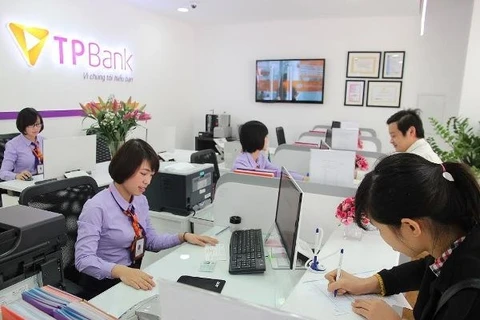
Forum talks future of retail banking in Industry 4.0 ảnh 1The Retail Banking Forum takes place in Hanoi on December 6 (Photo: thanhnien.vn)

Hanoi (VNA) – The trend of cashless payment anddigitalisation in personal banking services is generating major opportunitiesand challenges to banks, especially amid Industry 4.0, according to a 2017report on banking services compiled by IDG Vietnam Co. Ltd.

The information was highlighted at the RetailBanking Forum in Hanoi on December 6. The forum on the future of retail bankingand payment services in the Industry 4.0 era was part of a series of workshopsand events on smart city building.

The report said e-banking is increasinglypopular in Vietnam with the rate of e-banking users reaching 81 percent atpresent, compared to only 21 percent in 2015. Financial technology (fintech)solutions are also gaining greater preference due to their convenience andmodern security solutions.

The trend of cashless payment and digitalisationin personal banking services is also opening up a market for IT firms inVietnam to provide software products serving the finance-banking sector.

Ha Huy Tuan, Vice Chairman of the NationalFinancial Supervisory Commission, said Industry 4.0 with the appearance of anarray of breakthrough technologies like Internet of Things, robotictechnologies, artificial intelligence, automation, cloud computing, and bigdata is strongly changing many sectors and fields.

In the service industry, many new businessmodels have appeared such as Uber and Grab (transport), Traveloka and Airbnb(tourism, hotel room booking), Alibaba and Amazon (e-commerce), Atombank andFidor bank (digital banks without branches), he noted.

These technologies will help change the economyin general and the finance-banking sector in particular, Tuan said, adding thatcustomers tend to use more and more new digital technologies and have higherrequirements for banking services.

Financial experts said there remain manyshortcomings in e-banking solutions in Vietnam such as high transaction fees,frequent interface errors, and limited customer services.

At the forum, participants discussed and sharedinformation about new models in financial activities, new banking solutions,and digital infrastructure for the financial system. They also looked intocustomer data management, financial management in the use of big data, the useof artificial intelligence to calculate banking products and customer segments,personal information security, and the development of retail bankingservices.-VNA
VNA

See more

Vietnam is strengthening its position in the technology value chain, becoming a major manufacturing hub for complete consumer electronics products. (Photo: VNA)

ESG standards offer opportunities to reposition Vietnam’s electronics firms

The 2025-2027 period will be a critical turning point, as exporters to the European market will be required to strictly comply with ESG standards, including net-zero emissions roadmaps, labour standards, corporate governance and transparency requirements. As a key export sector, the electronics industry is being directly and strongly affected by this shift.

A production line for camera modules and electronic components at the factory of MCNEX VINA Co. Ltd, a Republic of Korean-invested company in Phuc Son Industrial Park, Ninh Binh province. (Photo: VNA)

Science, technology, innovation as engines of economic growth

To ensure that science and technology truly act as a powerful growth engine, experts emphasised the need for the Government to put in place supportive mechanisms and policies that encourage enterprises to invest in research and development, while strengthening cooperation among the State, research institutions and the business sector.

The headquarters of the Ministry of Industry and Trade in Hanoi (Photo: VNA)

PM updates lead roles to drive UKVFTA forward

The Ministry of Industry and Trade (MoIT) is named the lead agency, with overall responsibility for the agreement’s general goals and definitions, trade remedies, non-tariff barriers to trade and investment in renewable energy, competition policies, State-owned enterprises, enterprises with special or exclusive rights and those with designated monopolies, as well as institutional, general and final terms.

Vietravel Airlines is taking measures to enhance service quality and optimise operations amid high travel demand during Tet. (Photo: VNA)

Vietravel Airlines to add new route serving Lunar New Year travel peak

During the peak period of the Lunar New Year (Tet) festival in 2026, Vietravel Airlines plans to operate six – eight flights daily on the Ho Chi Minh City – Hanoi route, three flights daily on the Ho Chi Minh City – Da Nang and Ho Chi Minh City – Vinh routes; and two flights daily on the Ho Chi Minh City – Quy Nhon route.

The completion of Can Tho - Ca Mau expressway has helped shorten travel time from Can Tho to Ca Mau to just one hour and a half (Photo: VNA)

Can Tho–Ca Mau expressway fully opens from January 19

The new section, together with the Can Tho–Hau Giang segment that has been operating smoothly since late December last year, has completed the entire 110.85-km route. With total investment exceeding 27.52 trillion VND (1.04 billion USD), the four-lane expressway is built to modern standards and serves as a key transport artery linking major economic and political centres, industrial zones and seaports in the southwestern region.