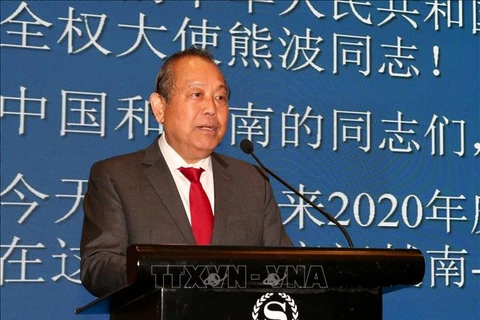
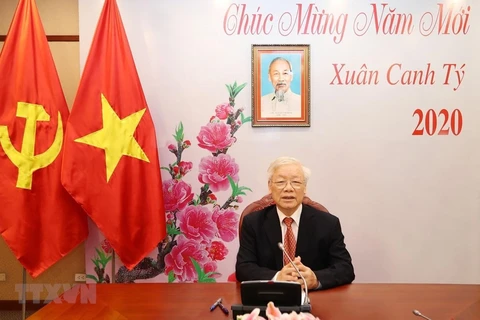
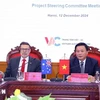
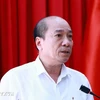
Deputy Prime Minister and Foreign Minister Pham Binh Minh (Photo: VNA)
 Hanoi (VNA) – Friendship and cooperation have been the mainstream of Vietnam-China relations over the past seven decades, Deputy Prime Minister and Foreign Minister Pham Binh Minh affirmed in his article on the occasion of the 70th anniversary of Vietnam-China diplomatic relationship.
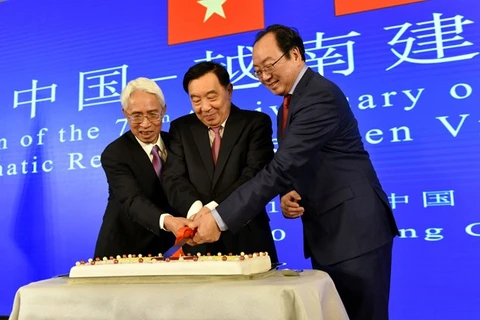
Minh, who is also head of the Vietnam sub-committee in the Vietnam-China Steering Committee for Bilateral Cooperation, said 2020 has an important meaning in the two countries’ traditional friendship as they celebrate the 70th founding anniversary of their diplomatic ties and look back at the neighbourly friendship built and nurtured by late Presidents Ho Chi Minh and Mao Zedong along with the two countries’ revolutionary predecessors.
According to the Deputy PM, January 18, 1950 went into the history of Vietnam-China relations as an important milestone. Not long after its establishment, the People’s Republic of China became the first country in the world to set up diplomatic ties with the Democratic Republic of Vietnam (now the Socialist Republic of Vietnam).
During the 70-year course of development, the Parties, States and people of the two countries have stood side by side and given each other great and valuable support and assistance, contributing to the success of the respective revolutionary causes of national liberation and socialist building.
Over the past seven decades, the relations between Vietnam and China have experienced ups and downs, but the friendship and cooperation remain the mainstream, Minh wrote, adding that the amity built and nurtured by late Presidents Ho Chi Minh and Mao Zedong and generations of leaders of the two nations has become common valuable asset that helps maintain the trend of stable development of bilateral traditional ties and benefit both peoples.
Particularly, since the normalisation of relations in 1991, Vietnam and China have deepened rapports in all fields from politics and economy to culture, security and defence. High-level exchanges and meetings between the two Parties and States have been regularly maintained in diverse forms. The two countries’ leaders have reached many important common perceptions, which contribute to the reinforcement and enhancement of political trust and comprehensive cooperation in all arenas, as well as serve as the long-term strategic direction for the healthy and stable development of bilateral relations, Minh said.
He added that the two sides have agreed to develop bilateral relations under the motto “friendly neighbourliness, comprehensive cooperation, long-term stability, and looking forward to the future” (set in 1999) and in the spirit of “good neighbours, good friends, good comrades, and good partners” (set in 20050.
In 2008, Vietnam and China entered into a comprehensive strategic cooperative partnership. This is the highest level of cooperation framework in Vietnam’s relations with countries in the world, and China was also the first country to build this framework with Vietnam.
With joint efforts, the bilateral comprehensive strategic cooperative partnership has maintained stable development and achieved new progresses over the past years.
So far, Vietnam and China have set up nearly 60 mechanisms of exchange and cooperation from central to local levels in almost all fields, according to the Deputy PM and FM.
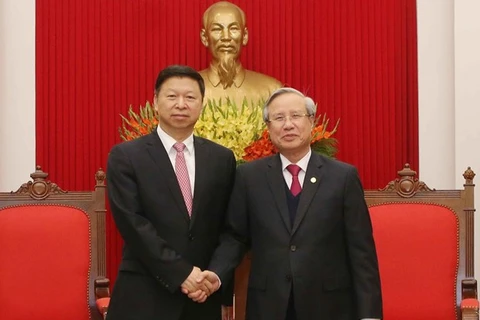
The two Parties’ cooperation has been strengthened, contributing to building trust between the two countries. The two sides have maintained regular delegation exchange in personnel training and Party building; organised high-level meetings and theoretical workshops for experience sharing in Party building, State management, reforms and international integration; and signed and effectively implemented cooperation agreements between the two Parties.
Vietnam’s National Assembly and China’s National People’s Congress, the Vietnam Fatherland Front and the Chinese People’s Political Consultative Conference, and ministries and sectors of the two countries have constantly expanded their exchange and cooperation. To date, Vietnam and China have successfully held 11 meetings of the Steering Committee for Bilateral Cooperation, along with other activities such as border defense friendship exchanges, strategic security dialogues and defence strategy dialogues. The two nations have maintained mutual visits by naval ships; conducted joint patrols on land and the Gulf of Tonkin and joint fishery inspection; and held young officer exchanges.
The two sides have also seen dynamic cooperation among their localities and Chinese cities and provinces, which have produced practical benefits for both sides. Nearly 50 Vietnamese cities and provinces have set up friendly ties with those in China with exchange events held frequently. Most notable events include spring meetings of Party Secretaries of four Vietnamese provinces – Quang Ninh, Lang Son, Cao Bang and Ha Giang – and China’s Guangxi as well as of the joint working committee of those five localities; conferences reviewing cooperation between Vietnamese ministries, sectors and localities and China’s Guangdong; the joint working group between Vietnam’s Ha Giang, Lao Cai, Lai Chau, Dien Bien and China’s Yunnan; economic corridor cooperation between Vietnam’s Hanoi, Lao Cai, Hai Phong and Quang Ninh and China’s Yunnan. During the meetings, the two sides have discussed ways to enhance mutual understanding and trust, bolster substantive ties in all areas, remove barriers and together build a border of peace, friendship and stability which plays a vital role in developing the Vietnam-China comprehensive strategic partnership in a stable and healthy manner.
Exchanges between mass organisations have been expanded to strengthen trust and mutually beneficial cooperation and create a solid basis for bilateral relations. The two countries have jointly organised many cultural events, for example people’s rorum, people’s friendship festival, border people’s festival and youth friendship meeting.
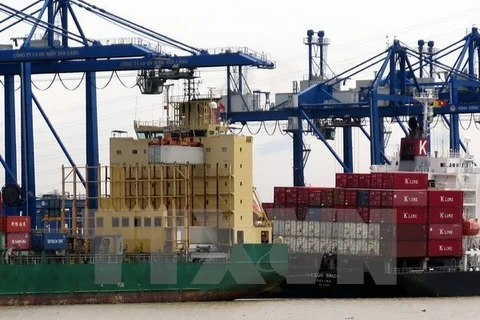
Bilateral ties in economics, trade, investment, science-technology, culture, education and tourism have also seen significant progress. In November 2017, Vietnam and China signed a memorandum of understanding on promoting connectivity between the “Two Corridors, One Belt” initiative and the “Belt and Road Initiative.” Since 2004, China has remained Vietnam’s largest trade partner. Today, China is Vietnam’s biggest import market and second largest export market, while Vietnam is China’s biggest trade partner in ASEAN and the 8th largest trade partner in general. Two-way trade hit 106.7 billion USD in 2018, 3,300 times higher than that of 1991. In the first 11 months of last year, the bilateral trade totalled 105.75 billion USD, a year-on-year increase of 8.71 percent. As of the end of last November, China was the seventh biggest foreign investor in Vietnam with 2,739 FDI projects, worth 16.1 billion USD in total. China has provided Vietnam with long-term soft credit packages and non-refundable financial aid to support the latter’s socio-economic development. About five million Chinese tourists visit Vietnam annually.
Currently, there are 11,000 Vietnamese students pursuing study at Chinese universities while some 2,000 Chinese nationals are studying in Vietnam.
Under agreements and common perceptions reached by the two countries’ leaders, outstanding problems in bilateral ties have been step by step solved. The two countries signed a wide range of important documents that create the prerequisite to build the Vietnam – China borderline of peace, stability and development, contributing to enhancing the traditional relations as well as cooperation between the two sides. The agreements include the Land Border Treaty (signed in 1999), the agreements on maritime boundary delimitation and on fishery cooperation in the Gulf of Tonkin (2000), and three documents on land border management (2009).
At present, disagreements and different perception remain between the two countries on the sea issue. High-ranking leaders of the two Parties and countries have reached many important common perceptions on controlling disputes and maintaining peace and stability in the East Sea. The two sides signed an agreement on basic principles guiding the settlement of sea-related issues in 2011 while establishing and maintaining a governmental-level negotiation mechanism on borderline and territory, meetings between deputy foreign ministers, and three negotiation mechanisms of expert-level working groups on the area off the mouth of the Tonkin Gulf, cooperation in less sensitive sea-related areas, and cooperation for common development at sea.
Regarding developments in the East Sea recently, Vietnam persistently protects its legitimate rights, while patiently pursuing dialogues to handle differences.
Valuable experiences during the negotiations on the land borderline and delimitation of the Tonkin Gulf, together with the agreement on basic principles guiding the settlement of sea-related issues and common perception between leaders will create the prerequisite and trust for the two sides to continue talking to seek measures to step by step settle the East Sea issue in a peaceful manner on the basis of the two countries’
long-lasting friendship, respect for legitimate rights and interests of each other, and in accordance with international law, particularly the UN Convention of the Law of the Sea 1982 (UNCLOS 1982) and the Declaration on the Conduct of Parties in the East Sea (DOC) between ASEAN and China.
In conclusion, Deputy PM and FM Minh affirmed that the achievements in the Vietnam – China relations in the past seven decades are valuable assets of both peoples. This year, the two countries will join hands to organise a multitude of celebration activities, which Minh said are expected to create a new driving force for bilateral relations.
He expressed the hope that 2020 will mark a new period of development of the relations between the two Parties, States and peoples./.
VNA