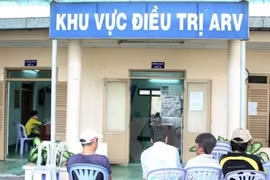
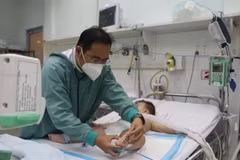
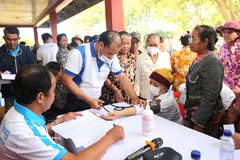
Patients wait for medical checks at the Central Children Hospital. (Source: VNA)
Hanoi (VNA) - Two senior officials have pledged that national healthcare and social insurance funding will not run out, but cautioned that appropriate reforms and adjustments were needed.
Bui Sy Loi, Vice Chairman of the National Assembly Committee on Social Affairs, and Pham Luong Son, Deputy General Director of Vietnam’s Social Insurance Organisation (SIO), delivered the promise at a seminar on “Solutions for effective management of Healthcare and Social Insurance Funds” on October 12.
However, Loi said that if the current situation is not remedied, one cannot rule out the possibility of social insurance and healthcare funds going insolvent by 2019 and 2037.
The current healthcare contribution required of each card-holder is 4.5 percent of basic salary, but this could be increased to the permitted ceiling of 6 percent. This additional revenue would help balance the budget, Loi said.
Son said that SIO has implemented a number of administrative reform measures and will review procedures further in order to cut out more superfluous steps and improve connectivity between relevant agencies.
The number of inspections will be increased and IT applications in management boosted in order to prevent fraud and abuse, the two officials said.
The conference heard that a medical data and healthcare information assessment portal will open nationwide on January 1, 2017, based on a pilot project launched in Hanoi.
Starting next year, medical facilities across the country will be required to join the portal and share their data, which would include the patients’ medical history, records of all check-up sessions, as well as prescriptions and invoices.
Concerns that the SIO’s exclusive control over spending could lead to a lack of transparency were misguided for the most part, Loi said at the conference.
He said the SIO was not monopolising the fund. Its function was to implement the Government’s policies and social insurance regimes, and to manage insurance funds as prescribed by law.
The Social Insurance Management Council – which comprises of representatives from various ministries and authorities – is the agency tasked with directing and managing the activities, including decisions on investment. The council will also propose adjustments to social insurance regimes, Loi said.
He encouraged the public to get involved by reporting suspected abuse and fraud to the authorities. They should also manage efficiently the individual social insurance card that will be issued soon, he said.
In the first half of 2016, 80 percent of the population had healthcare coverage, exceeding the Government’s set target.
However, this period posted a deficit of 8.5 trillion VND (381 million USD), with total expenditure surpassing last year’s same period by 40 percent.
Son listed a number of reasons for this deficit. He said the number of people enrolling healthcare regimes had increased by 12 percent, accounting for additional 2.9 trillion VND in expenditure.
Implementing the Ministry of Health’s Circular No 37/2015/TTLT-BYT-BTC on adjusting medical service fees also resulted in an expenditure of 3.2 trillion VND, he said.
Circular 37 aims to gradually end Government subsidies for hospitals.
Installing transfer mechanisms for patients from central-level to provincial or district-level hospitals in order to reduce overload on the former had also resulted in additional 1.4 trillion VND.
The rest of the deficit (approximate 1 trillion VND) is due to an unusual hike in inpatient care and doubtable drugs prescriptions.
Healthcare insurance abuse has taken place in both private and public medical facilities, the conference heard. It referred to reports in multiple media outlets which said some people have taken advantage of loopholes to have medical examinations and get prescribed drugs multiple times a day for free. These drugs were sold at lower prices or even used to feed cattle.
Son said that such abuse accounted for 1-3 percent of the increase in expenditure.
Both officials called for increased awareness of the social impacts of healthcare fraud.-VNA