Government cracks down on imports of used machinery

Vietnam has banned imports of used machinery, equipment and production line technology aged more than 10-years-old.
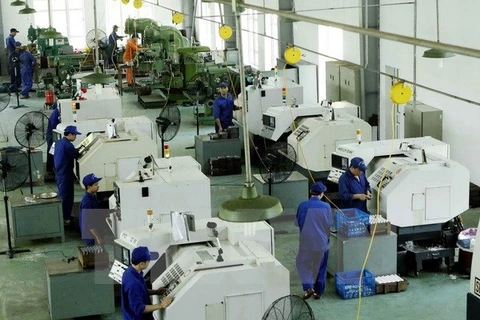
Government cracks down on imports of used machinery ảnh 1Illustrative photo (Source: VNA)

Hanoi (VNA)
- Vietnam has banned imports of used machinery, equipmentand production line technology aged more than 10-years-old.

The age limitation was regulated in a new Governmental decision – DecisionNo18/2019/QD-TTg – on the import of used machinery, equipment and productionline technology.

The decision was signed by Deputy Prime Minister Trinh Dinh Dung and will takeeffect from June 15, 2019, replacing regulations in circular No 23/2015/TT–BKHCN issued by the Ministry of Science and Technology in 2015.

The ban aims to stop outdated, poor quality, polluting and unsafe usedmachinery, equipment and production line technology being used in the country.

Only used machinery, equipment and production line technology directly servingproduction in Vietnam will be imported to the country.

In addition, they must be manufactured in accordance with a National TechnicalRegulation (QCVN) or Vietnam’s Standard (TCVN) or Standards of G7 countries andthe Republic of Korea with regard to safety, energy saving and environmentalprotection.

The imported used production line technology must have capacity of at least 85 percentof their designed capacity and energy. Their consumption of materials, fuel andenergy can't exceed 15 percent of designed consumption.

The Ministry of Science and Technology will be responsible for announcing thelists of used machinery, equipment and production line technology that othercountries have banned.–VNA
VNA

See more

A working session at the job fair (Photo: VNA)

Vietnamese students flock to Seoul Job Fair 2026

The second annual Job Fair 2026 was held for Vietnamese students in the Republic of Korea. Organisers pitched it as a straight-up bridge between eager students and bosses hungry for young talent who can actually handle multicultural workplaces.

Defendants at the court (Photo: VNA)

Ho Chi Minh City court opens trial over Agribank lending scandal

The investigation revealed that multiple credit files were incomplete or riddled with inaccurate information, while some pledged assets lacked proper legal standing yet were accepted and grossly overvalued. As a result, the loans became high-risk and largely unrecoverable, leading to losses surpassing 1 trillion VND.

Hanoi introduces 53 electric buses from April 18 (Photo: VNA)

Hanoi to add 53 electric buses from April 18

According to the plan, all buses operating within Ring Road 1 will use green energy by July 1, 2026. The requirement will expand to Ring Road 2 by January 1, 2028, and to Ring Road 3 by 2030.

Illustrative image (Photo: VNA)

National, local traffic safety committees to be dissolved from June 1

Under the dicision, ministries and ministerial-level agencies will assume responsibility for tasks previously performed by the committee, in line with their mandates under the Law on Government Organisation, the Law on Road Traffic Order and Safety, the Law on Roads and other relevant legal frameworks, ensuring that traffic safety and order are maintained without disrupiton.

Visitors explore technology showcases at the exhibition held during the Da Nang Startup and Innovation Festival (SURF 2025). (Photo: VNA)

About 10,000 students expected at National Startup Day 2026

This year marks the rollout of the “Student Startup Support Programme for 2026 – 2035”, approved under Decision No. 336/QD-TTg, which places emphasis on practical outcomes, real products, real testing, real partnerships, and measurable impact.

Hong Quang High School pilots teaching mathematics in English starting from the 2025–2026 academic year. (Photo: VNA)

National foreign language proficiency framework issued

The circular establishes a unified benchmark for foreign language proficiency across the national education system, providing a foundation for curriculum design, teaching, testing, assessment, and certification. It is expected to help learners better map out their language development pathways while enabling educational institutions to improve training quality and strengthen articulation between different levels of education.