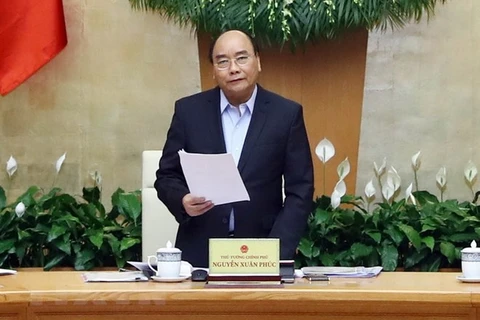
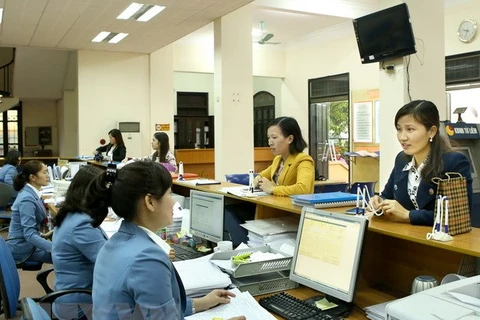
Clients at the State Treasury in Nam Tu Liem district, Hanoi (Photo: VNA)
 Hanoi (VNA) - The Government on January 1 issued a resolution setting targets for improving the business environment and national competitiveness for 2019 through to 2021.
The resolution, No 02/NQ-CP, replaced Resolution 19 which has been implemented for five years. The renumbering of the resolution demonstrated the Government’s priority in fostering the quality of Vietnam’s business environment.
The objective of the resolution is to improve Vietnam’s positions in international rankings on business environment tracked by the World Bank (WB), World Economic Forum (WEF), World Intellectual Property Organisations (WIPO) and United Nations (UN). This has great importance given the rapid development of the Industry 4.0.
Vietnam has set targets to improve its rankings by up to seven positions in the WB’s Doing Business Index in 2019 and 15-20 places by 2021; 3-5 positions in the WEF’s Global Competitiveness in 2019 and 5-10 places by 2021; and 2-3 spots in the WIPO’s Global Innovation in 2019 and 5-7 places by 2021.
The country’s rankings in the WB’s Logistics Performance, WEF’s Tourism Competitiveness and UN’s E-Government Index would be increased by 5-10 places this year and 10-15 grades by 2020.
In addition, Vietnam is targeting to be among ASEAN 4 with the best business environment by 2021.
To ensure the success, the Government requests a stronger commitment and responsibility of assigned ministries in supervising the implementation of solutions to improve the overall rankings and component indices tracked by international organisations.
Five ministries are assigned for this task including Ministry of Planning and Investment (MPI), Ministry of Science and Technology, Ministry of Industry and Trade, Ministry of Culture, Sports and Tourism and Ministry of Information and Communications.
Improving the business environment will focus on four key priorities, including simplifying procedures; continuing reforms in specialised inspections and connecting the National Single Window Portal; promoting electronic payment and providing e-public services at level four (highest level); and developing innovation ecosystems and supporting startups.
Regarding the first task on simplifying procedures for doing business, the Government has requested ministries and ministerial-level agencies to continue reviewing and submitting to the Government the plans for abolishing and simplifying unclear and unnecessary business conditions before 2019’s third quarter.
The ministries also need to speed up the drafting of the relevant laws under revision and submit it to the Government for submission to the National Assembly; thoroughly implement the approved plan for removing business obstacles; and fully publicise the business conditions that has been eliminated and simplified in 2018.
For reforms in specialised inspections, the State agencies have to follow the principles of risk management based on evaluation and analysis of corporate compliance and volumes of goods, shifting to post-inspection, mainly at the stage of goods circulation in the domestic market; increasing transparency in the list of goods subject to specialised inspection with clear HS codes; and applying online service at the highest level.
In the first quarter, the ministries must fully announce on their websites the list of goods which are no longer under specialist inspection (along with HS code). Before June, the authorities must complete the review and reduce 50 percent of the goods subject to specialised inspection and publicise this list.
This year, specialised inspection procedures should be carried out by one single focal point for a product or goods.
In the resolution, the Government also emphasised the task of promoting electronic payment and providing online public services following which at least 30 percent of public services should be done online at the highest level and allow people and businesses to make cashless payments.
State agencies must develop innovative ecosystems, encourage and support creative startups. This policy will put enterprises at the centre, strengthen the role of universities in research and development, and promote the establishment of private research institutes, especially in the field of science and technology.
Leaders of the provinces have to monitor and direct provincial departments to properly implement this policy and handle the staff and agencies who fail to comply with the new regulations.
The Ministry of Planning and Investment and Ministry of Finance preside and assess the performance and actual impact of the reforms on the sectors and enterprises in 2018 and report to the Prime Minister and Government in June this year.-VNA
The resolution, No 02/NQ-CP, replaced Resolution 19 which has been implemented for five years. The renumbering of the resolution demonstrated the Government’s priority in fostering the quality of Vietnam’s business environment.
The objective of the resolution is to improve Vietnam’s positions in international rankings on business environment tracked by the World Bank (WB), World Economic Forum (WEF), World Intellectual Property Organisations (WIPO) and United Nations (UN). This has great importance given the rapid development of the Industry 4.0.
Vietnam has set targets to improve its rankings by up to seven positions in the WB’s Doing Business Index in 2019 and 15-20 places by 2021; 3-5 positions in the WEF’s Global Competitiveness in 2019 and 5-10 places by 2021; and 2-3 spots in the WIPO’s Global Innovation in 2019 and 5-7 places by 2021.
The country’s rankings in the WB’s Logistics Performance, WEF’s Tourism Competitiveness and UN’s E-Government Index would be increased by 5-10 places this year and 10-15 grades by 2020.
In addition, Vietnam is targeting to be among ASEAN 4 with the best business environment by 2021.
To ensure the success, the Government requests a stronger commitment and responsibility of assigned ministries in supervising the implementation of solutions to improve the overall rankings and component indices tracked by international organisations.
Five ministries are assigned for this task including Ministry of Planning and Investment (MPI), Ministry of Science and Technology, Ministry of Industry and Trade, Ministry of Culture, Sports and Tourism and Ministry of Information and Communications.
Improving the business environment will focus on four key priorities, including simplifying procedures; continuing reforms in specialised inspections and connecting the National Single Window Portal; promoting electronic payment and providing e-public services at level four (highest level); and developing innovation ecosystems and supporting startups.
Regarding the first task on simplifying procedures for doing business, the Government has requested ministries and ministerial-level agencies to continue reviewing and submitting to the Government the plans for abolishing and simplifying unclear and unnecessary business conditions before 2019’s third quarter.
The ministries also need to speed up the drafting of the relevant laws under revision and submit it to the Government for submission to the National Assembly; thoroughly implement the approved plan for removing business obstacles; and fully publicise the business conditions that has been eliminated and simplified in 2018.
For reforms in specialised inspections, the State agencies have to follow the principles of risk management based on evaluation and analysis of corporate compliance and volumes of goods, shifting to post-inspection, mainly at the stage of goods circulation in the domestic market; increasing transparency in the list of goods subject to specialised inspection with clear HS codes; and applying online service at the highest level.
In the first quarter, the ministries must fully announce on their websites the list of goods which are no longer under specialist inspection (along with HS code). Before June, the authorities must complete the review and reduce 50 percent of the goods subject to specialised inspection and publicise this list.
This year, specialised inspection procedures should be carried out by one single focal point for a product or goods.
In the resolution, the Government also emphasised the task of promoting electronic payment and providing online public services following which at least 30 percent of public services should be done online at the highest level and allow people and businesses to make cashless payments.
State agencies must develop innovative ecosystems, encourage and support creative startups. This policy will put enterprises at the centre, strengthen the role of universities in research and development, and promote the establishment of private research institutes, especially in the field of science and technology.
Leaders of the provinces have to monitor and direct provincial departments to properly implement this policy and handle the staff and agencies who fail to comply with the new regulations.
The Ministry of Planning and Investment and Ministry of Finance preside and assess the performance and actual impact of the reforms on the sectors and enterprises in 2018 and report to the Prime Minister and Government in June this year.-VNA
VNA