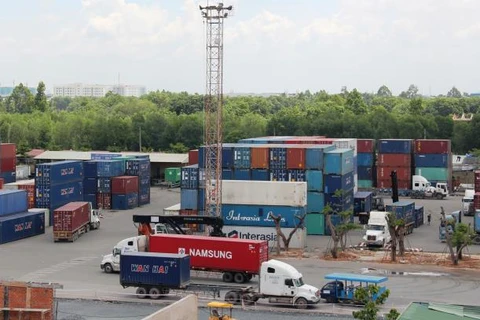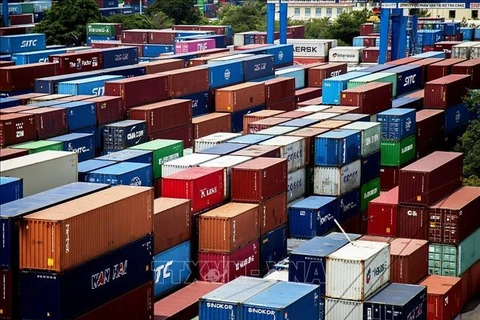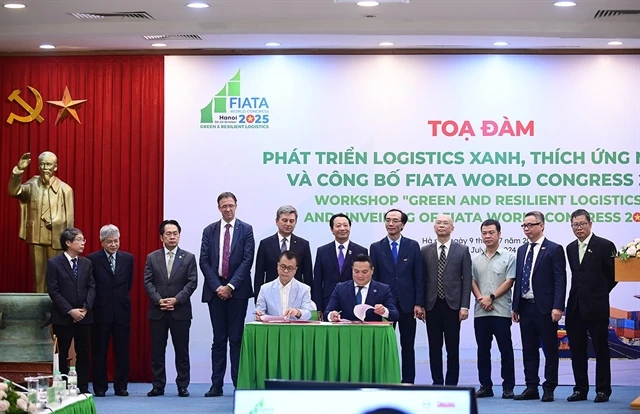
Hanoi (VNS/VNA) - Green logistics development is no longer a trend, it is an inevitable requirement with activities throughout the stage of purchasing raw materials, production, distribution, delivery, waste treatment - throughout the entire business life cycle.
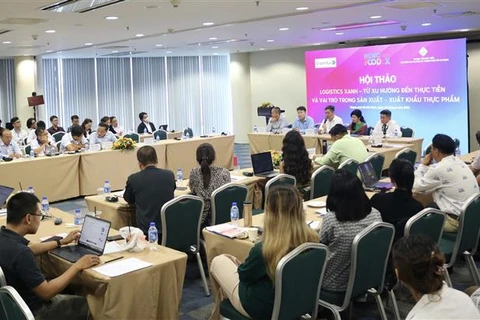
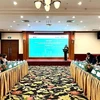
Nguyen Quang Vinh, Vice Chairman of Vietnam Chamber of Commerce and Industry (VCCI) stressed its importance at a workshop entitled 'green and resilient logistics and unveiling of FIATA world congress 2025' held in Hanoi on July 9.
Green growth and sustainable development have become indispensable and irreversible imperatives, representing a prevailing global trend in the current era.
The National Strategy on Green Growth for the period 2021-30, with a vision extending to 2050, aims to green economic sectors by fostering economic restructuring, promoting innovative growth models and ensuring environmental sustainability and social equity.
To implement this strategy, the Prime Minister issued Decision No 882/QD-TTg, approving the National Action Plan on Green Growth for 2021-30, which designates logistics services as one of its 18 key focus areas.
According to the Vietnam Business Council for Sustainable Development (VBCSD), the international business community is increasingly focused on transforming supply chains and value chains towards greater sustainability, considering it a top priority.
Green supply chain management encompasses the management of various facets such as green design, green production, green operations, green purchasing, green logistics and waste management.
“When all these elements are green businesses can enhance their production efficiency and operational capabilities, thereby establishing a sustainable ecosystem around their operations. This, in turn, can create competitive advantages and bolster resilience against market disruptions,” Vinh added.
He proposed that the Government should develop a comprehensive Logistics Development Strategy and Planning through 2030, with a vision extending to 2050.
“The Government should implement additional policies aimed at encouraging and promoting green logistics development among businesses, particularly small and medium-sized enterprises. This could include offering tax incentives and promoting the adoption of alternative energy sources in road transport. Additionally, incentivising the adoption of multimodal transport models and establishing carbon credits to monitor and regulate greenhouse gas emissions are essential,” he said, adding that businesses must swiftly develop and reinforce strategies aligned with green and sustainable development principles in their production and business operations.
Tran Thanh Hai, Deputy Director of the Import-Export Department under the Ministry of Industry and Trade said the push towards developing green logistics poses significant challenges for businesses.
The green transformation of logistics involves converting energy sources for vehicles and adopting alternative transportation methods. The inland waterway transport stands out as a sustainable transportation option, offering substantial benefits in energy savings and carbon emission reduction.
“Moreover, optimising work processes and enhancing operational efficiency are crucial for advancing green logistics. Streamlining the delivery process to maximise efficiency is essential. Additionally, governmental bodies should support businesses by simplifying administrative procedures to facilitate trade,” he said.
Ngo Sy Hoai, Vice Chairman cum General Secretary of the Vietnam Timber and Forest Products Association (VIFOREST) said Vietnam currently ranks 5th in the world in terms of total export turnover of wood products. However, the domestic wood industry is also facing many challenges in green transformation throughout the supply chain, including the key link green logistics.
Hoài added that wood products are highly sensitive to environmental considerations, necessitating adherence to regulations concerning origin, environmentally friendly processing, sustainable trade and green growth practices.
Consequently, businesses within the industry are proactively adopting green practices, such as conducting comprehensive inventories of greenhouse gas emissions. However, the success or failure of the wood industry also hinges on every aspect of the supply chain, including the logistics sector.
Le Duy Hiep, Chairman of Vietnam Logistics Bussiness Association (VLA) said that many prominent logistics enterprises worldwide, including shipping lines and seaport operators, have committed to earlier roadmaps for reducing greenhouse gas emissions and transitioning to green energy.
According to VLA, the transportation sector currently contributes 24% of global emissions. Embracing sustainable and agile logistics practices will aid in lowering carbon footprints within Vietnam's logistics industry and globally, thereby reinforcing the Vietnamese Government's pledge towards achieving Net Zero emissions.
“Developing a green supply chain is not just a future aspiration but an immediate necessity. It's no longer a matter of choice but an essential transformation aligned with the objective of achieving net zero emissions,” Hiep added.
Dr Stéphane Graber, Director General of the International Federation of Freight Forwarders Association (FIATA) told Viet Nam News that digitalisation is absolutely key to achieve sustainable goals.
Exchanging data and also changing mentalities is imperative, they said, because in every major change in our world we need to combine the people to the right training and help them adopt new ways of working that are more sustainable and renewable.
“FIATA will be coming back to the Asia region here in Vietnam, one of the most vibrant logistics market that is really expecting to make this transition to green and resilient logistics.
"We will bring our expertise small and medium and larger business so they have the tools to facilitate the green transition. FIATA has developed a lot of tools for its member such as electronic transport document, digital payment systems, calculation of Co2 emission, but also we are working now on schemes to offset carbon emissions which is very important to give the tools to the companies to achieve this green transition,” he added.
He said Vietnam will host the FIATA WORLD CONGRESS 2025 (FWC 2025) in Hanoi from October 6 to 10, 2025.
FWC 2025 is expected to attract participation from over 1,200 businesses spanning more than 80 countries across logistics, freight forwarding, warehousing, transportation, processing, procurement and innovative technology sectors. The event will feature over 50 leading experts from international organisations including the WTO, the UN and the ICAO, along with industry leaders.
The congress aims to bolster global connectivity, enhance operational efficiency and promote sustainable practices and regulatory reforms, addressing maritime challenges and advancing carbon neutrality goals.
FWC 2025 will include an exhibition with 126 booths reserved for businesses to showcase services and promote products in the logistics sector.
Talking about the Vietnam International Logistics Exhibition (VILOG) 2024 in August, he said: “I think it's a very important and key conference and exhibition. It will bring the community together because we will not achieve any change a major move and transition to bring logistics and resilient logistics without having people talking to each other, exchanging best practices, working together towards better logistics.
"This conference is absolutely key to prepare for the big event that we have next year with the FIATA WORLD Congress, so I invite everyone to join VILOG. I will try to manage to be there as well and to prepare together very successful event in August but also preparing the past for next year. FIATA congrats with international community coming to meet the logistic Vietnamese community.”/.