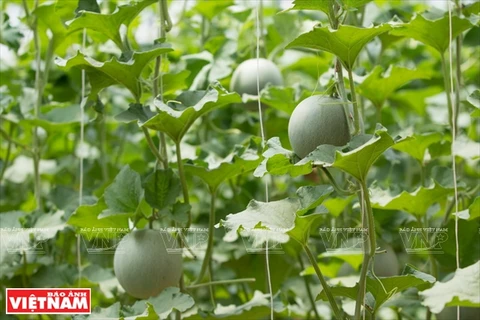
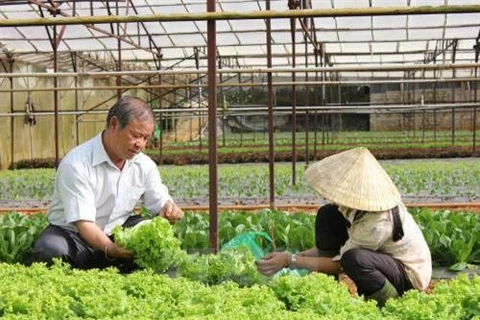
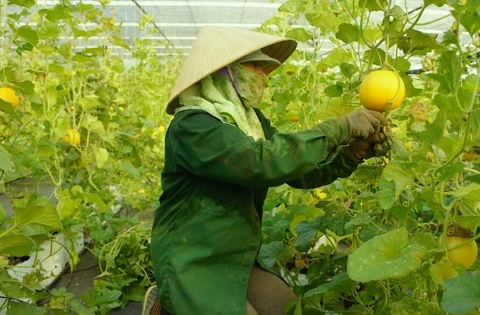
A worker tends to orchids in a greenhouse at a farm in Hanoi. The greenhouse is equipped with automatic watering and temperature control systems to boost production (Photo courtesy of the Hanoi Department of Agriculture and Rural Development)
 Hanoi (VNS/VNA) - Nguyen Duc Dan, Chairman of the Ba Trai Commune People’s Committee, cannot hide his happiness as he discusses his community’s strides in tea production.
Dan said tea production has been rising, boosting the incomes of local farmers making the commune the most important tea planting area in Hanoi’s Ba Vi district with a total cultivated area of 560ha.
In 2014, the commune received technical help from the Hanoi Department of Agriculture and Rural Development to plant tea that meets Vietnamese Good Agriculture Practice (VietGAP) standards, which ensure a high level of standardised quality through the use of modern farming techniques. Local farmers were taught methods to update their ineffective old farming techniques.
For example, farmers like Dan who elected to apply VietGap standards were trained to a use new, more efficient watering system and to harvest using machines instead of manually. Since then, tea production has gradually risen.
On average, each hectare of tea in the commune brings in about 220 million VND (9,400 USD) of profits per year, as much as twice the profit generated by conventional farming techniques.
Director of the municipal Department of Agriculture and Rural Development Chu Phu My said Hanoi has targeted increasing the amount of agricultural production that uses hi-tech practices from 25 percent of all agricultural areas last year to 35 percent by the end of this year.
Hanoi has applied biotechnology, new cultivation and preservation methods and automation to its agricultural production, according to the municipal Department of Agriculture and Rural Development.
My said it would also urge localities to complete programmes to set up new-style rural areas.
In addition to its hi-tech push, the municipal agricultural sector has also allowed farmers to import livestock from other countries to raise productivity.
Farmers have imported chickens from the Czech Republic, pigs from Thailand and Canada and cows from Belgium. The animals are cross-bred with domestic livestock to create more productive offspring. For instance, the cattle bred from domestic cows and imported Belgian cows grow larger than most Vietnamese cows, producing more beef.
Director of the Hanoi Centre for Agricultural Development Hoang Thi Hoa said the application of hi-tech farming practices not only served Hanoi’s demand for food, but also helped turn the capital city into the country’s biggest supplier of quality breeding stock.
Each year, Hanoi supplies more than 50 million domestic fowls, 200,000 pigs and 30,000 cows to different provinces and cities.
Despite this progress, the capital city still faces several obstacles to applying hi-tech agricultural practices.
The use of modern technologies remains low. Just 924.5ha of fruit trees are cultivated using hi-tech farming practices, making up 6.2 percent of the total fruit area of the city. Just 306.5ha of tea cultivation areas have taken the step, making up 10.2 percent of the total area in the city.
Change remained slow because farmers lack investment and have been unable to co-ordinate closely with businesses.
Agricultural experts said more investments are needed in agricultural production and processing.
My said that to ease difficulties, the department proposed the municipal authorities issue policies to urge agricultural production, and set up hi-tech agricultural zones.-VNS/VNA
VNA