Hanoi’s core zone develops typical cultural tourism

As the centre of ancient Thang Long capital more than 1,000 years ago and the heart of Hanoi at present, Hoan Kiem district is making efforts to develop tourism with its own identity, focusing on preserving and promoting cultural and historical values.
Hanoi’s core zone develops typical cultural tourism ảnh 1The Huc bridge and Ngoc Son Temple are popular destinations for international visitors and Vietnamese people. (Photo: VNA)
Hanoi (VNA) – As the centre of ancient Thang Long capital more than1,000 years ago and the heart of Hanoi at present, Hoan Kiem district is makingefforts to develop tourism with its own identity, focusing on preserving andpromoting cultural and historical values.

Hoan Kiem has been a destination not to be missed fortourists when coming to Hanoi. Its famous places include Hoan Kiem Lake, NgocSon Temple, the Old Quarter, St. Joseph's Cathedral and Hanoi Opera House.

The district also has many craft and food streets, considered an advantage to develop shopping and culinary tourism.

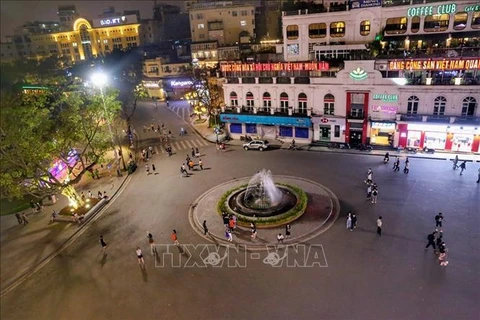
After a long closure due to the COVID-19 pandemic, Hoan Kiem’spedestrian spaces – the first of its kind in Vietnam – again welcomed visitorsback from March 18.

Hanoi’s core zone develops typical cultural tourism ảnh 2Many people gather at pedestrian streets around Hoan Kiem Lake at weekends. (Photo: VNA)
To ensure safety for visitors, the People’s Committee ofHoan Kiem district has deployed forces to perform COVID-19 prevention andcontrol activities and handle relevant violations.

Visitors are requested to make health declarations and washtheir hands before entering the pedestrian spaces, and not to enter the area ifthey have any COVID-19 symptoms.

The district has built a plan for tourism recovery anddevelopment in the new normal. To make it effective, Hoan Kiem is focusing ondiversifying and increasing the quality of products, stepping up promotionactivities, and expanding digital transformation in this field./.
VNA
See more

The Dien Bien Phu campaign headquarters has become a popular tourist attraction in Dien Bien province. (Photo: VNA)

Dien Bien Phu tourism cable car project receives in-principle approval

The project aims to effectively tap the area’s natural landscapes, geographical advantages and distinctive historical value, while creating a high-quality tourism product with strong competitiveness. It is also intended to preserve, honour and promote the value of the Dien Bien Phu Victory special national historical relic site.

Da Lat station is the hub of the roughly 84-km Phan Rang–Da Lat railway (Photo: VNA)

Da Lat city's century-old railway station doubles as tourist draw

It now functions as both a transport hub and a sought-after photo spot. In the early morning, with mist still threaded through the pines, the station radiates an old-world calm. Visitors arrive at dawn to breathe the mountain air and capture iconic images of the highland city.

Ha Long Bay in Quang Ninh province. (Photo: VNA)

Quang Ninh - magnet for affluent Indian travellers

Alongside wedding tourism, Quang Ninh is also seeing robust growth in arrivals of Indian MICE travellers. Delegations of hundreds, and sometimes thousands, of visitors have been coming to the province for conferences, seminars and incentive travel programmes combined with leisure stays.

Visitors explore the Tra Su cajuput forest in An Giang province. (Photo: Tra Su Tourism Area)

Mekong Delta eyes stronger foothold in global tourism

Enriched by the alluvial deposits of the Mekong River, the region stands out for its dense canal network, year-round fruit orchards, biodiversity-rich national parks, and vibrant folk festivals – invaluable assets for developing diverse tourism offerings, from orchard-based eco-tourism and river experiences to cultural, festival, resort and nature conservation tourism.

A Lunar New Year court ceremony of Nguyen Dynasty is reenacted at Thai Hoa Palace in the Imperial Citadel of Hue (Photo: VNA)

Culinary, heritage passports reshape cultural tourism

The central city of Hue is among the first to forge new paths. Its “Hue Tourism Passport” began as a destination brochure in 2018 and has since evolved into the “Hue City Passport” app, with a heritage-passport feature that strings monuments into a structured journey.

Phu Quoc International Airport in Phu Quoc special zone of An Giang province. (Photo: VNA)

Air travel surges to 1.68 million passengers during holiday periods

Domestic air travel accounted for 675,140 passengers and 3,400 tonnes of cargo, marking declines of 7.5% and 11.6%, respectively. In contrast, international transport showed robust growth, surpassing 1 million passengers and reaching 24,050 tonnes of cargo, up 10% in passenger numbers and 10.6% in cargo volume.

International visitors admire the beauty of the My Son Cham sanctuary in Duy Xuyen, Da Nang. (Photo: VNA)

Vietnam records 2 million foreign arrivals in April

The Vietnam National Authority of Tourism (VNAT) said the figures highlight the country’s rising profile as a safe, stable and increasingly compelling destination. It is the first time Vietnam has surpassed 2 million foreign arrivals for four straight months, and the first time the January – April tally has reached 8.8 million.

The Cau Vang (Golden Bridge) in the central city of Da Nang. (Photo: VNA)

Ho Chi Minh City, Da Nang lead Thai tourists’ searches

Data from the online booking platform Agoda shows that Ho Chi Minh City recorded the highest growth in searches from Thailand, reaching 134%, followed by Da Nang with a 58% increase. Other destinations such as Hong Kong (China) saw more modest growth.