HCM City boosts medical cooperation with RoK’s Gyeonggi province

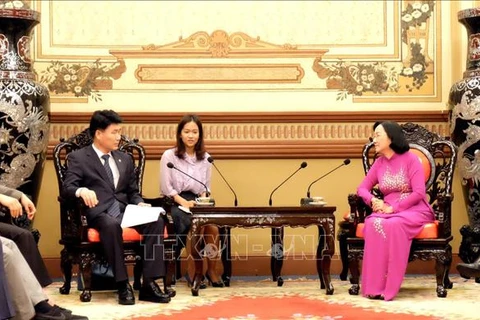
Hospital managers, renowned doctors and investors from the Republic of Korea’s Gyeonggi province attended a workshop in Ho Chi Minh City on June 4 to study investment opportunities in the field of health care in the southern economic hub.
HCM City boosts medical cooperation with RoK’s Gyeonggi province ảnh 1Illustrative image (Source: VNA)

HCM City (VNA) –
Hospital managers,renowned doctors and investors from the Republic of Korea’s Gyeonggi provinceattended a workshop in Ho Chi Minh City on June 4 to study investmentopportunities in the field of health care in the southern economic hub.

Director the municipal Department of HealthNguyen Tan Binh said his department and the Gyeonggi counterpart had signedminutes in 2018 on cooperation in human resources training, professional andmanagement experience exchanges, and information technology application toserve medical examination and treatment.

Under this document, 24 Vietnamese students weresent to the RoK for professional exchanges and intensive training, he said,adding that the RoK province also assisted Vietnam in research, diagnosis andprevention of cardiovascular diseases and cancer as well as in healthcaremanagement issues.

Ryu Yong Chol, director of Gyeonggi’s healthdepartment, evaluated HCM City as a potential market for medical investors fromthe RoK in general and Gyeonggi in particular, especially in the fields ofpharmaceutical products and healthcare equipment.

The RoK province hopes to set up in-depth cooperationwith HCM City in high-tech surgery for the treatment of cardiovascular diseases,cancer and organ transplantation as well as specialised medical care liketreatment of spine and joints, gynaecology, dentistry, orthopaedic injuries andcosmetic surgery.

During the workshop, the Gyeonggi medicaldelegation was informed about laws on foreign investment in health care inVietnam as well as regulations on the establishment and management of hospitalsand private clinics, and management of pharmaceutical products and healthcareequipment.

In 2017, the health departments of HCM City andGyeonggi province hosted successfully the Vietnam-RoK health care conferenceand set up a joint cooperation system including voluntary medical assistance, medicaltraining and technology sharing.-VNA
VNA

See more

Vietnamese Ambassador to Laos Nguyen Minh Tam extends greetings to leaders and staff of the Hanoi – Vientiane General Hospital on the occasion of the 71st anniversary of the Vietnamese Doctors’ Day on February 27. (Photo: VNA)

Vietnamese doctors in Laos help foster bilateral solidarity

Commending the Hanoi – Vientiane General Hospital’s 13-year development, Ambassador Nguyen Minh Tam noted that prioritising conscience and virtue has helped it build a strong reputation among Lao citizens, the Vietnamese community and international friends in Laos.

Organ transplantation at the University Medical Centre Ho Chi Minh City (Photo: the University Medical Centre Ho Chi Minh City)

Professional excellence, dedication define Vietnam’s healthcare system

When patients pull through from the brink of death, when their vital signs stabilise and transplanted hearts begin beating strongly in new bodies, the joy shared by the entire medical team is overwhelming. And when the country welcomes the New Year, saving lives takes on an even more profound significance — offering patients and their families a new spring of hope.

At Phu Rieng communal medical station in Dong Nai province (Photo: VNA)

Vietnam fosters maternal and child healthcare, advances toward 2035 goals

The under-five mortality rate in Vietnam in 2025 was estimated at below 16 per 1,000 live births, more than three times lower than the 1990 level. The infant mortality rate (under one year) declined fourfold to below 11 per 1,000, while the neonatal mortality rate dropped fivefold, from 44 per 1,000 in 1990 to 8.8 per 1,000 in 2025.

Medicine support programmes provide significant benefits to patients throughout their course of treatment. (Photo: VNA)

Over 6,000 patients receive free medicines

The schemes focus primarily on cancer, rare diseases and severe chronic conditions, areas where treatment costs are high and often require expensive biological and originator drugs.

A lung transplant surgery at the National Lung Hospital (Photo: VNA)

Vietnam reaches new height in organ transplantation

From demanding cross-country transplants to highly specialised procedures nearing regional and international standards, the sector has created new chances of survival for thousands of patients. However, persistent bottlenecks in organ donation and the legal framework highlight the urgent need to further perfect the national donation–transplantation system. In the era of advanced medicine, progress is measured not only by surgical mastery, but also by the ability to turn loss into hope and sustain life.

The DAV asks pharmacy producers and distributors to increase medicine supply capacity during Tet to meet increasing demand (Photo: VNA)

Measures rolled out to ensure adequate medicine supply during Tet

Accordingly, provincial and municipal health departments are required to direct hospitals, centres for disease control and health care facilities to urgently develop plans and carry out medicine procurement to ensure sufficient supply, absolutely avoiding shortages. Medicines must meet quality standards and be sold at reasonable prices, with no sudden price increases allowed.

Military doctors conduct ultrasound examinations for residents in Dong Dang town, Cao Loc district, Lang Son province. (Photo: VNA)

Resolution 72 opens path to a modern, sustainable healthcare system

To build a resilient healthcare system capable of meeting the challenges of ageing, emerging diseases and rising expectations for quality care, Vietnam must continue to strengthen primary and preventive care, invest in human resources, accelerate digitalisation and big data development, and refine healthcare financing mechanisms.

Vietnam steps up Nipah virus prevention at border gates (Photo: suckhoedoisong.vn)

Vietnam tightens Nipah virus prevention at border gates

Local authorities have been instructed to strengthen disease prevention and control measures at border gates, medical facilities and in the community, stay updated with global disease information, and closely monitor inbound travellers.

Nipah virus infection is designated a Group A infectious disease, with reported fatality rates of between 40 and 75%. (Photo: moh.gov.vn)

Health sector steps up preparedness against Nipah virus disease

Nipah virus infection is designated a Group A infectious disease, with reported fatality rates of between 40 and 75%. At present, no vaccine or specific antiviral treatment is available. The virus is mainly transmitted from animals to humans or through contact with contaminated food and objects, and can also spread between people via direct contact with bodily fluids and secretions of infected patients.

Member of the Party Central Committee and Minister of Health Dao Hong Lan (Photo: VNA)

Health minister highlights comprehensive, people-centred healthcare orientation

Member of the Party Central Committee and Minister of Health Dao Hong Lan said the Politburo's Resolution No. 72 provides a breakthrough orientation for the protection, care and improvement of the people’s health. It places the people’s health at the centre of all healthcare policies and services, while aiming to address long-standing bottlenecks in the health sector that have yet to be fundamentally resolved.

Elderly people do morning exercises in the Hoan Kiem Lake area in Hanoi. (Photo: VNA)

Strategic roadmap for healthier future

As Vietnam’s population ages rapidly, Dr Angela Pratt, WHO Representative in Vietnam, identified two strategic priorities: strengthening primary healthcare and developing a formal long-term care system. These measures are essential not only for healthy ageing, but also as long-term investments with wide-ranging socio-economic returns.