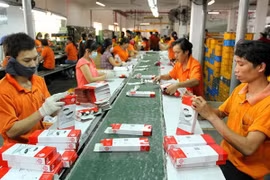
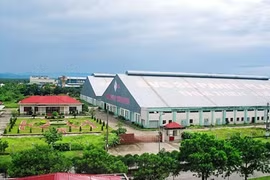
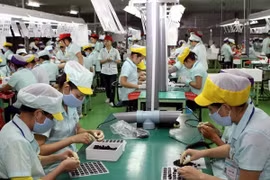
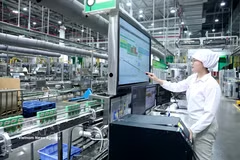
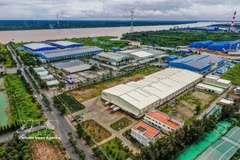
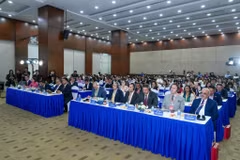
25 years after the first industrial and processing park was established, 4,500 hectares out of a total of 8,900 hectares in 19 parks are in use (Photo: VNA)
HCM City (VNA) - Industrial andprocessing parks in Ho Chi Minh City have not developed to their potential dueto poor infrastructure and a lack of connection among the parks, delegates saidat a weekend seminar.
Speaking on the 25th anniversary of the HCM City ExportProcessing and Industrial Zone Authority (HEPZA), Secretary of the municipal PartyCommittee Nguyen Thien Nhan said: “Related authorities and HEPZA should reviewand clarify a new development plan for industrial and processing parks based onhigh-tech enterprises."
Former assistant of the minister ofplanning and investment Nguyen Van Kich confirmed that HCM City was the firstlocality in Vietnam to open and lead the development of industrial andprocessing parks, but recently, its role in industrial and processing parks hasdeclined.
“The development master plan ofindustrial and processing parks hasn’t clarified inter-regional, inter-industryand production chain connectivity,” he said.
“In particular, the role of HCMCity as the biggest economic hub in Vietnam has been forgotten. Inthe past, industrial and processing parks in HCM City were not always able toanticipate and prepare for key sectors that require high technology, highintelligence and high competitiveness, such as electronics, informationtechnology, telecommunications, bio-tech and engineering,” Kich added.
Professor Nguyen Trong Hoai fromHCM City Economics University suggested that HEPZA should encourage industrialclusters to create close linkages with support industries. “Existingindustrial parks should be improved under the principle of a strong connectionamong manufacturing enterprises and the consumption system,” he said.
Hoai also urged that allenterprises still located in residential areas should be moved into industrialparks to help protect the environment of those areas.
Former director of Tan ThuanLimited company Phan Chanh Duong called on HEPZA to create economic developmenton a foundation of industrial and processing parks.
“Right now, industrial andprocessing parks should not only be concerned about how to attract investorsbut they also should participate in promoting technological innovation withexisting enterprises as well as promoting the development of industrial andprocessing parks in line with specific professional requirements,” Duong said.
Twenty-five years after the firstindustrial and processing park was established, 4,500 hectares out of a totalof 8,900 hectares in 19 parks have been put in use.
“Most projects are small and theproportion of high-tech, high-value added projects are small too,” Nguyen HoangNang, head of the HEPZA, said.
“Master planning hasn’t met thedemands of development. There are so many small industrial parks located indifferent places and there is no connection between them,” he added.
“Industrial and processing parkshaven’t used land for social welfare projects.”
“The most important thing is thatthe “one-gate” management model being applied for HEPZA hasn’t been establishedby law, only at the decree level. Therefore, it is very hard for us to manageand to develop,” Nang added.-VNA
VNA