HCM City office market begins to feel COVID-19 impact

Ho Chi Minh City’s office market has started to feel the effects of the COVID-19 pandemic, with grade A buildings impacted more than grade B, experts have said.
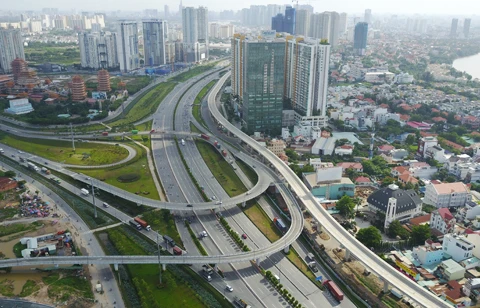
HCM City office market begins to feel COVID-19 impact ảnh 1Office buildings in HCM City (Source: VNA)

HCMCity (VNS/VNA) – Ho Chi Minh City’s office market has started tofeel the effects of the COVID-19 pandemic, with grade A buildings impacted more thangrade B, experts have said.

CBREsaid in its latest report, “The prolongation of COVID-19 haschallenged the recovery of economies in the Asia-Pacificregion as well as Vietnam.

“Though theHCM City office market did not record significantimpacts from COVID-19 in the first quarter of this year,it started to witness stronger reactions fromtenants in the second quarter after their revenuesplunged. With many going through a period of economic uncertainty,some were forced to return all or part of their office space.”

Accordingto CBRE, while there was no new supply in the HCM City office marketin the second quarter, new office area in 2019 and the firstquarter of this year has not been fully absorbed by the market.

Thiswas because many tenants have been planning to eithercontinue in their current buildings or relocate tobuildings with lower cost at the edge ofthe CBD or suburban areas. 

GradeB was steady, especially buildings with rents of less than 30 USD persquare metre.

TheCOVID-19 outbreak has changed the leasing tendency of occupiers,particularly after the social isolation period in March and April. 

Companiesopted for work-from-home to sustain operations and acknowledged thatthe productivity of employees was not affected when they workedout of non-office spaces. 

So relocatingoffices to CBD borders is not as difficult as before. Somecompanies have also adopted a long-term work-from-homestrategy of at least one day per week; others haverelocated to buildings with cheaper rents.

JLL,concurring with the view, said a number of buildings saw negative netabsorption in the second quarter as tenants facing financialdifficulties returned spaces. 

Thishappened for the first time in a decade, with the absorption being minus3,619sq.m in the second quarter. This was mainly due to small and medium-sizedenterprises, who were major tenants in the grade B market, scaling down andterminating contracts prematurely as a result of the pandemic.

GradeA, though more resilient and backed up by deep-pocketed companies, was alsounder pressure. This was proven by the low demand from expansion and newset-ups during the outbreak.

JLLpredicted that this year the market would add more than 100,000sq.m of grade Boffice space, mainly outside the CBD, to take the total space in grades A and Bto 1.5 million square metres.

Amidthe global economic uncertainty due to the impacts of Covid-19, office tenantswill take a hard hit, probably those in grades B and C first and then followedby those in Grade A if the virus is not soon contained globally.

Therefore,depending on the pandemic situation, buildings with increasing vacancies,especially in the lower grades, will likely reconsider their rents and leasingstrategies.

CBREsaid the construction of new office buildings in HCM City continued, and morethan 70,000sq.m were expected to be completed by the end of thisyear. 

Mostof the addition would be concentrated in the east (Binh ThanhDistrict) and south (District 7). 

Thelandlords of many/most/all of these buildings had already decreased askingrents by1-3 USD per square metre compared to the last quarter of 2019.

CBREsaid with countries in the neighbourhood struggling with the pandemic,demand for office space in HCM City from foreign companies had beenimpacted.

Rateswere expected to shrink by 8 -10 percent year-on-year and the vacancyrate would increase by 7-9 percentage points by the end of 2020 due to newsupply and the influence of COVID-19, it said.

PhamNgoc Thien Thanh, its associate director, said: “The changes in occupierleasing preferences are becoming more vivid. We expect that themarket will see more relocation andcontraction transactions this year. So, it requireslandlords to have appropriate solutions for the short and longterms to catch up with occupier leasing preferences. 

“Moreover,flexible workspace operators should be more prudent with their expansion plansat the moment, and should focus more on improving performance at their currentcentres by providing incentive packages and diversifying target tenants.”/.
VNA
See more

The 30th Export Day draws representatives from various organisations and businesses in Argentina. (Photo: VNA)

Vietnam, Argentina eye broader Mercosur access amid free trade push

During the 30th Export Day, organised on September 15 in Buenos Aires by the Chamber of Exporters of the Argentine Republic (CERA) under the theme "New Export Frontier: The Transformation Underway," Vietnamese Ambassador to Argentina Ngo Minh Nguyet highlighted that Vietnam considers Argentina and Mercosur important partners in South America and sees broad potential to deepen trade and investment ties.

Drone is used in seeding, fertilising and pesticide spraying (Photo: VNA)

Greening agriculture through low-emission crop production

The scheme to sustainably develop 1 million ha of high-quality, low-emission rice in the Mekong Delta by 2030 is advancing, said Nguyen Quoc Manh, Deputy Director of the Department of Plant Production and Protection at the Ministry of Agriculture and Environment.

DACE launches organic spice processing, preservation and export plant in Cao Bang (Photo: VNA)

Cao Bang develops organic farming zones linked to European markets

Around 2,353ha of farmland in the province meets organic standards, including more than 2,332ha of spice-growing areas cultivating cinnamon, star anise and ginger that have obtained internationally recognised certifications such as USDA (US), EU and JAS (Japan).

Electronic components are produced at a factory in Hanoi. (Photo: VNA)

Hanoi's imports surge 41% in first eight months of 2026

Hanoi aims to achieve average annual export growth of at least 12% during 2026-30, with the city seeking to diversify export markets, boost high-tech and value-added products and reduce reliance on traditional markets.

Ben Thanh Market in Ho Chi Minh City attracts a large numbers of domestic and international visitor.( Photo: VNA)

Vietnam targets 50 million international visitors by 2030

The Ministry of Culture, Sports and Tourism has outlined three scenarios for 2027–2030. Under the high-growth scenario, international arrivals would rise 15–18 percent annually to reach 45–50 million, while domestic tourism would reach around 160 million trips. Total tourism revenue is projected at 80–90 billion USD.

Factories and production facilities in the Chu Lai Open Economic Zone, Da Nang city, are equipped with modern production lines. (Photo: VNA)

Ready-built factories gain from new manufacturing FDI wave

Ready-built factories attracted 73% of new manufacturing FDI in northern Vietnam over the past two quarters, as foreign investment continued to surge at the region's industrial hubs during the first eight months of 2026. The trend points to growing demand for premises that can be put into operation quickly.

Vietnamese durian industry pivots from volume to value

Vietnamese durian industry pivots from volume to value

Durian has morphed from a high-value crop into a strategic Vietnamese export. But as output climbs and importing markets tighten rules on quality, food safety and traceability, the industry must pivot from volume growth to sustainable value chains, better quality and diversified markets.

A display area for Mid-Autumn Festival cakes at a supermarket (Photo: VNA)

Mid-Autumn Festival cake market heats up at affordable end

Industry insiders say competition is no longer just about the cake itself. Product quality, packaging, brand reputation, delivery services and personalisation are increasingly shaping consumer choices in a market crowded with both domestic and foreign players.

Minister of Foreign Affairs Le Hoai Trung (Photo published by VNA)

Vietnam, India set 25 billion USD trade goal

Vietnam and India agreed to make better use of complementary strengths, ease market access difficulties and facilitate business activities toward achieving the 25 billion USD bilateral trade target.

Delegates at the meeting between Vietnamese businesses operating in Cambodia and the Council for the Development of Cambodia (CDC) on September 14. (Photo: VNA)

Vietnamese businesses seek to expand investment in Cambodia

Vietnam currently has 223 investment projects in Cambodia with total registered capital of nearly 3.4 billion USD. Vietnamese companies operate in agriculture, particularly large-scale farming, finance and banking, telecommunications, aviation, processing, trade and services.