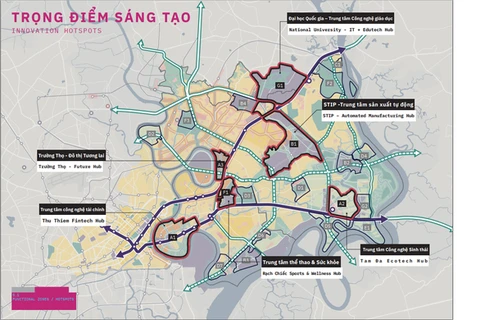
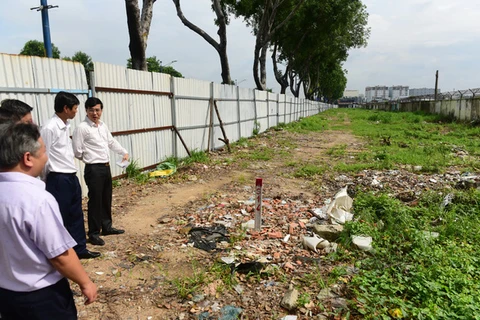
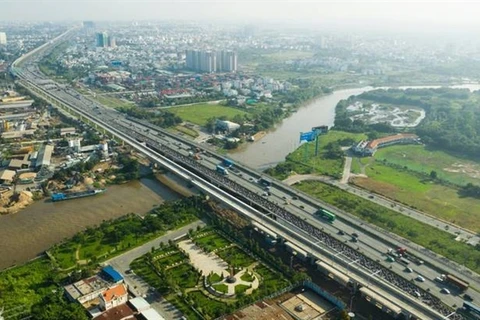
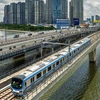
A view of the proposed innovative hub tentatively called Thu Duc City (Source: VNA)
 HCM City (VNS/VNA) - Deputy Prime Minister Truong Hoa Binh has told Ho Chi Minh City’s authorities to consult foreign experts on its plan to build an innovative ‘city within a city’ in the eastern part of the sprawling metropolis.
The government has approved a HCM City proposal to merge the eastern districts of 2, 9, and Thu Duc into one administrative unit, tentatively called ‘Thu Duc City’.
To build the new city, Binh said HCM City authorities must seek advice from foreign experts and investors, including technology, finance and real estate companies.
Such consultations will allow the city to better understand investment needs and infrastructure requirements for Thu Duc City. “The consultations can be done online,” he said.
To attract investment, HCM City must make clear how the new area would be distinguished from other urban areas in the country and other financial and technological centres in Asia, he added.
The plan should also be in accordance with the general planning for HCM City and the southeastern region to avoid overlaps that could lead to unnecessary competition within HCM City and the region, according to Binh.
To seek ideas for the new hub, the city last year launched a contest on planning concepts. The winner, the US architecture and design solution firm Sasaki Associates Inc, proposed different zones, facilities and development plans, with all the elements needed for a smart city and innovation, as well as other features to support the growth of technologies and key industries.
Dr Tran Du Lich, member of the Government’s Economic Advisory Group, said the new city should be considered as an economic driver for the city and region, connecting research, entrepreneurship, academia, and industry to create an innovation eco-system.
Dr Huynh The Du, lecturer at Fulbright University Vietnam, said Thu Duc City should study the experiences of major cities in other countries, including the Pudong area in Shanghai and Gangnam in Seoul, and propose policies for a creative ecosystem and improved competitiveness.
According to the Ministry of Construction, the plan to build a new “city within a city” is “unprecedented” in the country and will require extensive study.
The ministry said the establishment of the new city directly under HCM City management would also require amendments in urban planning and construction laws.
Pham Thai Son of the Vietnam-Germany University pointed out that the city’s current resources were still insufficient to build the innovation district in the city’s eastern part.
Dr Nguyen Cao Tri of Van Lang University also noted that it would be difficult to change management methods immediately, so the city must devise “creative methods based on current policies”.
Pham Chanh Truc, former deputy secretary of the municipal Party Committee, said: “A smaller area should be designated first as the innovation district and then expanded because the project will involve huge expenditures.”
To make the plan feasible, the city has to start with the basics such as traffic infrastructure, he added.
The city’s administration has established a steering committee, led by Nguyen Thanh Phong, Chairman of the municipal People’s Committee, which will develop a master plan for the development of the new city.
The master plan includes strategies for a knowledge-based economy that promotes investment in urban development and a highly skilled workforce.
The committee plans to develop a centralised urban database with data about land use, transportation, canals and other works in the three districts.
In addition, the committee will consult both the public and agencies, and promote international cooperation in investment.
Experts recommend that Thu Duc City should be designed to “attract more investment and new opportunities while promoting globalisation and maintaining local culture, appealing to a talented workforce from around the world, and adapting to climate change”.
Thu Duc City would be spread over 211 square kilometres and house more than a million people.
Currently, the 48sq.km Thu Duc District has a high concentration of educational institutions and research centres and four large universities with more than 10,000 lecturers and professors and 100,000 students.
The 50sq.km District 2, which includes the Thu Thiem new urban area, will provide international exhibition and financial centres for the new urban area and the city as a whole.
The 114sq.km District 9, which includes the Saigon Hi-Tech Park, would be a hub for research and an incubator for innovative technologies.
The new city is expected to contribute 30 percent of the city’s economic growth, and 4-5 percent of the country’s.
HCM City contributes 23 percent of national GDP, 30 percent of Government revenues, 16 percent of industrial output, and 15 percent of exports./.
VNA