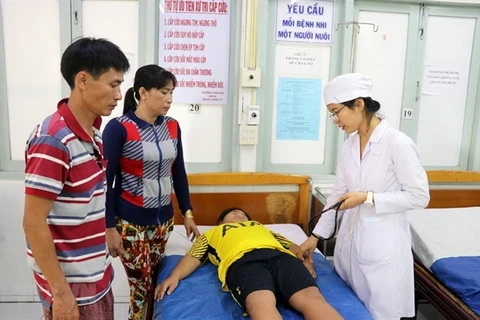
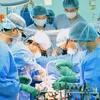
Doctors at Binh Dan Hospital in HCM City’s District 3 use robots to assist in surgeries (Photo courtesy of the hospital)
 HCM City (VNS/VNA) – Ho Chi Minh City’s Department of Health has sped up the process of building a database and adopting IT as instructed by the municipal Party Committee.
They were required as part of the smart city project, work on which began more than 18 months ago.
Nguyen Thien Nhan, Secretary of the municipal Party Committee, at a meeting held to review the project progress in June, had instructed departments including health to publish what they would need and do in the third quarter so that companies in relevant fields such as IT could take part in bids for the work.
Assoc Prof Dr Tang Chi Thuong, the department’s deputy head, said: “We need to do many things to usher in smart health.”
Smart health, which the department is developing, aims to serve the public better and make the use of healthcare services and sending feedback to the department convenient, according to Thuong.
It also aims to improve how doctors access the latest professional knowledge and technologies to reduce medical errors.
It seeks to streamline administrative procedures at hospitals and the department.
The department has to create its own database and connect it with the city’s to create a foundation for a smart city.
Health facilities in the city had to create IT infrastructures, he said, adding that while many were diligent others were not, leading to inconsistency.
This year the department would digitise health records at 24 ward and commune health stations operating as family medicine clinics if approved by the Department of Information and Communication, he said.
It was also developing software for managing information about individuals’ health at the 24 health stations, he said.
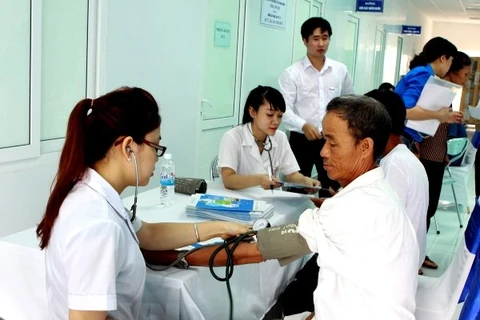
It had set up an IT system for telemedicine linking them and city-level hospitals to improve the quality of primary healthcare since March, he said.
It had collaborated with the HCM City University of Technology for a project to make electronic health records uniform so that hospitals could exchange the data, he said.
In 2016, the department started to operate an electronic portal which individuals and companies could access to search for information about licences and others.
It has now incorporated other utilities such as messages and emails to keep track of the department’s processing of applications.
This year it has used IT to connect with medicine suppliers and traders in the city and link with national pharmaceutical database as required under the ministry’s roadmap.
More than 6,000 suppliers and traders have so far linked with the national database.
A system to manage the supply and use of drugs at hospitals under the department’s management will be developed to prevent medicine shortages.
The department expects the Department of Information and Communication to provide funds for this year.
The city has many hospitals under the management of the Ministry of Health and others.
Thuong said the department had developed software to help hospital administrators manage better, especially finance, when they get in administrative autonomy.
Moreover, the department has created many other IT applications for management and issuing disease outbreak warnings.
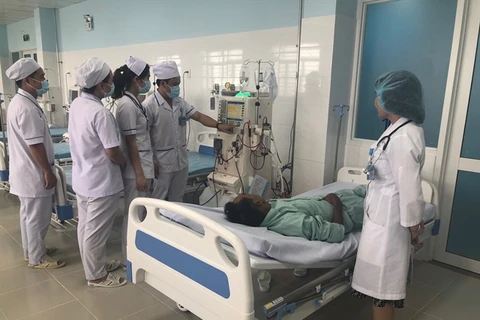
Many hospitals in the city use robots and artificial intelligence for diagnosis and treatment.
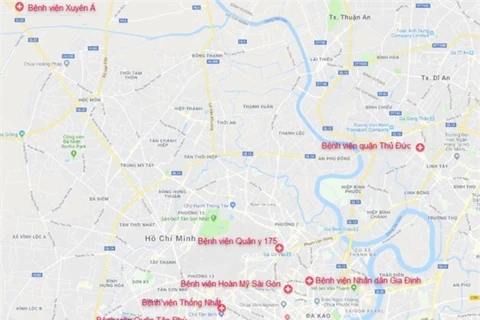
Thu Duc District Hospital has successfully digitised health records stored in its warehouse as of 2015. More than 6,000 records have so far been digitised.
This would help store patients’ records for longer and doctors get easy access to them for treatment and conducting research, Thuong said.
The department planned to digitise more hospitals’ records, he added.
The department had to hire many IT experts and set up an IT board for consultation and implementation of smart health, he said.
The country has a major need for personnel who have understanding of both health, especially hospital healthcare services, and IT, according to the department.
Most hospitals have a shortage of such medical informatics specialists while the country’s universities and colleges do not train people in this.
This shortage is a hurdle to the health sector using IT more efficiently and improving the efficiency and safety of healthcare services, especially at hospitals.
Many hospitals have to employ IT engineers who had to acquire expertise in health on their own.
Some hospitals have doctors interested in IT and learning it.-VNS/VNA
VNA