HCM City strengthens food safety measures at schools

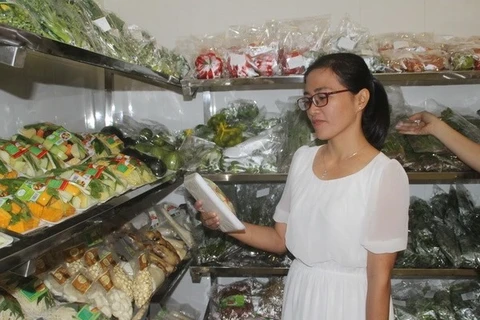
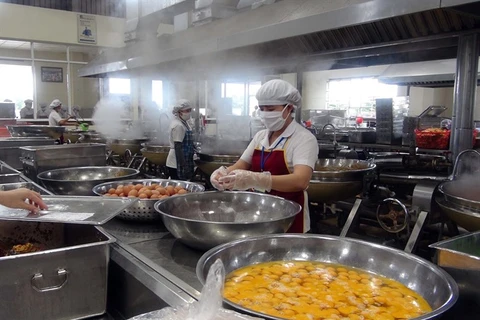
Six pilot schools in Ho Chi Minh City have ensured food-safety standards and teachers have become more aware of food-hygiene regulations, but schools still need to ensure quality meals and publication of food prices as well as the names of companies that make the food, the deputy director of the HCM City Department of Education and Training has said.
HCM City strengthens food safety measures at schools ảnh 1Teachers and representatives of different schools in HCM City on May 10 attended a meeting to review food hygiene and safety activities at schools (Photo: VNA)

HCM City (VNA) - Six pilot schoolsin Ho Chi Minh City have ensured food-safety standards and teachers have becomemore aware of food-hygiene regulations, but schools still need to ensurequality meals and publication of food prices as well as the names of companiesthat make the food, the deputy director of the HCM City Department of Educationand Training has said.

Speaking at a meeting to review food hygiene andsafety activities at schools from 2017 to 2019 late last week, Bui Thi Diem Thusaid one of the seven food-poisoning cases in the 2017-2018 period was at schools.

She stressed the importance of closercooperation between schools and students’ parents, and the need to inform themof the names of companies that make their food at school.

For the 2018-2019 academic year, the Food SafetyManagement Board and the Department of Education and Training appointed schoolsin districts 3, 5, 6, 8, 11, Binh Thanh and Tan Binh to only use food providedby companies recognised in food-safety supply chains or those with HACCP, ISO22000, VietGAP, GlobaGAP certificates.

The Department of Education and Training targetsby the end of next year to have all canteens with food hygiene and safetycertificates and to have all schools run food-check systems and take part intraining courses.

The department will also organise a large-scalerehearsal on investigation and handling of food poisoning in schools whilefurther piloting food hygiene and safety activities in schools in the city’sremaining 18 districts.

HCM City has 1,974 schools, including 1,038kindergartens, 466 primary schools, 281 secondary schools and 189 high schools.

There are 2,314 catering facilities found acrossall schools in HCM City, according to the department.

The head of the Food Safety Management Board,Pham Khanh Phong Lan, among many representatives and teachers, attended themeeting.-VNA
VNA

See more

Automated ticketing system is used on the urban railway Cat Linh-Ha Dong line in Hanoi. (Photo: VNA)

Digital transformation powers Hanoi metro expansion

Beyond convenience, stable fares and the elimination of fuel, parking and maintenance costs have made urban rail increasingly attractive. The growing preference for metro travel is also contributing to a greener, more modern urban lifestyle.

Delegates cut the ribbon to inaugurate the operation of electric bus route No. 43. (Photo: VNA)

Hanoi accelerates shift to green buses, targets 100% by 2030

In the 2027–2030 period, the city will accelerate the transition towards the complete phase-out of fossil fuel-powered buses. The share of electric and green energy-fueled buses is projected to reach 79–89% by 2029 and 100% by 2030.

At the second session of the Ho Chi Minh City People’s Council (Photo: VNA)

Ho Chi Minh City greenlights central square, administrative centre in Thu Thiem

The new central city square and administrative centre will create a modern, centralised political-administrative complex for Ho Chi Minh City, designed to house around 8,000 officials, civil servants, and employees. It will also handle daily traffic of 1,500- 2,000 citizens and business representatives through a unified one-stop-shop administrative service system.

A working session at the job fair (Photo: VNA)

Vietnamese students flock to Seoul Job Fair 2026

The second annual Job Fair 2026 was held for Vietnamese students in the Republic of Korea. Organisers pitched it as a straight-up bridge between eager students and bosses hungry for young talent who can actually handle multicultural workplaces.

Defendants at the court (Photo: VNA)

Ho Chi Minh City court opens trial over Agribank lending scandal

The investigation revealed that multiple credit files were incomplete or riddled with inaccurate information, while some pledged assets lacked proper legal standing yet were accepted and grossly overvalued. As a result, the loans became high-risk and largely unrecoverable, leading to losses surpassing 1 trillion VND.

Hanoi introduces 53 electric buses from April 18 (Photo: VNA)

Hanoi to add 53 electric buses from April 18

According to the plan, all buses operating within Ring Road 1 will use green energy by July 1, 2026. The requirement will expand to Ring Road 2 by January 1, 2028, and to Ring Road 3 by 2030.

Illustrative image (Photo: VNA)

National, local traffic safety committees to be dissolved from June 1

Under the dicision, ministries and ministerial-level agencies will assume responsibility for tasks previously performed by the committee, in line with their mandates under the Law on Government Organisation, the Law on Road Traffic Order and Safety, the Law on Roads and other relevant legal frameworks, ensuring that traffic safety and order are maintained without disrupiton.

Visitors explore technology showcases at the exhibition held during the Da Nang Startup and Innovation Festival (SURF 2025). (Photo: VNA)

About 10,000 students expected at National Startup Day 2026

This year marks the rollout of the “Student Startup Support Programme for 2026 – 2035”, approved under Decision No. 336/QD-TTg, which places emphasis on practical outcomes, real products, real testing, real partnerships, and measurable impact.

Hong Quang High School pilots teaching mathematics in English starting from the 2025–2026 academic year. (Photo: VNA)

National foreign language proficiency framework issued

The circular establishes a unified benchmark for foreign language proficiency across the national education system, providing a foundation for curriculum design, teaching, testing, assessment, and certification. It is expected to help learners better map out their language development pathways while enabling educational institutions to improve training quality and strengthen articulation between different levels of education.