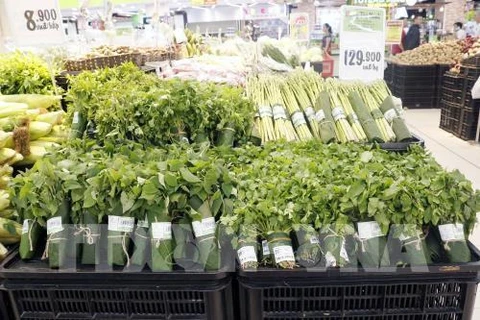
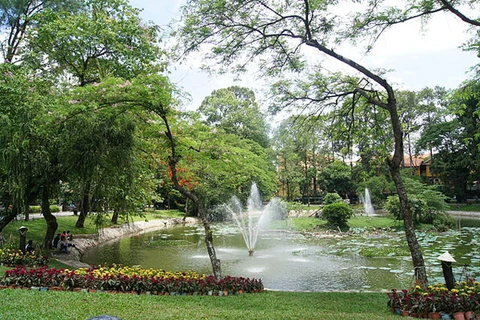
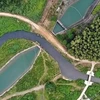
Parts of many parks in HCM City are being rented for cafe shops, eateries and other establishments contrary to their original purpose. (Photo: VNA)
 HCM City (VNS/VNA) - Rapid urbanisation is eating away at Ho Chi Minh City's green space, with parks coming under increasing threat from shops, cafes, office blocks and parking lots.
Ho Anh Tuan, who lives on Tan Binh district's Au Co street, has watched as green areas disappear around his home.
Tuan told the Vietnam News Agency that he wanted to exercise every morning but there was a lack of green spaces close by while remaining parks were too far away. He is forced to exercise on the street.
Living next to Le Thi Rieng Park in district 10, Nguyen My Oanh has recently been unable to fully enjoy the space.
She said the park was a place for everyone to relax after a hard day or at the weekend, but the space was increasingly invaded by shops and play areas, causing discomfort for local residents.
According to a newspaper report, the number of parks in the city is dwindling, with many divided into smaller areas or turned into parking lots.
Like Le Thi Rieng Park, many other parks in the city are also disappearing. A building for ceremonies and parties has been built in district 6’s Phu Lam Park.
Le Van Tam Park in the city centre often hosts fairs and exhibitions.
Land for parks in HCM City is limited and unevenly allocated.
For example, in district 1, there are large parks like Tao Dan, 23/9, 30/4 and Le Van Tam, while there are no large parks in district 3.
The land fund for parks in the city centre is almost non-existent, so most park projects included in city planning are located in outlying areas.
According to the city’s Department of Planning and Architecture, new parks are slated for districts 7, 12, Thu Duc, Hoc Mon, and Binh Chanh. But the spaces have not been built.
The Sai Gon Safari Park project in Cu Chi district, with an area of over 456ha, has been delayed for 15 years. No one knows when it will finally be built as the investor announced their withdrawal from the project, the newspaper reported.
Tran Quang Lam, Director of the city’s Transport Department, said the improper use of parks was because the city did not have a master plan for parks.
Hoang Tung, Deputy Director of the city's Planning and Architecture Department, said the department was assigned to adjust general planning, in which green space needed to be adjusted to fit the general planning because parks were a highlight of the city.
"With limited budget resources, the city gives priority to more urgent projects such as roads, flood-proofing works, schools and hospitals. So many park projects have been suspended," said Tung.
Chairman of the city’s People's Committee, Nguyen Thanh Phong, said: "The park is for people to relax, but there are many problems in management."
Under the plan, green space per capita is expected to be at least 7.2sq.m. In fact, residents enjoy just one tenth of this level.
This has a significant impact on residents' health and the environment, according to Phong.
Urgent solutions
In order to solve this problem, the municipal People's Committee has issued an urgent order to recover the green space.
The committee has instructed relevant departments and agencies to relocate buildings, offices, restaurants, shop and parking lots. But it is not easy to regain encroached land.
From the middle of 2018, Phong urged sectors and agencies to recover green spaces that were being used improperly. However, efforts have been slow.
Phong said land in 23/9 Park had been reclaimed three times, but in July many installations had not been dismantled, the newspaper reported.
Overlapping management between committees, sectors and agencies is to blame for the slow process in relocation of misused land.
The city leader also asked relevant agencies to upgrade existing parks while waiting for new ones.
Nguyen Dinh Hoa, an architect who has experience in city planning, said it was time for HCM City to increase its green spaces for residential and urban areas to improve living quality.
The municipal People’s Committee should approve the construction of apartment buildings in combination with parks, said Hoa.
In the near future, the city also plans to build five more parks in districts 12, Binh Thanh and Thu Duc, according to Nguyen Toan Thang, Director of the city’s Department of Natural Resources and Environment.
According to the city’s Department of Planning and Architecture, the city plans 11,400ha of parks by 2020, of which 491ha has been completed so far, accounting for 4.3 percent.
Green space per capita is expected to be at least 2.4sq.m in inner areas and 12sq.m in outlying areas by 2025.-VNS/VNA
VNA