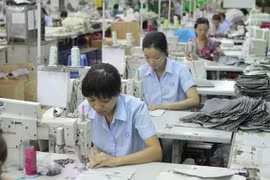
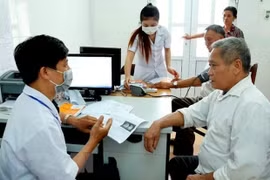
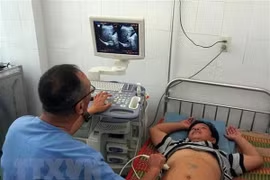
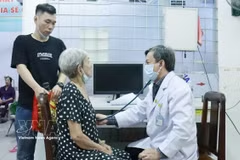
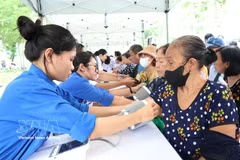
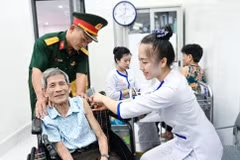
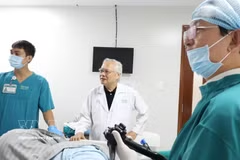
According to the Vietnam Social Security, Vietnam has 83.4 million health insurance cardholders, accounting for 88.1 percent of its population (Photo: VNA)
Hanoi (VNS/VNA) - The public health insurance fund paid more than halfa million US dollars for treatment of just a single patient over three years.
The 35-year-old haemophilia patient from thesouthern province of Vinh Long racked up medical costs which were coveredby public health insurance fund at a record rate – nearly 13 billion VND (560,000USD).
According to the Vietnam Social Security, the country’shealth insurance fund paid more than 4.5 billion VND for the patient’streatment in HCM City’s Cho Ray Hospital in 2017, another 7 billion VND in 2018and nearly 1.4 billion VND in the first five months of this year.
The payment marked a record amount that public healthinsurance fund has ever covered for an individual’s medical treatment since theearly 1990s when Vietnam’s first health insurance policies were passed.
As the patient is from a poor family he is eligible to getfree health insurance, meaning that the State’s budget was spent to buy healthinsurance for him. Besides those from poor families, people in 19 other groupsare also eligible for the incentive including children under 6 six years old,elderly over 80 years old, people from ethnic groups living in disadvantagedareas, certificated unemployed people and people who contributed to nationalrevolutions.
Meanwhile, the Government pays 70 percent of health insurancefees to help people from near-poor households to get insurance cards.
The yearly public health insurance fee in Vietnam is 750,600 VND(32 USD).
Comparing the two numbers – 750,600 VND and 13 billion VND,many people would be surprised and understand more about the meaning of healthinsurance participation, especially those in disadvantaged situations.
Doctor Nguyen Thi Mai, head of Haemophilia Centre underNational Institute of Haematology and Blood Transfusion, said patients withhaemophilia suffered the blood disorder disease for the whole of their livesand must undergo medical treatment for long periods.
She said their medical cost was about 400,000-500,000 millionVND on average yearly and patients at serious stages of the disease requiredtreatment that could cost billions of Vietnamese dong each year.
“The sum is not small at all even to non-poor people,” Maisaid.
A 30-year-old male patient Ho Huy Bao from the centralprovince of Ha Tinh said he was found to have haemophilia ten years ago and heusually had uncontrollable bleeding.
“I have undergone surgery to remove my left leg because oflast month’s bleeding,” Bao said, adding that after the surgery, the wound keptbleeding, which made him move to Bach Mai Hospital for curettage the wound andthen, back to the Haemophilia Centre.
Bao said that his medical treatment this time could cost morethan 1 billion VND.
“The treatment costs too much for my family to afford as wemainly do farming,” Bao said.
“Without health insurance, I could not continue thetreatment,” he said, adding that all of his medical treatment cost at thehospital was covered by health insurance.
Next to Bao is a 12-year-old boy from Chuong My district in Hanoi’ssuburban area. The boy looks healthier and more energised than other patientsin the room thanks to regular treatment, his mother Do Thi Thom said.
“Whenever he bleeds, he was taken to the hospital,” Thom said,adding that every hospital stay costs 20 million VND.
“We are relieved to see my son’s treatment cost covered byhealth insurance. He has to live with the disease for the rest of his life,”she said.
Head of the Haemophilia Centre – doctor Mai said healthinsurance was a lifeline for patients with life-threatening diseases likehaemophilia.
“Without the health insurance cards, many of them would notbe able to afford treatment costs and they might die,” Mai said.
“If public health insurance can expand its coverage topreventive and early treatment, it could help reduce burdens caused by thediseases, at least financial burden for both patients and the insurance fund,”Mai said.
According to the Vietnam Social Security, Vietnam has 83.4million health insurance cardholders, accounting for 88.1 percent of itspopulation.
By the end of this year’s first quarter, health insurancecardholders registered more than 41.7 million doctor’s visit, an increase of1.47 million visits compared to those of the same period last year.
Health insurance fund paid nearly 227 trillion VND, about 794billion VND more than that of the same period last year.
Vietnam expects to have 95 percent of its population joinhealth insurance by 2025.
Last year, the Government issued a decree to add morepeople eligible to join health insurance as well as the spendingof State’s budget and other legal funds to buy health insurance.
For examples, people from poor and near-poor households inmost disadvantaged areas in the country will be given free health insurancecards.
Those from poor or near-poor households in other areas willbe given 70 percent of health insurance fees. Some localities in the country offerhigher rates of assistance.
Thao said many patients and their families fell into povertyas they got diseases that required long and expensive treatment.
“Joining health insurance helped many patients avoid thepoverty trap,” he said, adding that patients who received huge amounts ofinsurance payments are usually those suffering from blood diseases,particularly haemophilia.
However, covering high-cost treatment for certain groups ofpatients did not affect the benefits of other health insurance cardholders.
“This reflects the basic principle of health insurance policy– the many pay for the few,” Thao said.
Thao added that the Vietnam Social Security was makingefforts in improving assessment and health insurance payment as well as callingon healthcare institutions and health insurance cardholders to use the fundeffectively.
“Ensuring the payment ability of the fund is to ensurebenefits of healthcare institutions and insurance cardholders,” he said. — VNS/VNA
VNA