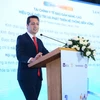
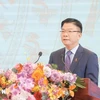
Deputy Nguyen Tri Thuc of HCM City speaks at the discussion on November 1. (Photo: VNA)
 Pointing to an increase in the number of cancer patients, deputy Nguyen Tri Thuc of Ho Chi Minh City cited data of the Union for International Cancer Control as showing that Vietnam recorded over 182,000 new cancer cases in 2020, and 60% of them required radiotherapy.
However, there are only 84 ordinary radiotherapy machines in the country, meeting about 60 - 70% of the demand. Notably, there haven’t been any proton therapy machines – the most advanced radiotherapy at present that minimises adverse effects on normal tissues.
Therefore, he proposed the Government establish a proton radiotherapy centre in Hanoi and another in Ho Chi Minh City to improve the quality of public health care.
Talking about the recent slow supply of pharmaceuticals, deputy Nguyen Lan Hieu of central Binh Dinh province noted bidding in drug procurement has been improved considerably, but the trading of consumable supplies remains a big problem.
He blamed the problem on the large number of legal regulations in this regard, making it hard to concurrently meet the rules of many different ministries and sectors when procuring. Besides, it is also difficult to purchase quality supplies as some bidders are ready to commit frauds to win bids at low prices.
Hieu proposed enhancing the requirements on warranty and technique transfer as only suppliers of quality goods accept a warranty period of up to five years. He added that these requirements will be useful for the health sector if they are facilitated by detailed guidance documents.
 Minister of Health Dao Hong Lan addresses the discussion on November 1. (Photo: VNA)
 She cited a report by the World Health Organisation (WHO) as saying that the shortages of pharmaceuticals and medical supplies is a prolonged challenge in many countries, and have become even more severe during and after the pandemic.
This problem has different causes, mainly the scarcity of material substances and soaring prices worldwide.
In that context, thanks to directions from the Party Central Committee, the NA and the Government, the close coordination from ministries, sectors, and localities, along with support from legislators, voters and the public, the sector has strived to address difficulties and reform working methodology.
In the long term, the health sector will invest efforts in fulfilling the set tasks and targets, building and perfecting regulations and strategies, improving the quality of health examination and treatment at all levels, stepping up the prevention of infectious diseases, and resolving outstanding problems pointed out by legislators, according to the minister./.
VNA