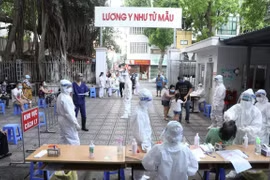
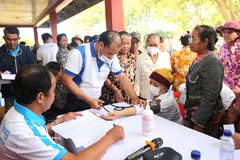
A healthcare worker provides check-ups for patients at the National Lung Hospital. (Photo: VietnamPlus)
Hanoi (VNA) - Grassroots healthcare plays a crucial role, contributing to stopping the spread of tuberculosis and protecting the community in the process, Dinh Van Luong, director of National Lung Hospital has said.
Luong made the remarks at a conference with health departments of cities and provinces nationwide on August 18 which reviewed TB prevention and control in the first six months of this year and set tasks for the remaining months of 2023.
Since the beginning of this year, the National Tuberculosis Control Programme (NTCP) has piloted a model of active TB detection in the community on a large scale with the involvement of the grassroots health system and guidance from leaders of the People's Committee and Health Department of Ninh Binh province.
The model has shown promising results and the programme is expected to continue to be multiplied to other localities on the basis of drawing lessons in the implementation process.
 Dinh Van Luong, Director of the National Lung Hospital, speaks at the conference. (Photo: VietnamPlus)
According to a WHO report, Vietnam is currently ranked 11th among 30 countries with the highest burden of tuberculosis and multidrug-resistant tuberculosis.
Each year, there are about 169,000 new tuberculosis cases in Vietnam, of which 4,000 are multidrug-resistant tuberculosis cases. This disease also causes about 14,200 deaths each year.
During the two years of the COVID-19 pandemic, TB prevention and control in Vietnam was actually elevated due to social distancing. This made Vietnam one of the countries with the highest reduction in TB detection globally.
The year 2022 witnessed strong recovery of the NTCP programme, with 103,120 TB patients detected, up nearly 31% year-on-year. However, it has detected only 60% of the estimated TB patients in the community.
Statistics from the NTCP programme showed that the number of new TB cases in the first six months of 2023 increased compared to the same period in 2020, 2021, 2022, and the year before the COVID-19 pandemic (2019).
Regarding drug-resistant TB, the total number of TB patients detected in the period was 1,632, and all of them received treatment. However, this result was just 36% of the set target.
The successful treatment rate of patients in the first two quarters of 2021 was 73%, lower than the set target (78%), and the dropout rate is high (12%) while the standard short-term regimen has been extended across the country.
 Participants at the conference. (Photo: VietnamPlus)
He said that the National Lung Hospital has set a goal of ending TB by 2035. If the target is missed, the consequences will be very serious as more than 12,000 people die of the disease every year, affecting the income of more than 100,000 families.
It should be noted that 70% of TB patients are of working age and the cost of treatment for most patients is around 20% of their annual income.
According to Luong, there are still many difficulties in the fight against tuberculosis, since 12 provinces still do not have tuberculosis and lung disease hospitals. Coupled with that, the merger of disease control centers has not yet been completed due to a lack of human resources.
He underlined the need to promote the role of grassroots healthcare in TB prevention and control, saying it will help detect people with suspected TB and high-risk groups to get timely medical care services.
Luong said that the grassroots health system provides effective diagnosis and treatment services. These are easy to access while ensuring that patients are diagnosed early and receive treatment to minimise the spread of disease in the community./.