Heat inversion worsens air pollution in Hanoi: report

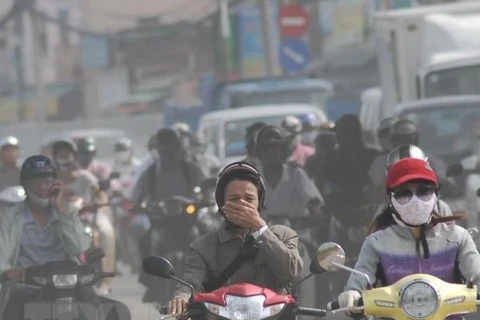
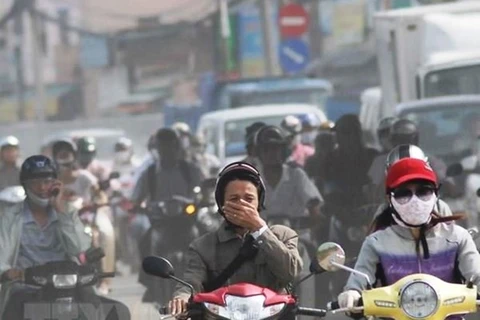
Many studies in Hanoi have shown that heat inversion is one of the main causes for recent sharp rises in pollutants, according to the Ministry of Natural Resources and Environment (MoNRE).
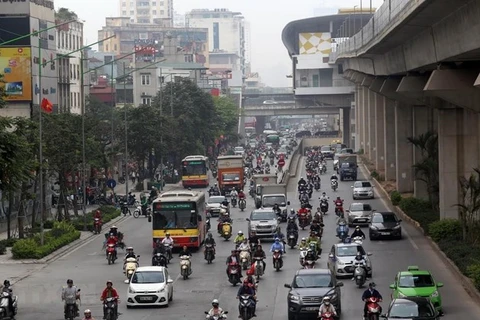
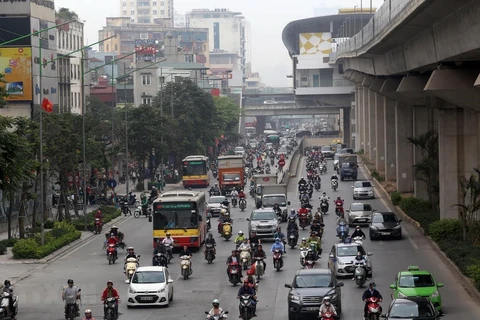
Heat inversion worsens air pollution in Hanoi: report ảnh 1A bus picks up passengers in Hanoi (Photo: VNA)

Hanoi (VNS/VNA) - Many studies in Hanoi haveshown that heat inversion is one of the main causes for recent sharp rises inpollutants, according to the Ministry of Natural Resources and Environment(MoNRE).

In a report released on September 4, the MoNRE said that inorder to comprehensively assess air quality in a certain area, it is necessaryto analyse and evaluate the monitoring data of many parameters continuously ondifferent days throughout the year.

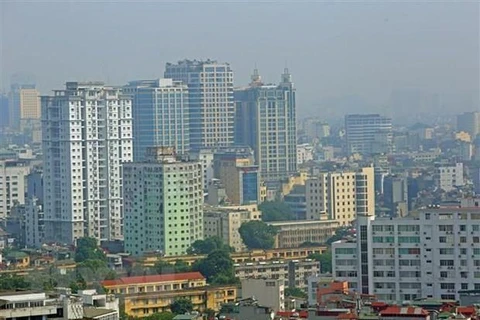
The report was released after Hanoi’s air quality has beenreported at harmful levels over recent days.

The monitoring results showed that the air pollution ismainly dust, especially PM2.5, a single particle that has a diameter of lessthan 2.5 micrometres.

Other parameters such as sulfur dioxide, nitrogen dioxide,carbon monoxide and ozone are still within permissible limits, except for somespots near roads with elevated levels of nitrogen dioxide.

The report said that during summer months in the rainy season,air quality is the best of the year. However, sometimes abnormal meteorologicalconditions led to increases in dust concentration.

On September 2, the PM2.5 dust concentration increased, thusair quality remained at a harmful level at air monitoring stations in thecapital city.

The PM2.5 dust concentration reached the highest level atnight and dawn on September 2, possibly because of a lack of wind limiting thecirculation of pollutants, according to the report.

In order to explain the meteorological conditions that causethe dust concentration to increase suddenly, it is necessary to conduct furtherstudies.

Recent research by the Hanoi University of Natural Resourcesand Environment said that heat inversion was an atmospheric phenomenon thatoccurred when the temperature of the upper atmosphere is greater than thetemperature of the lower atmosphere.

Heat inversion occurs at different times of the year, oftenwith high frequency in the winter when the air is stable, the nights are longand cold air is flowing in.

When heat inversion occurs, it stops the atmospheredisturbance process leaving pollutants trapped in the atmosphere.

This process raises the concentration of pollutants andaffects human health.

In developing countries, many studies have shown that humanhealth is affected by polluted air during the days of heat inversion. Heatinversion also causes acute respiratory diseases.

The MoNRE believes that to improve polluted air in Hanoi,it’s necessary to limit the number of personal vehicles in the city andencourage environmentally-friendly public transportation.

Industrial enterprises should be moved to suburban areas andreduce waste from construction work.

More inspections should also be conducted on vehicles.-VNS/VNA
VNA
See more

The forum takes place in Hanoi on August 25, 2026. (Photo: VNA)

Vietnam, RoK promote cooperation to deliver on net-zero commitments

Sectors such as semiconductor manufacturing, nuclear power, science and advanced technologies are playing an increasingly important role in national competitiveness and economic development of each country. They also offer considerable room for Vietnam and the RoK to expand professional exchanges, share experience and promote cooperation, particularly among their energy experts.

Storm Narra's projected path as of 7:00 on August 22. (Photo: National Centre for Hydro-Meteorological Forecasting)

Storm brings heavy rains to northern Vietnam

Storm Narra, the fourth to hit the East Sea this year, brought strong winds and heavy rains to northern Vietnam on early August 22, with some areas forecast to receive more than 500mm of rain as the storm moves slowly over the northern waters of the East Sea.

A view of the meeting between Phu Tho authorities and a visiting delegation from Germany's KfW Development Bank in the province on August 20, 2026. (Photo: VNA)

Phu Tho, German bank discuss wastewater treatment plan for Da River's left bank

The project is being implemented in the former Hoa Binh city, now Hoa Binh ward. It has a total investment of 688.7 billion VND (26.38 million USD), including 507.3 billion VND in ODA and 181.4 billion VND in counterpart funding. Major components include a wastewater treatment plant, pumping stations, a collection network, and connection infrastructure.

Construction workers reinforce steel and pour concrete to cover the underground drainage channel, helping collect rainwater and tackle flooding in Da Nang. (Photo: VNA)

A new “shield” against climate change

Smart urban areas are no longer simply about technology; they are becoming a tool that enables authorities to forecast risks, adapt quickly and protect their residents.

Vietnam is exerting efforts to cope with climate change. (Illustrative photo: VNA)

Vietnam approves carbon credit pact with Singapore under Paris Agreement

Signed on September 16, 2025, the Implementation Agreement on carbon credits collaboration under Article 6 of the Paris Agreement on climate change affirms Vietnam and Singapore’s pioneering role and commitment to close cooperation in the international carbon market, making a substantive contribution to global climate response.

A view of Vo Cuong ward, Bac Ninh province (Photo: VNA)

Bac Ninh earmarks over 1.7 billion USD for environmental protection

By 2030, Bac Ninh aims to ensure that all operating industrial clusters and industrial parks have centralised wastewater treatment systems meeting standards, while at least 95% of wastewater in Grade-I urban areas and 70% in Grade-II urban areas is collected and treated to required standards.

Many inland canals in Can Tho city dries up following a prolonged period of extreme heat. (Photo: VNA)

Government adopts action programme on environmental protection, climate resilience

The programme aims to translate the Party's orientations into concrete actions while strengthening environmental governance, enhancing climate resilience, and promoting a green, circular and low-carbon economy. It will serve as the basis for ministries, sectors and localities to formulate implementation plans for the 2026–2030 period, with a vision to 2045.