Hi-tech application touted as solution to climate change adaptation

Vietnam has been promoting the application of high technologies in agriculture production as part of efforts to adapt to climate change and strive towards sustainable agriculture development, heard the Asia-Europe Meeting (ASEM) in Mekong Delta city of Can Tho on July 19.
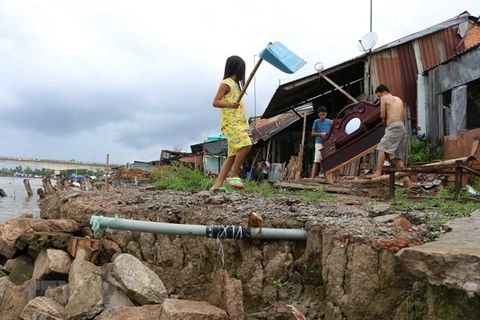
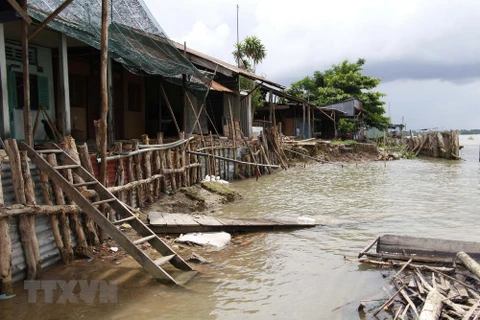
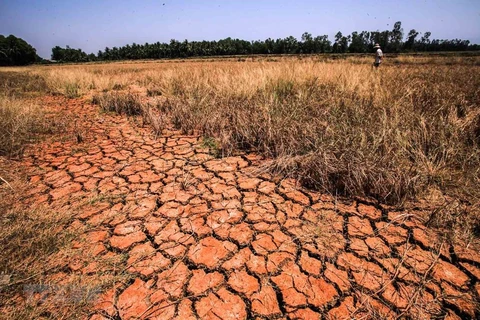
Hi-tech application touted as solution to climate change adaptation ảnh 1Illustrative image (Source: VNA)

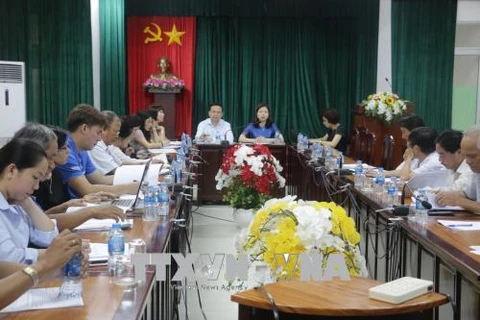
CanTho (VNA) - Vietnam has been promoting the application of high technologiesin agriculture production as part of efforts to adapt to climate change andstrive towards sustainable agriculture development, heard the Asia-Europe Meeting (ASEM) in MekongDelta city of Can Tho on July 19.

Participantsto the event are debating impacts caused by climate change on the regionalagriculture as well as advantages and challenges of the progress towardssustainable agricultural development and adaptation to climate change in ASEMmember countries.

Dr. Tang The Cuong, Director of the Department of Climate Change under theMinistry of Natural Resources and Environment stressed that Vietnam considersclimate change response as a vital task as it is one ofthe countries hardest hit by climate change.

TheVietnamese Government has taken drastic actions in restructuring its economy,especially agricultural restructuring, in order to cope with climate change,with the most effective solution being hi-tech application.

In recent years, many technological solutions have been used in agricultureproduction in Vietnam, bringing effective results, Cuong said, citing asexamples the production of safe vegetables in line with VietGAP standards, water-savingirrigation, hydroponic vegetable production, irradiation technology for preservingfruits, and super-intensive Tra fish farming.

Sharing Cuong’s opinion, Dr. Jan Verhagen from the Wageningen University and ResearchCentre of the Netherlands said his country adopted a strategy to invest inagriculture production and restructuring over the last two decades, aiming to increaseproductivity while reducing raw materials.

To realise the goal, the Dutch Government gave priority to improving soilquality, building canal systems and promoting mechanization, he said, notingthat thanks to the investment, the Netherlands has become the second biggestexporter of agricultural products in the world despite its small area and highpopulation density.

ASEM member economies should consider technology as a solid and decisive factorfor the development of regional agriculture amid the unpredictable climatechange, he suggested.

Participants said it is necessary to have regional-level cooperation projects amongASEM member countries in investing resources, transferring technique-experience,and training human resources, in order to help developing countries applytechnology more effectively.

Sein Htoon Linn from Myanmar’s Ministry of Natural Resources and EnvironmentConversation said his country is willing to share solutions to adapting to naturaldisasters, which are applied effectively for its agriculture sector.

Meanwhile, Andrea Faulkner,Assistant Secretary at the Australian Department of Foreign Affairs and Trade, said her country hopes to transfer its technology in agriculture, which used dedicatedremote sensing satellites to record data of soil quality, humidity, air andatmospheric pressure, helping with the analysis of changes of crops and waterquality.

Recorded data will be publicised on the Internet, enabling farmers to closelymonitor the development of crop, pest and other threats, thus taking appropriateinterventions in right places and time, she said.

Thesmart cultivation model has helped Australian farmers save fuel, seeds,fertilizers, plant protection products and water, bringing high efficiency and sustainability,she noted.

Participants also said that development economies need to have incentivepolicies for enterprises joining hi-tech agriculture, especially private firmsas they are playing a key role in investing in sustainable agriculturedevelopment and climate change adaptation.

The ASEM Conference on Climate Action toAchieving the Sustainable Development Goals - Ways Forward is one of the mostimportant inter-regional events on climate change and the only one of ASEM 2018hosted by Vietnam. It is an initiative of Vietnam which was approved at the13th ASEM Ministerial Meeting last November in Myanmar and won support andsponsorship from many countries.-VNA
VNA
See more

Deputy Director of the Vietnam National Innovation Centre (NIC) Do Tien Thinh speaks at the launch of RE:ACT in Hanoi on August 7. (Photo: NIC)

Youth innovation challenge for sustainable communities launched

Unlike conventional idea-based competitions, RE:ACT focuses on deploying solutions that have already reached the minimum viable product stage through Living Labs – community-based pilot environments where innovations are tested under real-world conditions.

The special national science, technology and innovation programme on strategic technologies targets mastery of at least four strategic technologies for 2026-2030. (Photo: baochinhphu.vn)

Vietnam approves national programme on strategic technologies

The programme seeks to master, develop, perfect and commercialise highly competitive strategic technology products, with priority given to core technologies. It also aims to build a strategic technology ecosystem and strengthen linkages among the State, businesses and science and technology organisations.

FPT Group headquarters ( Photo courtesy of FPT)

FPT named an OpenAI Select Partner

Under the partnership, FPT and OpenAI will work together to help businesses develop AI transformation roadmaps, build AI platforms, strengthen workforce capabilities and deploy responsible AI solutions tailored to their operational needs.

Dak Lak province's Smart City Monitoring and Operations Centre manages and operates the provincial data centre, as well as shared digital platforms and software systems used across the province. (Photo: VNA)

Vietnam draws hyperscalers, cloud titans, AI players

These developments highlight growing confidence in Vietnam as a destination for hyperscale, cloud, and AI infrastructure. The broader digital infrastructure ecosystem also strengthened during the period.

 Da Nang seeks to become a strategic investment destination

Da Nang seeks to become a strategic investment destination

Da Nang is accelerating efforts to attract investment and mobilise social resources for new development models, leveraging expanded development space, special policy mechanisms and institutional reforms to position itself as a strategic investment destination and a pioneer in Vietnam's economic growth in the new era.

PM Le Minh Hung chairs the second meeting of the National Cybersecurity Steering Committee on August 6. (Photo: VNA)

PM urges stronger coordination in cybersecurity response

PM Le Minh Hung pushed for the Regional Counter Cybercrime Hub for Asia-Pacific to be put into operation in 2027, a “Cybersecurity Economy” initiative to be prepped for APEC 2027, stronger specialised cybersecurity agencies, and an expansion of the national cybersecurity operations centre by the second quarter of 2028.

An overview of BSides Hanoi 2026 on August 5 (Photo: baodautu.vn)

Trust emerges as one of modern cybersecurity’s biggest challenges

Speaking at the event, VSEC Chairman Truong Duc Luong said this was the second time BSides has been held in Hanoi, continuing to attract strong interest from the cybersecurity community. BSides Hanoi 2026 was designed as a platform connecting Vietnam’s cybersecurity community with international networks, encouraging knowledge sharing and contributing to the sustainable development of the cybersecurity ecosystem.

AI Day 2026 product showcase area. (Photo: VNA)

Vietnam positioned to harness AI wave, World Bank report says

The WB report identifies Vietnam as one of the few economies outside the European Union (EU) to have adopted a comprehensive AI regulatory framework as early as 2025. Vietnam applies a risk-tiered approach similar to that of the EU AI Act, imposing different obligations depending on whether an AI system poses “unacceptable,” “high,” “low” or “minimal” risks. The approach is viewed as a strategic step towards ensuring safe and transparent AI governance.

Thai Binh Seed Group JSC is one of Vietnam’s leading crop seed producers, holding rights for 30 varieties and operating three globally certified plants. (Photo: VNA)

Politburo’s Resolution 57-NQ/TW powers new growth momentum

NSO Director Nguyen Thi Huong said alongside foreign investment and the green economy, science – technology, innovation, the digital economy and digital transformation are the new drivers that can can pack a serious second-half punch.

Research lab of the Vietnam National University Ho Chi Minh City. (Illustrative photo published by VNA)

Drastic measures taken to turn Resolution 57 into action

A recent meeting of the Central Steering Committee on science, technology, innovation and digital transformation, chaired by Party General Secretary and State President To Lam, marked a new phase in implementing Resolution 57 following the committee’s restructuring.

A view of Kinh Bac Ward in Bac Ninh Province. (Photo: VNA)

Bac Ninh targets world's top 50 smart cities by 2030

According to Chairman of the provincial People's Committee Pham Hoang Son, the province will pursue a people-centred smart city model driven by science, technology, innovation and digital transformation to improve public services, urban management and competitiveness.

Illustrative photo: VNA

Vietnam expected to fast-track mastery, rollout of 6G technology

Vietnam has so far deployed more than 40,000 5G base transceiver stations (BTSs), providing coverage for about 92% of the population, making it one of the world's fastest countries in this regard. By comparison, many advanced economies typically take two to three years to extend 5G coverage to more than 80% of their populations.

Deputy Prime Minister Ho Quoc Dung chairs the meeting in Hanoi on July 31 to discuss the establishment of a high-tech park in the northern province of Hung Yen. (Photo: VNA)

Deputy PM chairs meeting on establishment of Hung Yen High-Tech Park

Chairman of the Hung Yen provincial People’s Committee Nguyen Manh Quyen said the proposed high-tech park will cover about 496.1 hectares in Hoan Long and Viet Yen communes. The location is expected to attract high-quality talent and innovation resources from Hanoi while strengthening production and logistics links across the Northern Key Economic Region, including Bac Ninh, Hai Phong, Quang Ninh, Phu Tho and Ninh Binh.