Hi-tech parks need more investment

As the development of hi-tech parks in Vietnam is still below expectations, they are seeking measures to attract more investments, especially in research and development projects.
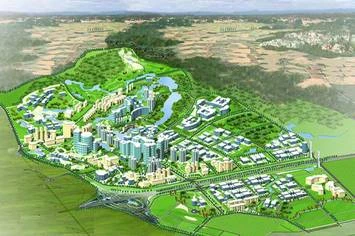
Hi-tech parks need more investment ảnh 1Illustrative image (Source: VNA)

Hanoi (VNA) - As the development of hi-tech parks in Vietnam is still below expectations, they are seeking measures to attract more investments, especially in research and development projects.

Deputy Minister of Science and Technology Tran Viet Thanh said the establishment of national hi-tech parks aimed to boost science and technology to narrow the gaps with other countries in the region and the world.

Still, the development of hi-tech parks is not as efficient as expected due to several problems in investment policies and shortage of technical infrastructure.

Vietnam has three national hi-tech parks, namely Hoa Lac, HCM City and Da Nang.

At a recent meeting, Deputy Head of the HCM City Hi-Tech Park Le Thi Bich Loan said there are still overlaps and inconsistencies in regulations, which cause difficulties in the development of hi-tech parks.

The shortage of capital for technical infrastructure development is a problem, in addition to poor investment management and lack of special mechanisms, said Nguyen Quang Dai from Da Nang Hi-Tech Park's Department of Planning and Investment.

Representatives from national hi-tech parks have proposed incentives for ​(R&D) projects, as many foreign direct investment projects do not bring R&D activities into Vietnam.

In addition, investment promotion programmes should be organised for the three national hi-tech parks, together with early promulgation of legal documents related to investments in hi-tech parks in line with the Law on High Technology and the Law on Science and Technology.

Statistics showed that Hoa Lac Hi-Tech Park has so far attracted nearly 55.4 trillion VND (2.47 billion USD) into 69 projects, 32 of which are currently under operation, while HCM City Hi-Tech Park has attracted 82 projects, worth more than 4.3 billion USD.

Under the planning for hi-tech park development for 2020 with a vision towards 2030, approved by the Prime Minister in June, the focus will be on developing synchronised infrastructure systems for the three existing hi-tech parks.

In addition, three more hi-tech parks will be founded in Hanoi and Dong Nai and Binh Duong provinces.-VNA

VNA

See more

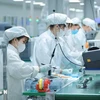
Students practice microcontroller programming at the Viet - Han College of Technology in Bac Ninh province (Photo: VNA)

Vietnam steps up semiconductor talent training to meet market demand

Vietnam needs to step up semiconductor workforce training to meet growing market demand and enhance its capacity to participate in the global technology value chain, experts said, highlighting the importance of closely linking training with businesses, production and technological research.

Vietnam seeks to boost education and technology cooperation with France

Vietnam seeks to boost education and technology cooperation with France

Education and training, science and technology, and high-quality human resources are key areas of cooperation in Vietnam-France relations, said Politburo Member, Secretary of the Communist Party of Vietnam Central Committee, and Chairman of its Commission for Organisation Nguyen Duy Ngoc while visiting the Institut Polytechnique de Paris on September 11.

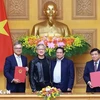
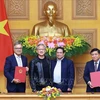
General Secretary of the Communist Party of Vietnam Central Committee and President To Lam witnesses the exchange of cooperation agreements between the two countries. (Photo: VNA)

Vietnam, France deepen cooperation in science, technology, workforce training

The University of Science and Technology of Hanoi (USTH), under the Vietnam Academy of Science and Technology (VAST), and the French Alternative Energies and Atomic Energy Commission (CEA) exchanged two cooperation agreements in Paris on September 11, in the presence of General Secretary of the Communist Party of Vietnam Central Committee and President To Lam.

A display area for unmanned aerial vehicles (UAVs) at a workshop in Da Nang city on June 12, 2026. (Photo: VNA)

Vietnam eyes UAV industry as key driver of low-altitude economy

For Vietnam, the opportunity presented by unmanned aerial vehicles (UAVs) lies not only in expanding their applications but, more importantly, in gradually building industrial capacity, mastering technologies and engaging more deeply in global value chains.

A semiconductor chip by TSMC (Photo: VCG)

Vietnam seeks deeper integration into global semiconductor value chains

Nguyen Anh Tuan, Director of the National Centre for Pilot Semiconductor Chip Manufacturing Support under the Ministry of Science and Technology, said that amid increasingly intense global technological competition, the semiconductor industry is not only a high-value-added economic sector but also a foundation for technological self-reliance, national security and economic competitiveness.

Demonstration of an autonomous electric street sweeper. (Photo: VNA)

Hanoi approves controlled pilot of two technology projects

The two projects involve an intelligent autonomous transportation system developed by Phenikaa-X JSC and a technology for producing mixed rare-earth oxides with a purity of over 95% on a semi-industrial scale developed by the Mining Technology and Construction Consultancy JSC.

Prof. Dr. Tran Hong Thai, President of the Vietnam Academy of Science and Technology (VAST), has a working session with leaders of Russia’s State Atomic Energy Corporation Rosatom. (Photo: VNA)

Vietnam, Russia develop quantum technology cooperation roadmap

Quantum technology is an emerging field undergoing rapid breakthroughs and requiring enormous investment resources. Learning from the experience of pioneering countries such as Russia will enable Vietnam to significantly shorten the time needed to build its workforce and develop endogenous capabilities.

Senior Vice-President of Latin America and Asia at Thales Group Guy Bonassi (L) at a meeting with Vietnamese Ambassador to France Trinh Duc Hai (Photo published by VNA)

Vietnam, France should expand cooperation in strategic fields: business leader

General Secretary of the Communist Party of Vietnam Central Committee and President To Lam’s visit to France, Guy Bonassi, Senior Vice-President of Latin America and Asia at Thales Group, said the upgrade of bilateral ties to a Comprehensive Strategic Partnership reflects their shared desire to deepen and broaden cooperation, with technological autonomy, resilience and human resources development assuming increasingly important roles.

The Vietnamese delegation led by Deputy Prime Minister Ho Quoc Dung visits the Korea Institute of Science and Technology (KIST). (Photo: VNA)

Vietnam, RoK promote strategic technological cooperation

Deputy Prime Minister Ho Quoc Dung proposed expanding joint research programmes, particularly in strategic areas where Vietnam has development needs, and KIST has strengths, including semiconductor integrated circuits, AI, batteries and energy storage, and biotechnology.

Digital transformation brings economic benefits closer to businesses

Digital transformation brings economic benefits closer to businesses

In addition to streamlining processes and reducing the time required to complete administrative procedures, digital models are creating more opportunities for businesses, household enterprises and small traders to access information, adopt new payment methods, connect with partners and expand their markets.