Hoi An Ancient Town – attraction of Asia's leading cultural destination

Stepping into the ancient city of Hoi An in the south-central province of Quang Nam, visitors can deeply feel a diverse and artistic blend of typical architectural works from the Japanese, Chinese, Vietnamese and French cultures.
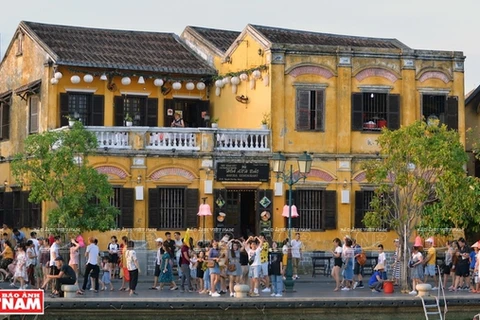
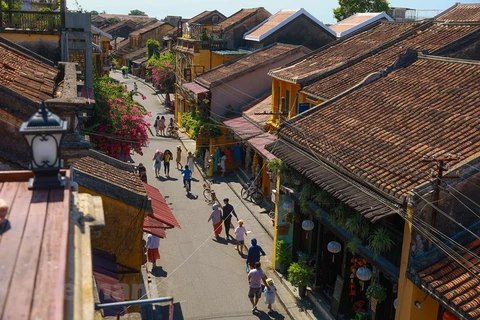
Hoi An Ancient Town – attraction of Asia's leading cultural destination ảnh 1Tourists at Hoi An (Photo: VNA)

Hanoi (VNA) - Stepping into the ancient city of Hoi An in the south-central province of Quang Nam, visitors can deeply feel a diverse and artistic blend of typical architectural works from the Japanese, Chinese, Vietnamese and French cultures.

Located in the lower reach of Thu Bon River in the coastal plain in Quang Nam province, about 30 km south of Da Nang city, Hoi An has been known in the international market by various names such as Lam Ap, Faifo, Hoai Pho and Hoi An. The only Southeast Asian port-market in Vietnam and very rare in the world, Hoi An keeps almost 1,360 architectural relics intact. These include streets, houses, assembly halls, communal houses, pagodas, shrines, clan houses, ancient wells and tombs. They exhibit both Vietnamese traditional art characteristics and the convergence of eastern and western cultures.

The cultural and economic exchanges that occurred from the 16th to 19th centuries have left in ancient Hoi An most of the forms of Vietnam’s ancient architecture, grouping traditional national arts enriched with sketches of foreign arts.

Researchers hold that the ancient architecture in Hoi An was renewed in the early part of the 19th century, but the real starting point could be much earlier. The ancient architecture is clearest seen in the ancient quarter located inside Minh An ward, covering about 2 square km and housing most of the famous relics in Hoi An.

The streets in the ancient quarter are short, narrow and crisscrossing.

Architectural works there were mostly built from traditional materials, including brick and wood, and they are not higher than two storeys.

It is easy for tourists to recognise traces of the time not only in the architectural design of each construction but also everywhere else, from moss-covered tile roofs, walls, sculptures depicting a strange creature or an ancient story. It is a convergence of Chinese, Japanese, Vietnamese and Cham artisans. Each construction still bears the cultural hallmarks of many nations. At present, Hoi An is still the dwelling place of thousands of residents, serving as a living museum in terms of architecture and urban lifestyle.

Through centuries, customs and practices, rites, cultural and belief activities as well as traditional foods of Hoi An are still kept and preserved along with generations of ancient street dwellers. The town also boasts a natural environment which is healthy and peaceful with small suburban villages engaged in crafts like carpentry and pottery.

On December 4, 1999, in Marrakech city of Morocco, the 23rd session of the World Heritage Committee of the UNESCO officially included Hoi An ancient town into the list of world’s cultural heritage sites.

It is honoured by many famous travel magazines. In July 2019, with 90.39 points, Hoi An was elected by the Travel and Leisure travel magazine as the most attractive city in the world that year. It is also the first tourist site in Vietnam honoured by the Google Doodle./.
VNA

See more

The Dien Bien Phu campaign headquarters has become a popular tourist attraction in Dien Bien province. (Photo: VNA)

Dien Bien Phu tourism cable car project receives in-principle approval

The project aims to effectively tap the area’s natural landscapes, geographical advantages and distinctive historical value, while creating a high-quality tourism product with strong competitiveness. It is also intended to preserve, honour and promote the value of the Dien Bien Phu Victory special national historical relic site.

Da Lat station is the hub of the roughly 84-km Phan Rang–Da Lat railway (Photo: VNA)

Da Lat city's century-old railway station doubles as tourist draw

It now functions as both a transport hub and a sought-after photo spot. In the early morning, with mist still threaded through the pines, the station radiates an old-world calm. Visitors arrive at dawn to breathe the mountain air and capture iconic images of the highland city.

Ha Long Bay in Quang Ninh province. (Photo: VNA)

Quang Ninh - magnet for affluent Indian travellers

Alongside wedding tourism, Quang Ninh is also seeing robust growth in arrivals of Indian MICE travellers. Delegations of hundreds, and sometimes thousands, of visitors have been coming to the province for conferences, seminars and incentive travel programmes combined with leisure stays.

Visitors explore the Tra Su cajuput forest in An Giang province. (Photo: Tra Su Tourism Area)

Mekong Delta eyes stronger foothold in global tourism

Enriched by the alluvial deposits of the Mekong River, the region stands out for its dense canal network, year-round fruit orchards, biodiversity-rich national parks, and vibrant folk festivals – invaluable assets for developing diverse tourism offerings, from orchard-based eco-tourism and river experiences to cultural, festival, resort and nature conservation tourism.

A Lunar New Year court ceremony of Nguyen Dynasty is reenacted at Thai Hoa Palace in the Imperial Citadel of Hue (Photo: VNA)

Culinary, heritage passports reshape cultural tourism

The central city of Hue is among the first to forge new paths. Its “Hue Tourism Passport” began as a destination brochure in 2018 and has since evolved into the “Hue City Passport” app, with a heritage-passport feature that strings monuments into a structured journey.

Phu Quoc International Airport in Phu Quoc special zone of An Giang province. (Photo: VNA)

Air travel surges to 1.68 million passengers during holiday periods

Domestic air travel accounted for 675,140 passengers and 3,400 tonnes of cargo, marking declines of 7.5% and 11.6%, respectively. In contrast, international transport showed robust growth, surpassing 1 million passengers and reaching 24,050 tonnes of cargo, up 10% in passenger numbers and 10.6% in cargo volume.

International visitors admire the beauty of the My Son Cham sanctuary in Duy Xuyen, Da Nang. (Photo: VNA)

Vietnam records 2 million foreign arrivals in April

The Vietnam National Authority of Tourism (VNAT) said the figures highlight the country’s rising profile as a safe, stable and increasingly compelling destination. It is the first time Vietnam has surpassed 2 million foreign arrivals for four straight months, and the first time the January – April tally has reached 8.8 million.

The Cau Vang (Golden Bridge) in the central city of Da Nang. (Photo: VNA)

Ho Chi Minh City, Da Nang lead Thai tourists’ searches

Data from the online booking platform Agoda shows that Ho Chi Minh City recorded the highest growth in searches from Thailand, reaching 134%, followed by Da Nang with a 58% increase. Other destinations such as Hong Kong (China) saw more modest growth.