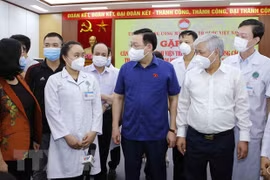
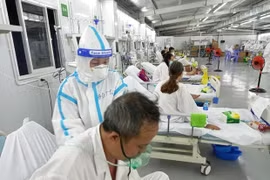
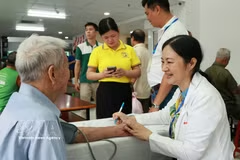
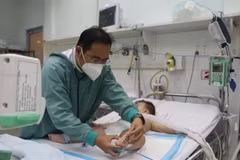
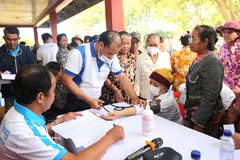
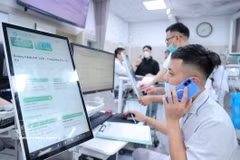
Medical supply shortages in multiple hospitals have caused a major impact on treatment for patients. (Photo: VNA)
The situation has been affecting a large number of patients, with someeven buying their own from outside sources.
After three days in the emergency room for a femoral neck fracture, Nguyen Thi Minh’smother was scheduled for hip replacement surgery.
However, the operation was postponed due to insufficient medical supplies.
Minh said: “I thought that my mum would soon have the surgery so that she canquickly recover.
“However, the doctors told us that it was postponed, as the hospital has justperformed several emergency operations, which led to a shortage of medicalsupplies.
“We were told that the new schedule would be announced as soon as possible.”
Meanwhile, other patients had to buy medicine and surgical instrumentsfrom outside sources.
Linh, a Hanoi resident, had to go out herself to buy hypodermicneedles and catheters for her relative who was undergoing surgery.
It cost her 800,000 VND (34.4 USD) in total, and was not covered by theinsurance.
Linh said: "It was not a large amount, but the supply shortage is makingus miserable.
"It was only just before the day of the surgery, and I wasstill rushing to buy the catheters."
Another hospital manager in Hanoi who asked not to be named said: “Lackingmedical supplies after emergency cases, we constantly need to apologise topatients for postponing their surgeries.”
“In many cases, we have to advise them about the choices they have -either wait so that they can be covered with medical insurance, or agreeto buy supplies from external sources, or they can choose to go to othermedical facilities.”
According to Doctor Tran Van Phuc from Saint Paul General Hospital, the currentshortage of medical supplies and medicine was due to delays in bidding and procurement.
He said: “In the current legal context instruction circulars have not yetcovered all the possible situations, and arrests for bidding violations havecaused unease among the procurement staff.
“It is obvious that the violators must take responsibility for their actions,but it is also necessary to improve the legal framework so that the currentstaff have guarantees in their work.
“Health policy makers need to take into consideration the majority ofthe patients.”
Phuc added that centralised bidding is now showing several shortcomings, andadjustments are needed.
One of the problems is the costs in the bidding plan, which is the reason forthe shortage of medical supplies and the unrepairable equipment.
According to Provision 01/2012/TTLT-BYT-BTC, units responsible for the pricingin the plan have to refer to the winning bid prices within the previous 12months, as updated by the Ministry of Health.
Hospitals would then decide on the lowest price point. However, in reality,pricing from the sources for materials, storage, transportation anddistribution can increase, and therefore these medical facilities cannotprocure supplies at the planned prices.
Dr Nguyen Huy Quang, former head of the health ministry’s department of legalaffairs, said: “The major issue that the health sector is struggling with rightnow is that the staff can easily become violators, especially in procuringmedical equipment.”
Many medical facilities are not aware of the legal frameworks. Therefore, it isnecessary to have official instruction documents to specify the laws on publicproperty, public investment, and bidding.
Quang added that there should be a separate regulation for the health sector,as it directly concerns people’s health.
“This will help the sector have a transparent legal framework that couldregulate any related issues," he said.
“It will also create an institution to manage and protect bidding participants,otherwise they would be very confused and perplexed.”
Discussing this topic in a recent meeting on amending the Law on MedicalExamination and Treatment, Dr Nguyen Anh Tri said that the procurement ofmedical supplies, biologicals and medicine is seeing a major disruption, whichgreatly affected the patients and the people.
Dr Tri also recommends prioritising legal amendments, including the Law onMedical Examination and Treatment, Law on Health Insurance, and Law onPrevention and Control of Infectious Diseases, as well as the relevant decreesand laws, such as the laws on price, procurement, and public property.
“A comprehensive and suitable legal framework is needed for medical workers tofollow,” he said./.
VNA