How does yuan price reduction affect garment, footwear industries?

The sudden depreciation of Chinese yuan against the US dollar brings more difficulties to Vietnam’s yarn industry, according to Vietnam Textile and Apparel Association (VITAS).
How does yuan price reduction affect garment, footwear industries?
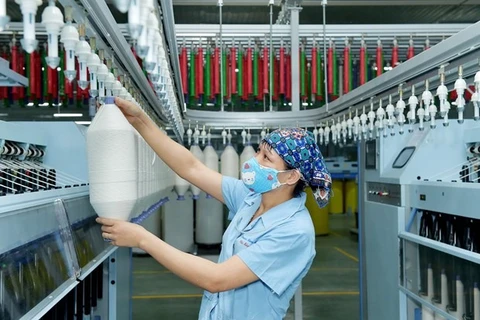
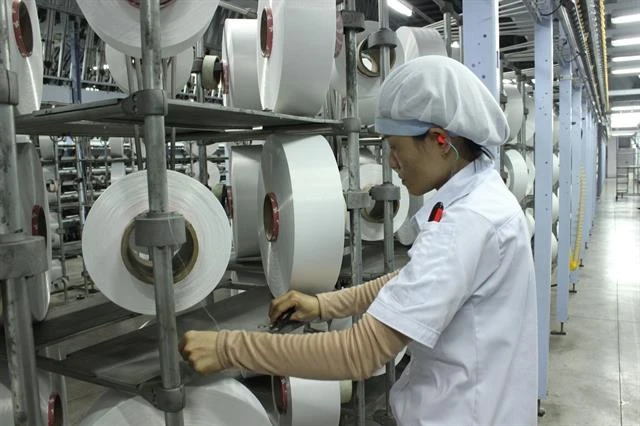
How does yuan price reduction affect garment, footwear industries? ảnh 1A worker of Dinh Vu Polyester Fibre Plant in the northern port city of Hai Phong (Photo: VNA)

Hanoi (VNA) - The sudden depreciationof Chinese yuan against the US dollar brings more difficulties to Vietnam’syarn industry, according to Vietnam Textile and Apparel Association (VITAS).

Vietnam imports cotton from the US to make yarn products for export to China.
If the yuan continues to fall, Vietnam's yarn producers will continue to facedifficulties, the association said.

VITAS Chairman Vu Duc Giang told the Vietnam News Agency that due to theUS-China trade war, in the period from May to September 2018, Vietnam yarnexport price to China dropped from an average of 3.05 USD to 2.99 USD per kilo,down by 1.97 percent, causing average yarn export value each month to decreaseby 2.5 percent.

According to experts, the US-China trade saw Chinese yarn importers buy theminimum quantity to meet manufacturers’ demand.

Giang said Vietnam yarn exports had been mainly shipped to China, accountingfor more than 60 percent of total annual yarn export value to the world. Vietnamis also one of China’s major yarn suppliers, with a continuously growing marketshare.

In 2014, Vietnam ranked third in China's yarn import markets, after India andPakistan. In 2017 and 2018, Vietnam rose to the first place, accounting for 30 percentof China's yarn imports, higher than both India and Pakistan.

The Dam San Joint Stock Company’s representative said in the past, the companysold 1,400 tonnes of yarns to China, but now the volume was declining sharplyand even in September, it would not have export contracts to sign.

According to some enterprises, Chinese partners have pressured firms to reducefurther import prices.

Other markets such as the Republic of Korea, Japan, Egypt, Turkey, the Philippinesand Taiwan still have orders but only small quantity.

They also face fierce competition from domestic foreign-invested (FDI)enterprises and businesses from competing countries such as India, Thailand,Indonesia, and Pakistan to get contracts.

The selling price is still on a downward trend and there is no sign ofrecovery, while China has launched a large amount of cotton stockpiles, which makescotton prices fall sharply.

The Vietnam Yarn Association said this year, the export volume of Vietnameseyarn industry would reduce by 10-15 percent year on year and the selling pricehad also dropped from 3.5 USD to 2.8 USD per kilo at present. Therefore, theindustry could suffer no less than 500 million USD.

Meanwhile, Phi Viet Trinh, General Director of the Ho Guom Garment Group, saidhis company exports to Europe, Japan and the Republic of Korea who pay in USdollar so the depreciation of yuan would not have much effect on his group.

Than Duc Viet, General Director of the May 10 Corporation, also said the May 10had not had much export volume to China and its payment was mainly in US dollarso it would not be affected much by the yuan depreciation.

For the domestic leather and footwear industry, Phan Thi Thanh Xuan, SecretaryGeneral of the Vietnam Leather and Footwear Association (Lefaso), saidenterprises had to import many raw materials from China. However, thesecontracts mainly came from large-scale businesses and foreign direct investmentfirms so the payment for the contracts were in US dollar.

Lefaso was following developments in import and export activities of theindustry to be able to inform its members, especially in the last quarter whenthe enterprises promote production meeting higher demand for holidays.-VNA
VNA
See more

Steel products of Hoa Phat Group. (Photo: VNA)

Vietnam aims to meet 80–85% of domestic steel demand by 2030

Vietnam aims to meet 80–85% of domestic steel demand by 2030. Crude steel production is targeted at 25–26 million tonnes per year, with annual growth of 7–8%, while finished steel output is expected to reach 32–33 million tonnes per year, growing by 5.5–6.5% annually. Per capita steel consumption is projected at 270–280 kg per year.

One of the products granted Halal certification in 2026. (Photo: moit.gov.vn)

Spring Fair 2026 boosts momentum for Vietnam’s Halal sector

The fair’s greatest value for Halal products lies less in immediate revenue than in building trust and standardising business practices. In a market where certification determines entry, it highlights that expansion must begin with fundamentals, standards, raw materials, production processes and readiness.

Prime Minister Pham Minh Chinh speaks at the fifth meeting of the Steering Committee for Nuclear Power Plant Construction. (Photo: VNA)

PM calls for more vigorous implementation of nuclear power projects

Describing nuclear power plants as nationally significant, strategic projects with a century-long vision, PM Chinh called for urgent and responsible implementation of tasks within assigned authority, with any outstanding issues promptly reported to higher authorities.

Vehicles transporting import and export goods at Bac Luan II Bridge border gate. (Photo: VNA)

Building smart border gates to enhance competitiveness, drive growth

With plans to build the Mong Cai–Ha Long–Hai Phong railway alongside the smart border gate and economic cooperation zone, Quang Ninh is positioning itself as a new growth pole in northern Vietnam and a key gateway for economic cooperation between Vietnam, ASEAN and China.

Noi Bai International Airport is expected to receive a record number of passengers (Photo: VNA)

Noi Bai, Tan Son Nhat airports expect record passenger volumes during Tet

Information from Noi Bai International Airport showed that during the peak Tet period, passenger traffic is forecast to reach a record high, posting double-digit growth year on year. Specifically, in the seven days before Tet (February 10–16), Noi Bai is expected to serve more than 725,000 passengers, up 16% from the same period in 2025, with 4,467 flights, an increase of 12.5%.

The booth of Lang Son province brings about distinctive local products to the fair, and also implemented various promotional programmes to stimulate consumer demand (Photo: VNA)

Spring Fair 2026 spreads cultural values, boost trade

From handwoven brocade textiles to traditional ethnic costumes, the fair presents vivid cultural colours and highlights how local producers are introducing heritage products to the modern market, expanding consumer reach, building brands, and strengthening trade links.

Hanoi markets come alive as Tet 2026 approaching (Photo: nhandan.vn)

Hanoi markets come alive as Tet 2026 approaching

A recent survey shows flower prices have seen only slight fluctuations this year thanks to favourable weather conditions. Peach blossoms are priced from 200,000 VND to several million VND, depending on size and shape.

Ho Chi Minh City’s public spending rose in 2025 but fell short of the amount it had targeted (Photo: dangcongsan.vn)

Ho Chi Minh City to tackle public spending bottlenecks

By the end of 2025, the city had disbursed 74% of the amount targeted by the Government – 89.07 trillion VND (3.7 billion USD) out of 120.32 trillion VND – well below the near-100 % rate typically required to maximise economic impact.

A view of Hanoi. The capital city will boost trade promotion and advertise the ‘Hanoi - A Green Destination’ programme to attract investment and international markets (Photo chinhphu.vn)

Hanoi aims to attract 4.5 billion USD in FDI in 2026

The plan was under Decision No. 53/KH-UBND on international economic integration in 2026, aiming to create momentum for rapid and sustainable growth, while simultaneously enhancing the competitiveness and position of the capital city in the context of deep integration.

People buy gold at a shop in Hanoi (Photo: VNA)

Ministry of Finance clarifies new gold bar tax amid market concerns

Under the new Personal Income Tax Law No. 109/2025, adopted by the National Assembly, a 0.1% tax will be levied on each transfer of gold bars. The Government will set value thresholds to exempt individuals purchasing gold for savings rather than speculative purposes.

Hyundai Thanh Cong automobile manufacturing and assembly plant in Ninh Binh province. (Photo: VNA)

Vietnam reports 95% jump in January auto sales

Passenger cars accounted for the lion’s share of the gain, with 26,102 units sold. Commercial vehicles contributed 10,312 units, while special-purpose vehicles totaled 461 units.