HSBC headquarters (Photo: VietnamPlus)
 Hanoi (VNA) – HSBC Vietnam has said Vietnam’s services sector remains a bright spot, partially offsetting some external weakness.
In its report themed “Vietnam May data: Still a long way to go” released on May 31, the bank said while Vietnam’s May trade data points to no further deterioration, there is still a long way to see a meaningful rebound in its trade cycle.
Exports slightly fall
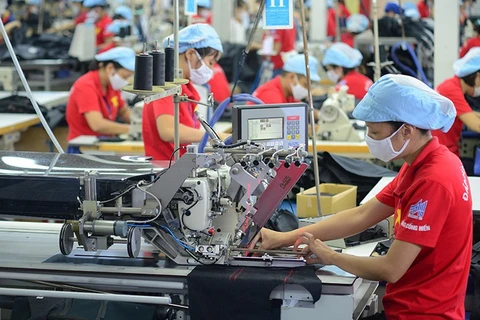
According to the report, exports fell 5.8% year on year in May, a slower pace than the market expected, but with lingering broad-based weakness. None of the major categories, including electronics, machinery, textiles/footwear and wooden furniture showed signs of a meaningful rebound.
Data as of April 2023 suggests substantial falling shipments in Vietnam’s three largest exporting destinations - US, China and the EU. In particular, with a hefty share of 30%, Vietnam is particularly sensitive to a US economic slowdown.
Despite exports falling by single-digit, imports declined at a much faster pace of 18.3% year on year. Arguably this is beneficial to Vietnam’s trade surplus, registering at 2.2 billion USD, twice of 2022’s monthly average, the report said.
However, given Vietnam’s import-intensive nature in its manufacturing sector, the extreme weakness in imports signals a sluggish rebound in future exports.
Rosy picture of tourism
“That said, it is not all doom and gloom. Vietnam’s services sector remains a bright spot, partially offsetting some external weakness. However, there is a clear divergence between big-ticket items, such as automotive sales, and tourism-related services – a trend that is occurring in regional peers as well,” the report pointed out.
 Tourists in the northern province of Tuyen Quang (Photo: VietnamPlus)
 Encouragingly, Vietnam continues to see a positive influx of tourists. Despite falling slightly from April’s high, Vietnam welcomed more than 900,000 tourists again, bringing its tourism recovery to around 70% of 2019’s level.
In particular, tourists from China recovered to 35% of 2019’s level – though still slow, the progress is ongoing. Indeed, Vietnam has made good progress to restore direct flights with China, now recovering to 44% of 2019’s level.
Vietnam has received 4.6 million international tourists so far this year, approaching 60% of its annual target of 8 million in 2023. With the approaching summer holidays and potential easing of visa restrictions, which are under considerations by the National Assembly, Vietnam will likely see a punchier boost from international tourism, a much-needed support for its sharply slowing economy.
 Inflation keeps cooling (Photo: VietnamPlus)
 The proposal includes extensions of e-visa to 90 days (from 30 days) and visa-free stays to 45 days (from 15 days), as well as expanding the list of countries eligible for e-visas, aiming to catch up with regional peers.
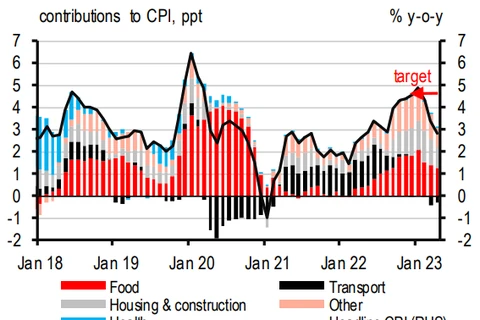
“Lastly some good news, inflation has been consistently cooling down,” the report said. “Headline inflation momentum remained flat in May, bringing y-o-y headline inflation to 2.4% y-o-y.”
Although ‘housing and construction materials’ costs rose 1.0% month on month, mainly reflecting a one-month lag of electricity prices hike, significantly lower transport costs (-3% month-on-month) offset some upside risks.
Indeed, moderating inflation is one of the reasons behind the State Bank of Vietnam’s (SBV) third rate cuts recently./.