Hanoi (VNA) – In an era of the fast-changing digital economy, the Association of Southeast Asian Nations (ASEAN), the world’s fifth largest economy, sees high-quality human resources development as key to enhance labour productivity and regional competitiveness.
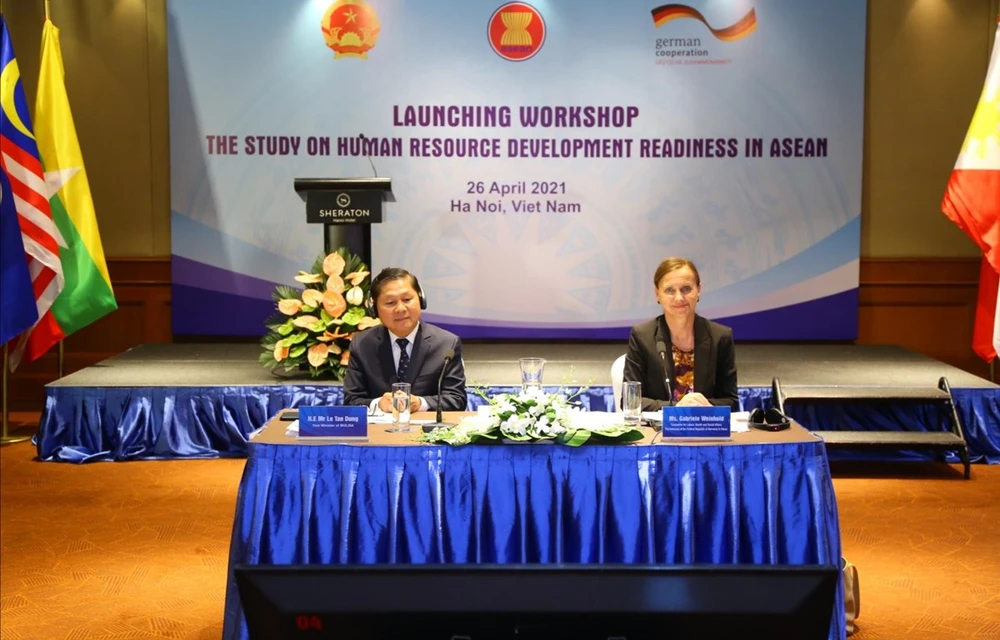
It was heard at a workshop on April 26 to launch the Regional Study Report on Human Resources Development Readiness in ASEAN, which was witnessed by over 100 participants from within and outside the region.
The study was initiated by the ASEAN Secretariat together with the Vietnamese Ministry of Labour, Invalids and Social Affairs (MOLISA).
The purpose of the study is to support implementation of the ASEAN Declaration on Human Resources Development for the Changing World of Work adopted by the 36th ASEAN Summit in June 2020.
The study was conducted as an initiative under Vietnam’s Chairmanship of ASEAN with the support of the Deutsche Gesellschaft für Internationale Zusammenarbeit (GIZ) GmbH through the Regional Cooperation Programme in Technical and Vocational Education and Training (RECOTVET).
Global megatrends are changing the world of work. Digital transformation, ageing societies, and climate change presents opportunities along with challenges to the economies, industries and workforce in ASEAN.
In 2020, the world also witnessed the impacts brought about by the COVID-19 pandemic which further accelerated these developments. The International Labour Organization (ILO) estimates that 8.8 percent of global working hours, equivalent to 255 million full-time jobs, were lost due to the pandemic.
Against this backdrop, it is crucial for ASEAN to prepare the region’s workforce with the essential skills needed in adapting to a continuously changing environment and uncertain future.
 Participants introduce the Regional Study Report on Human Resources Development Readiness in ASEAN. (Photo: VietnamPlus)
 In his opening remarks, Vietnamese Deputy Minister of Labour, Invalids and Social Affairs Le Tan Dung appreciated technical support provided by RECOTVET, ASEAN Secretariat and ASEAN member states’ labour, education and economic ministries in developing the regional report and implementing the ASEAN Declaration on Human Resources Development at large.
He said the report is a valuable document offering a panorama of the current state of national human resources development policies, practices and available resources to promote lifelong learning and future skills.
The report provides baseline information on the building of human resources development policies across ASEAN member states in enabling their workforce to be relevant and resilient to the changing world of work, he noted.
ASEAN Deputy Secretary-General for Socio-Cultural Community Kung Phoak, for his part, applauded findings of the study, saying they showed efforts of ASEAN member states in incorporating human resources development and lifelong learning components into their national policies and practices in order to boost socio-economic development, and improve institutional capacity and access to education and vocational training.
He expected findings of the study and in-depth discussions will play a role in promoting the implementation of the ASEAN Declaration on Human Resources Development and its roadmap.
According to Vietnamese Minister of Labour, Invalids and Social Affairs, the report not only introduces a conceptual framework for HRD describing the existing practices in the ASEAN Member States and identifying options for future policies but it also compiles and synthesises the strategies, policies, and programmes that the ASEAN Member States currently apply with regard to HRD in response to the future challenges in a changing world of work, including the impact of COVID-19, which have demonstrated a need for dynamic reforms - at the national and regional level.
ASEAN Secretary-General Lim Jock Hoi hoped that the findings of this report will support ASEAN member states in their readiness to keep up with the accelerating pace of change in the labour market, as the bloc strives towards achieving a resilient and future-ready workforce./.