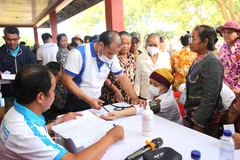
A doctor shows ethnic minority people in the border commune of Dan Hoa, Tuyen Hoa district, Quang Binh in central Vietnam how to prevent malaria. (Photo: VNA)
Hanoi (VNA) – Vietnam has beenmaking great strides to move from malaria control towards elimination of thedisease, but increasing malaria in disadvantaged areas is threatening thecountry’s overall progress.
According to the World Malaria Report2017 by the World Health Organisation, the global progress against malariaappeared to have stalled after many years of great public health achievementsin response to the disease.
In 2016, 91 countries reported a totalof 216 million cases of malaria, an increase of 5 million cases over theprevious year. The global tally of malaria deaths reached 445 000 deaths, aboutthe same number reported in 2015. Although malaria case incidence has fallenglobally since 2010, the rate of decline has stalled and even reversed in someregions since 2014, the report said. Without urgent action, countries riskgoing backwards and missing the global malaria targets for 2020 and beyond.
Vietnam’s National Institute ofMalariology Parasitology and Entomology estimated that an average of 30,000people were infected by malaria virus in Vietnam annually, 100 out of whichsuffered from malignant malaria and about ten died.
In 2017, the number of malaria casesdropped by 35.4 percent from 2016. The Central Highlands remained the country’shardest hit region which accounted for almost half of the cases.
In the first 14 weeks of 2018, Vietnamreported over 1,700 malaria cases, up 7.45 percent from the same period lastyear, with the Central Highlands and southern Binh Phuoc provinces carrying themajority of the national malaria burden, according to the Ministry of Health(MoH).
Binh Phuoc was the country’s mostheavily-affected province with 738 malaria cases, up 70 percent from the sameperiod of 2017. Meanwhile, faster growth was also seen in the Central Highlandsprovince of Gia Lai where 201 people contracted the malaria virus, a 2.3-foldsurge year on year. The neighbouring Dak Lak and Dak Nong reported 89 and 78cases, representing 1.6-fold and 0.3-fold increases, respectively.
Malaria occurred mostly in disadvantagedareas where people know very little about how to prevent the disease, said theMoH’s Department of Preventive Medicine. Impacts of climate change which fuelthe spread of mosquito-borne diseases and anti-malarial drug resistancealongside lack of responsibility from local authority have caused severemalaria outbreaks in areas where malaria control efforts are not sustainable.In addition, public budget for malaria control has declined sharply in recentyears.
In response to this, the Department ofPreventive Medicine has sent an inter-sectorial team to inspect and supervisemalaria control work in hot-spots in Binh Phuoc, said head of the departmentTran Dac Phu. At the same time, the National Institute of MalariologyParasitology and Entomology has worked with the local health authority toprovide the province with technical support and effective measures on malariacontrol, he added.
The department plans to raise awarenessof malaria prevention among people in the hot-spots, particularly high-riskgroups like seasonal workers, farmers who stay in fields in the forest,forestry workers and forest managers in the time ahead. It will also providedrugs for these people and ensure they will get access to early diagnostic andtreatment services.
This year’s World Malaria Day, April 25,is being celebrated under the theme “Ready to beat malaria”which aims to promote the commitment of the global community in uniting aroundthe common goal of a world free of malaria.
Vietnam has adopted a national strategy on malaria prevention andelimination for the 2011 – 2020 period with a vision towards 2030. It aims to ensure that allpeople have better access to early diagnosis and prompt and effective treatmentat public and private health facilities and to ensure the full protection forpeople at risk of malaria by appropriate malaria control measures.-VNA
VNA